All dishes / 東欧
Kulebyaka Period BOrigin theory BVerified
Some fields (dish name, region and gates) are shown from the Japanese-edition data.
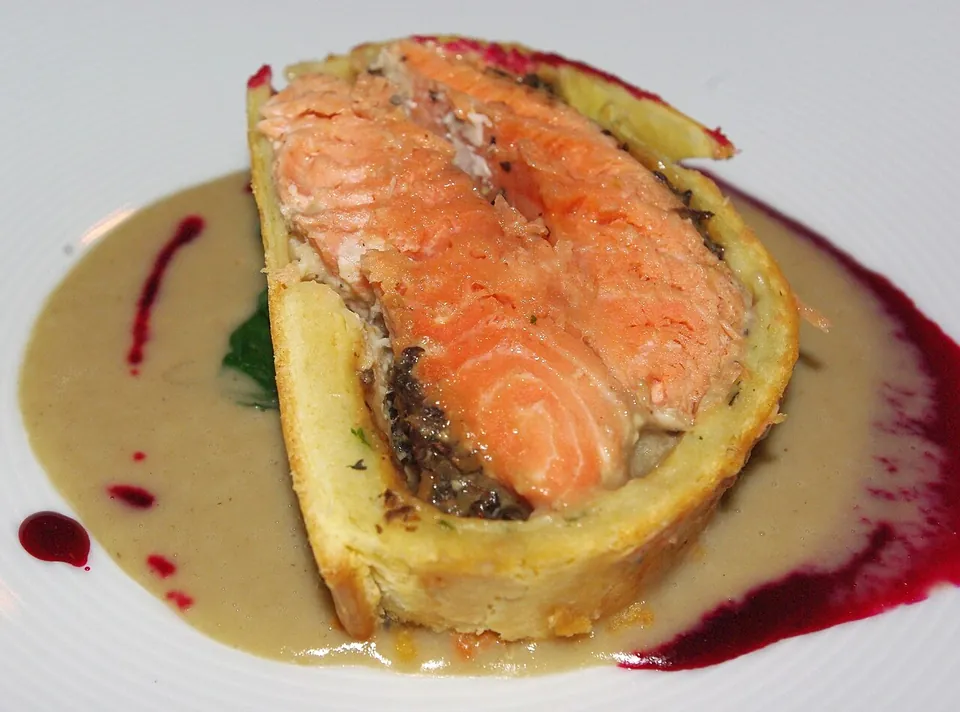
A Russian festive pie of many layers. The celebrated French chef Carême is often said to have invented it, but the order is reversed: the pie is older than Carême. The French-routed name "coulibiac" is a coat of paint applied later.
Verification highlight popular claim → verdict → evidence
Kulebyaka is sometimes said to have been invented by the French chef Careme during his stay in St. Petersburg around 1819, but the dish already existed as a native Russian pastry before his visit -- the name is attested by the 17th century, and Gogol's famous description of a four-cornered kulebyaka in Dead Souls (1842) shows it was already an established specialty; Careme's role was to adapt an existing Russian dish with French technique, not to originate it.
The three gates
- Ingredient-supply gate
- Grain, chicken, and butter were all native, so no ingredient acted as a bottleneck.
- Cooking-technique gate
- A multi-layered pie technique using crepes (blini) to separate the fillings.
- Venue gate
- A festive banquet dish (weddings and celebrations) that later became a home-cooked staple.
Overview
Kulebyaka is a Russian pie of long form, its filling—fish or minced meat, buckwheat, hard-boiled egg—stacked in layers and baked. The Russian pie in general (pirog) is an old and deeply rooted dish: it is already visible in twelfth-century sources, and the sixteenth-century household manual Domostroi records many kinds of baking. Within that lineage, the name kulebyaka settled on the long, many-layered festive pie in the seventeenth century. The word comes from the Old Slavic kulebyachit' (to knead by hand, to fold), the very act of folding the dough around its filling passing into the name.
Wheat flour, chicken, buckwheat and butter were all old products of the Russian land, of a piece with the daily kitchen. What assembled them into this single dish was the baking. Sheets of blini (crêpes) were laid in as dividers between the layers, the filling stacked tier upon tier, and the whole baked as one great parcel. This technique of setting the layers without letting them collapse produced a showpiece for wedding feasts and other celebrations. The festive dish came down in time to the home and settled into Russian everyday life.
How we know
Kulebyaka is often trailed by the tale that Antonin Carême, the great French cook who stayed in Saint Petersburg in the early nineteenth century, invented "coulibiac"—a dish, so the story runs, refined into being by a great Western chef. But set the dates side by side and the story does not hold. Carême crossed into Russia around 1819, yet the name kulebyaka had settled into Russian well before that, by the seventeenth century at the latest. The clinching evidence is Gogol's Dead Souls (1842), which describes a "kulebyaka of four corners" as a famous delicacy in vivid detail. The pie was already a face of the Russian table without needing Carême's hand.
So where did the sound "coulibiac" come from? It is a name that settled later, by way of France, onto a Russian dish that already existed. The westernisation that can be traced with certainty is Escoffier's inclusion of the dish in Le Guide Culinaire (1903), which folded it into the French culinary vocabulary in the early twentieth century. What Carême did was not to conjure it from nothing but to adapt an existing Russian dish to French technique.
The "Carême invented it" story, then, swaps a name that came later for the beginning of the dish itself—a made-up pedigree that seeks to place this pie within a continuous French lineage. The making of the name (coulibiac) and the making of the dish (kulebyaka) are two separate events. The native Russian festive pie came first; the French-routed name arrived after. That is the right order.
The full set of origin theories and the detailed verification log — traceable all the way to their sources — are available on the Japanese edition.
See the full origin theories and verification log (Japanese) →
Related dishes
Shares the key ingredient
- PierogiPolandC
- EmpanadaRío de la Plata (Argentina)C
- BliniRussiaB
- PirozhkiRussiaB
- CheburekiCrimea (Crimean Tatar)C
- BelyashiVolga-Ural (Tatar / Bashkir)C
- JalebiNorthern IndiaB
- Fortune cookieCalifornia (USA)C
- StroopwafelGouda (Netherlands)C
- LamingtonQueensland (Australia)C
- ChimichangaTucson, Arizona (USA)C
- BuuzMongoliaB
- YantıkCrimea (Crimean Tatar)C
- VarenykyUkraineC
- MandaziEast Africa (Swahili Coast)C
- LángosHungaryC
- Daoxiaomian (knife-cut noodles)Shanxi (China)C
- KhuushuurMongoliaB
- Dobos torteHungaryB
- SambusaEast Africa (Swahili Coast)B
- SarburmaCrimea (Crimean Tatars)B
- ThenthukTibet / NepalB
- ShumaiGuangzhou (China)B
- Jiaozi (gyoza)ChinaC
- Hohhot shaomaiHohhot (China)B
- OliebollenNetherlandsC
- MarquesitaYucatán (Mexico)D
- Halwa puriLahore (Pakistan)D
- Roti prataSingaporeB
- SopaipillaNew Mexico (USA)C
- CoyotaSonora (Northern Mexico)C
- RunzaMidwestern United StatesB
- BanshMongoliaC
- Kashyk-ash (къашыкъ-аш, Crimean Tatar spoon-dumpling soup)Crimea (Crimean Tatar)C
- Spring roll (Chinese)ChinaC
- ChuchvaraUzbekistan (Samarkand / Fergana)C
- DamperAustraliaC
- SamsaCentral AsiaC
- HalushkyUkraineC
- BanitsaBalkans (Bulgaria)C
- Har gowGuangzhou (China)C