All dishes / 北米
Mission burrito Period BOrigin theory CVerified
Some fields (dish name, region and gates) are shown from the Japanese-edition data.
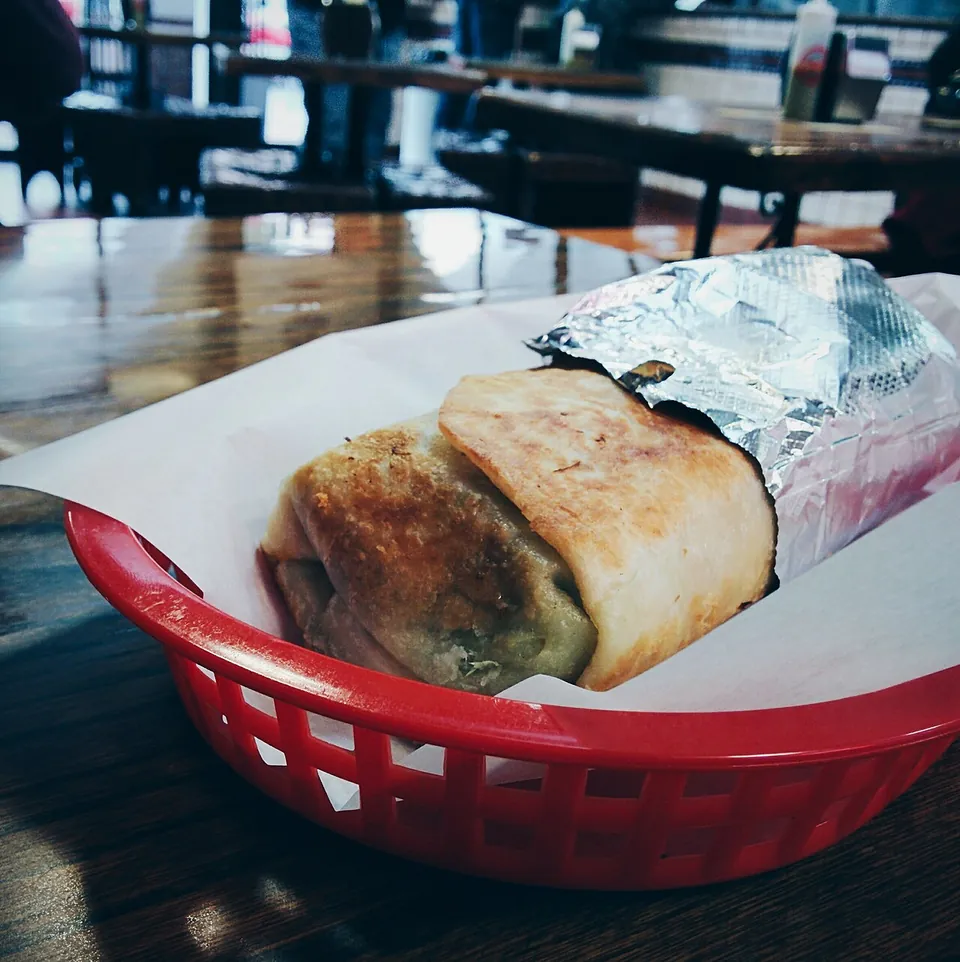
A big wheat tortilla packed heavy with rice, beans, and meat, then wrapped tight in foil: the outsized Mission burrito. This form, born in San Francisco's Mission District, became the template for what most of America now pictures as a burrito. Yet two taquerias each insist they made it first, and there is a lingering suspicion that the very name 'Mission-style' was a later marketing tag.
Verification highlight popular claim → verdict → evidence
Neither shop's founding story -- El Faro's 1961 claim nor La Cumbre's 1969 claim -- is backed by any contemporary record; both are unverifiable oral business lore, and even the label 'Mission-style' turns out to be later marketing language that local taqueria owners themselves are skeptical of. Main source: a January 24, 1977 San Francisco Chronicle article, the earliest confirmed press coverage of Mission burritos.
The three gates
- Ingredient-supply gate
- All the fillings were easy to obtain; the limiting factor was the urban manufacturing and distribution needed to reliably supply large flour tortillas, which came together in San Francisco by the mid-20th century.
- Cooking-technique gate
- Large tortillas stuffed with a heavy load of rice, beans, meat, and other fillings, then wrapped in foil to be portable.
- Venue gate
- From taquerias in the Mission District's Mexican immigrant community to the prototype for the burrito image nationwide.
Overview
The Mission burrito is a large wheat tortilla stuffed without restraint with rice, pinto beans, beef, cheese, avocado and more, then wrapped snugly in aluminum foil into something portable. Held in one hand and eaten on the move, it is far larger and far richer than the burritos that came before it.
It took shape in San Francisco's Mission District in the 1960s and 70s. The fillings were all easy to come by in the city of that day, but wrapping this much into a single tortilla calls for a large wheat one. Until the mid-twentieth century, tortillas that big were found only in Sonora in northern Mexico and the stretch of southern Arizona. According to the food historian Gustavo Arellano, the man who began using these large tortillas in the Mission District came from Durango and brought the giant tortilla he had learned in a bracero (migrant labor) camp into the city.
The stage was the taquerias of the Mission District, where Mexican immigrants gathered. On January 24, 1977, page 4 of the San Francisco Chronicle carried a piece by the reporter Jerry Burns, headlined "Fast, Inexpensive, Good," on the swelling appetite for burritos. The burrito it described was "an oversized flour tortilla smeared with sauce, packed with rice, beans and meat." Named on the page were Raul Duran of Taqueria La Cumbre, Heriberto Penaranda of Nito Burrito, and Taqueria Tepatitlan out on 10th Street, with prices running from Taco Bell's 39 cents to more than a dollar at the independent shops. By January 1977, in other words, the form now called Mission-style was in the newspaper with a definition attached.
Neighborhood shops served the big burrito as a meal that filled a working stomach, and it travelled out of the district and eventually across the country, until it became the very image people hold of a burrito. It is a dish that took the traditional Mexican burrito and grew it larger, its form settled by the eateries of the street.
How we know
The origin of the Mission burrito is unsettled, with two taquerias each claiming to have made it first.
One is the claim of El Faro. Its owner, Febronio Ontiveros, is said to have served a large 'Super Burrito' to a firefighters' crew on September 26, 1961. The early version was two six-inch tortillas layered together, later becoming a single large one. The other is the claim of Taqueria La Cumbre, where Raul and Micaela Duran are said to have created the San Francisco burrito on September 29, 1969. The shop began as a butcher's and, the story goes, turned into a taqueria in 1972.
Both are stories the shops told and retold in later years, and no contemporary record of either founding has surfaced. La Cumbre's beginning is variously reported as 1967 or 1969, the year shifting from one outlet to another. In his book Taco USA (2012), Arellano sides with the El Faro account, while adding that among origin stories in Mexican food 'very few are indisputable.'
The shops that claim the founding were certainly there. The San Francisco Chronicle of January 24, 1977 names Raul Duran as the owner of La Cumbre. What that page does not do is mention El Faro, or raise the question of who made the first one. The burrito turns up there as a food of rising popularity and nothing more; where it came from is not a topic at all. Silence in one newspaper article is no proof that such talk was absent at the time. Still, the two founding stories, dates and all, only began to circulate decades after this page appeared. What the page does establish is narrower and firmer than any claim of priority: by January 1977 the form now called Mission-style was in print, spelled out for readers who might not know it.
Push further, and there is a view that the name 'Mission-style' was itself an outside marketing tag. When KQED asked the established taquerias of the Mission District itself, Miguel Jara, founder of La Taqueria, called the origin story something he 'couldn't say was true,' and the owner of El Metate laughed it off, saying he just makes them the traditional way. The longer a shop had stood in the neighborhood, the more its people kept their distance from the name and from the founding dispute. Both foundings are given down to the day, yet no account from the time has come to light to confirm either, and the origin of the Mission burrito stays in exactly that shape: a question of who came first that cannot be settled.
The full set of origin theories and the detailed verification log — traceable all the way to their sources — are available on the Japanese edition.
See the full origin theories and verification log (Japanese) →
Related dishes
Shares the key ingredient
- SamosaIndian subcontinent (Delhi Sultanate)B
- KhachapuriGeorgia (Caucasus)C
- PelmeniSiberia (Russia)C
- Hot dogNew York, United StatesB
- HaleemHyderabad (Deccan)C
- KobeteCrimea (Crimean Tatar)C
- BrikTunisiaC
- BoortsogMongoliaC