All dishes / 南アジア
Samosa Period BOrigin theory BVerified
Some fields (dish name, region and gates) are shown from the Japanese-edition data.
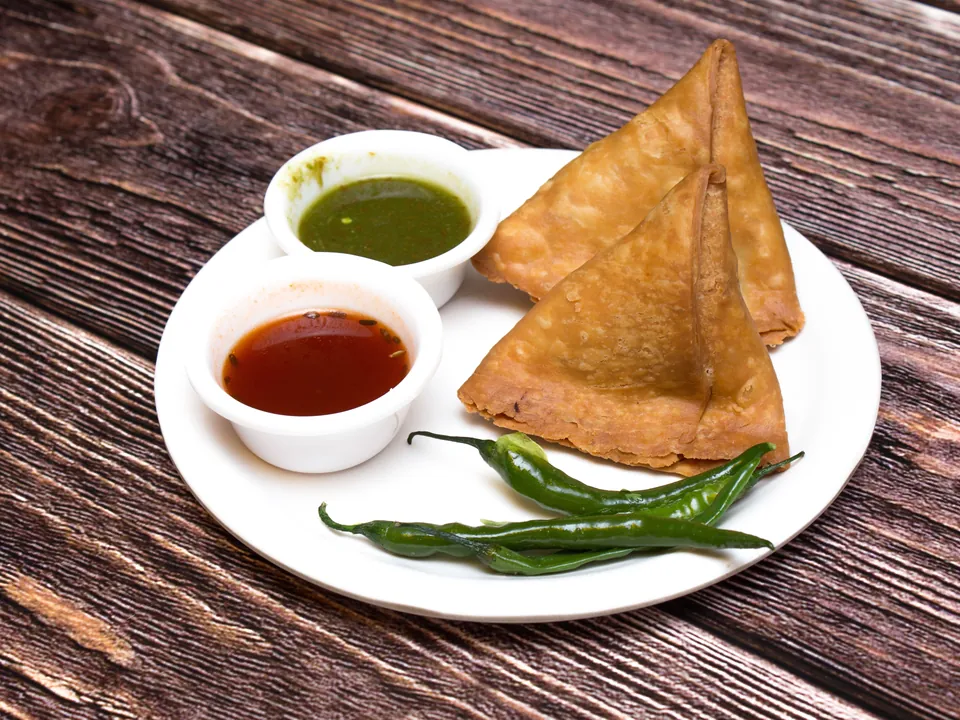
The samosa, an Indian national favourite, was not in fact an Indian invention. Its name and its earliest records both point to Central Asia and Persia, and it was carried into South Asia through the court of the Delhi Sultanate: a foreign fried parcel that came from outside.
Verification highlight popular claim → verdict → evidence
A popular myth claims the samosa is an Indian invention, but the etymology (Persian sanbosag) and the earliest records point to Central Asia/Persia instead. Eyewitness accounts by Ibn Battuta (1333) and Amir Khusrau (c.1300) at the Delhi Sultanate court show it arrived via royal-kitchen cooks from Central Asia and the Middle East.
The three gates
- Ingredient-supply gate
- The wheat for the pastry was a long-established local crop, so no ingredient sets an earliest possible date for the dish. The original filling was minced meat; the potato-based vegetarian version is a later offshoot that followed the arrival of the potato in South Asia (around the 17th century) and does not bear on when the samosa itself appeared.
- Cooking-technique gate
- Kneading wheat dough into pastry, shaping it, and deep-frying in oil — a portable fried, filled pastry.
- Venue gate
- First served at the royal court of the Delhi Sultanate and eaten by the courtly circles gathered around it, the samosa was also something bought and sold, and through the markets it spread until it was shared by the wider region as a whole.
Overview
The word samosa goes back to the Persian sanbosag ("triangular parcel"). Arab cookbooks of the tenth to thirteenth centuries record fried parcels stuffed with minced meat and nuts as sanbusak or sanbusaj, and the eleventh-century Tarikh-i Bayhaqi mentions sambosa.
It reached South Asia in the era of the Delhi Sultanate (thirteenth to fourteenth centuries). Cooks from Central Asia and the Middle East entered the court kitchens and brought this fried parcel with them. The court poet Amir Khusrau (c. 1300) wrote of the samosa (filled with meat, ghee, and onion) that was loved at court, and the traveller Ibn Battuta (fourteenth century) noted the sambusak served at the court of Muhammad bin Tughluq.
The wheat used for the pastry was a long-established local crop of South Asia, and it was not what set the timing of the samosa's emergence. The original form was, after all, a fried parcel filled with minced meat. Sealed in a kneaded wheat casing and fried in oil, it needed neither plate nor cutlery and could be carried even when cold. That is precisely why it did not stay in the court kitchen: it became something you could hawk in the market, and it came down into the streets as everyday snack food.
Within about two centuries of its arrival, the samosa put down roots as a dish of South Asia itself. The Niʿmatnama, a cookbook compiled for a ruler of the Malwa Sultanate (c. 1500), sets down a method for making the samosa, showing that this fried parcel was actually being cooked in courts of the subcontinent. And the Mughal court record Ain-i-Akbari (1590) notes a stuffed pastry as "what the people of Hindustan call sanbusah." By this time the snack that had come from outside was already a local food known by a local name.
How we know
Many people think of the samosa as an Indian invention. The triangular fried parcel is now a national favourite in India and looks like a dish rooted in the soil. But trace its name and its history, and the needle points outside India, toward Central Asia and Persia.
The clue lies in the name of the dish itself. Samosa goes back to the Persian sanbosag, "triangular parcel." Medieval Arab cookbooks record triangular fried parcels stuffed with minced meat and nuts, and eleventh-century Persian records show the same family of food. Before this dish appeared in India, it was already on the tables of West Asia.
It crossed into South Asia in the age of the sultans who ruled Delhi. Cooks invited from Central Asia and the Middle East entered the court kitchens and brought their home fried parcel with them. A poet in service at court wrote down this snack, filled with meat and ghee and onion and much loved, and a traveller who ranged across many lands also recorded it served at a king's court. Sealed in a kneaded wheat casing and fried in oil, the parcel needed neither plate nor cutlery and could be carried even when cold. That is why it did not stay in the court kitchen but became, in time, something to be hawked in the market and came down into the streets as snack food.
The foreign snack eventually took root in this land. A cookbook compiled for the Malwa court (c. 1500) records how to make the samosa, and a Mughal court record (1590) writes of a stuffed pastry as "what the people of Hindustan call sanbusah." Within two centuries the parcel that came from Central Asia had become a local food known by a local name.
The potato-filled vegetarian version taken as typical of India today is a later shape still. The potato reached South Asia from the New World in the sixteenth and seventeenth centuries. In other words, that quintessentially "Indian" filling is itself a later, local reworking, a change of clothes the incoming parcel put on in this land. The view that the samosa is an Indian invention spread as a belief that was never backed by firm sources; its true starting point lies in the portable snack food of Central Asia and Persia.
The full set of origin theories and the detailed verification log — traceable all the way to their sources — are available on the Japanese edition.
See the full origin theories and verification log (Japanese) →
Related dishes
Cross-links Sister dishes & same-name dishes (separate lineage)
- Sister dish (shared ancestor)SambusaEast Africa (Swahili Coast)B
- Sister dish (shared ancestor)EmpanadaRío de la Plata (Argentina)C
- Diffusion prototypeSamsaCentral AsiaC
Shares the key ingredient
- KhachapuriGeorgia (Caucasus)C
- PelmeniSiberia (Russia)C
- Hot dogNew York, United StatesB
- HaleemHyderabad (Deccan)C
- KobeteCrimea (Crimean Tatar)C
- BrikTunisiaC
- BoortsogMongoliaC
- Mission burritoSan Francisco, California (USA)C