All dishes / 東欧
Solyanka Period COrigin theory CVerified
Some fields (dish name, region and gates) are shown from the Japanese-edition data.
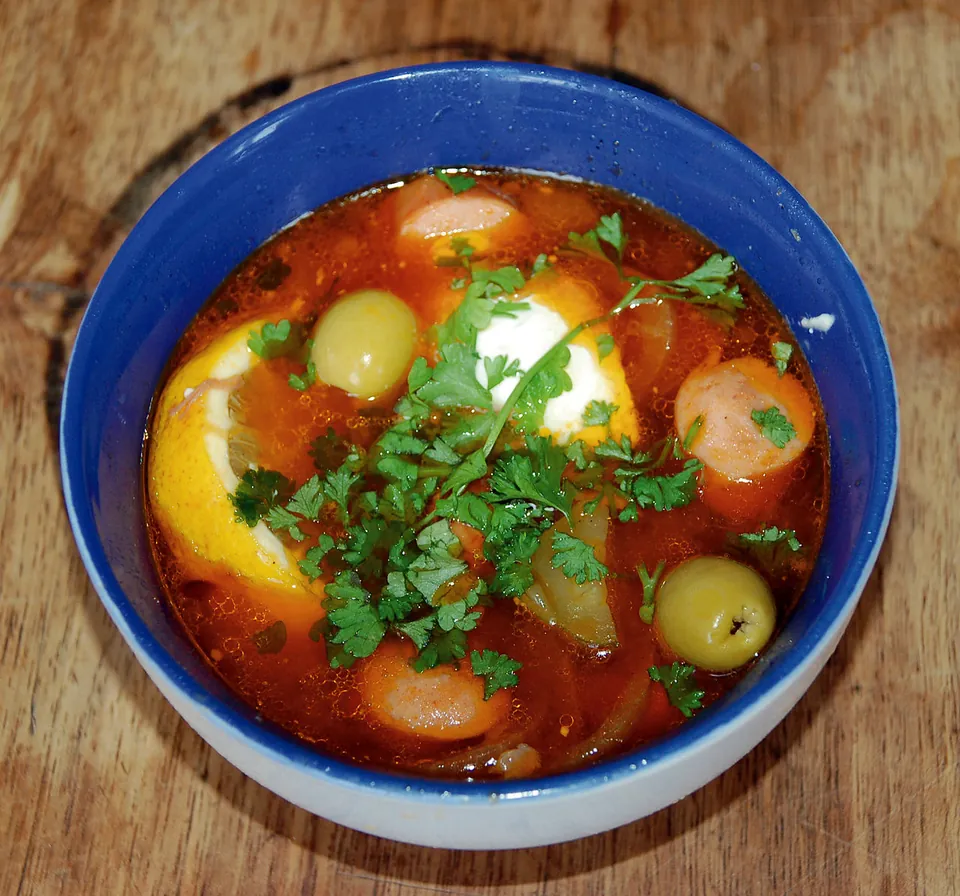
A thick, sour Russian soup in which meat and brined tang melt together. A well-known story holds that it already appears in a sixteenth-century household manual, yet the word "solyanka" is nowhere to be found in that text. Today the soup is stained red with tomato, but that red, over the soup's long history, is a very recent color.
Verification highlight popular claim → verdict → evidence
Myth: Pokhlyobkin's claim that solyanka already appears in the Domostroy (1547), making it a 16th-century dish. Verdict: rejected — the Domostroy and the 1610-13 tsar's dish list mention only rassol (brine) dishes, not the word solyanka itself, and even Pokhlyobkin's own writing elsewhere contradicts this with a 17th-century dating; food historian Pavel Syutkin and the Russian Wikipedia reject the 16th-century claim. What is documented: the dish appears in the 17th century as a hot one-course meal, the soup form is fixed in the 19th century (the 1822 Russian Academy dictionary, Stepanov 1834, Avdeyeva 1842), and the name's etymology is disputed between selyanka ('village dish') and solyanka ('salted dish').
The three gates
- Ingredient-supply gate
- Salted cucumbers (the limiting element, part of a long-standing native pickling tradition), various meats/smoked meats, and the sour notes of olives, capers, and lemon were all native or already established, so ingredients placed little constraint on origin. Tomato is a later 19th-century addition (arriving in Russia in the late 18th century among elites, becoming food from the 19th century) and is not limiting.
- Cooking-technique gate
- Salting/fermenting for preservation combined with stewing — a native preservation technique, not a limiting factor. The soup form was fixed in the 1830s (Stepanov 1834, Avdeyeva 1842).
- Venue gate
- the tavern (traktir); common people; everyday; local community.
Overview
Solyanka is a strong, sour, richly filled soup rooted in the Russian table. A hearty bowl packed with meat, smoked meat, and sausage, it hits the tongue with salt and sourness at once. That sourness rises from brined cucumbers, the brine itself, olives, capers, and lemon, ingredients that store up salt and acid. It is often served with a spoonful of sour cream and a slice of lemon floating on top.
This soup did not come from a glittering courtly table. It grew up in the village household and in the roadside tavern, the traktir. In the taverns above all it was loved as a bowl for the morning after, drunk almost as a cure for a hangover; a hot soup sharp with salt and sourness was well suited to exactly that role.
The core of solyanka's flavor lies in preserved foods. The brined cucumbers, the brine, the smoked meats, all were preserves that Russians had long kept on hand. Salting and fermenting vegetables and meat to carry them through the long winter, that everyday wisdom is itself the backbone of the soup's flavor. As a hot single-pot dish of meat, brined cucumber, cabbage, and mushroom, solyanka appears in seventeenth-century records. It was arranged into the fixed soup form we know in the first half of the nineteenth century: the Russian Academy dictionary of 1822 lists it as a "second course," and cookbooks of the 1830s wrote down its shape.
The solyanka most people picture today is reddened with tomato. But that tomato was a latecomer to this dish. Tomatoes reached Russia at the end of the eighteenth century, at first only a curious ornamental plant enjoyed by the upper classes; they entered the pot as food only in the nineteenth century. The red solyanka is thus a relatively new face, and beneath it lies an older layer of flavor, one that stood on brined sourness and salt alone.
How we know
Solyanka's history carries a legend long handed down. The mid-sixteenth-century household manual, the Domostroy of 1547, is said to have already contained this dish; because the food historian Pokhlyobkin wrote as much, solyanka came to be widely introduced as a sixteenth-century dish.
Open that old text, though, and the word "solyanka" does not appear. What is written there is rassol, brine, and "brined dishes," not solyanka itself. The Registry of the Tsar's Dishes drawn up in the 1610s likewise lists brined dishes but not the name solyanka. Pokhlyobkin, who proposed the sixteenth-century origin, elsewhere wrote of it as a seventeenth-century dish, and his own accounts did not agree. The Russian-language encyclopedia and the food historian Syutkin both reject this sixteenth-century claim. In the written record the name solyanka appears clearly as a hot single-pot dish in the seventeenth century (some accounts say the fifteenth), and its shape as a soup is set down in dictionaries and cookbooks only in the nineteenth. The sour brined stew itself is old, but the claim that pushes it back to "a sixteenth-century text" lacks documentary support.
As for the name, two views still stand side by side. One is the "villagers' dish" reading, which ties the old name selyanka to the words for "of the village" or "rustic," and sees a plain country hotchpotch of whatever was on hand, carried into the taverns, its name drifting from selyanka to solyanka. The other is the "salt dish" reading, which ties the present name solyanka to the word for salt and locates the essence of the dish in brining and sourness themselves. Both lack a decisive proof, and researchers have set them down together.
What is striking is that these two etymologies mirror the two faces of the dish itself. A village hotchpotch of odds and ends on one side, a preserved dish whose essence is brined sourness on the other. Neither is false, and both overlap within the single bowl that is solyanka. And the red of the tomato is only a later layer painted over the top. Long before it was stained red, this soup warmed people with salt and sourness and rescued the morning after.
The full set of origin theories and the detailed verification log — traceable all the way to their sources — are available on the Japanese edition.
See the full origin theories and verification log (Japanese) →