All dishes / 東アジア
Tteokbokki Period BOrigin theory CVerified
Some fields (dish name, region and gates) are shown from the Japanese-edition data.
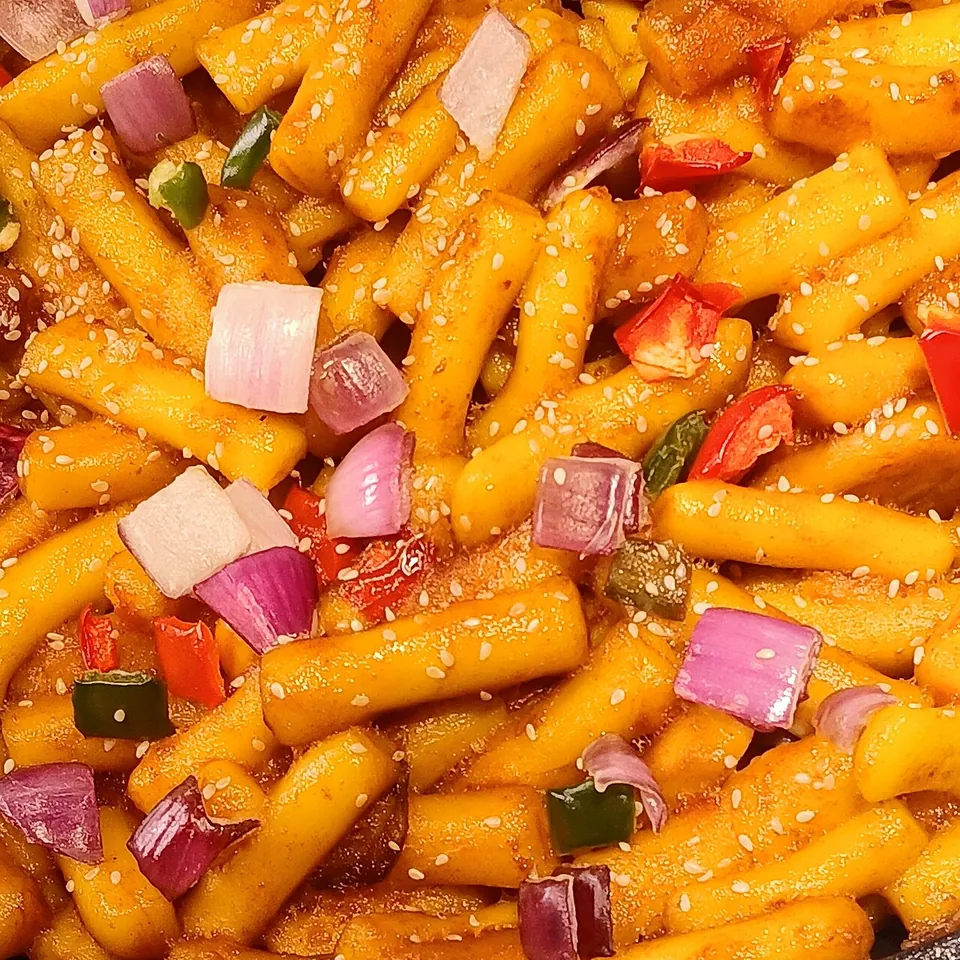
To picture the red, fiery street-stall tteokbokki as an ancient Korean tradition is, in fact, a mistake. The chili that gives it its heat is a New World crop that reached the Korean peninsula only from the late sixteenth century onward, and the red, gochujang-flavored tteokbokki spread from the Sindang-dong neighborhood of Seoul in 1953 - a very recent dish.
Verification highlight popular claim → verdict → evidence
Popular story: the fiery red street-food tteokbokki eaten today is an ancient, traditional Korean dish. Verdict: refuted -- chili pepper, a New World crop, did not reach the Korean peninsula until the late 16th century to 1614 (recorded in the Jibong Yuseol), and cookbooks show the dish was still soy-sauce based as late as 1924; the red gochujang version is generally credited to Ma Bok-rim's 1953 street stall in Sindang-dong, though her personal credit is treated as anecdotal even by English Wikipedia ('is believed'). Key sources: Kwon, Jang & Kim, History of Korean gochu, gochujang, and kimchi (2014); analysis of 조선무쌍신식요리제법 (KCI).
The three gates
- Ingredient-supply gate
- The bottleneck for today's red version is chili pepper (a New World crop). It reached the Korean peninsula between the late 16th century and 1614 (recorded in the Jibong yuseol, range 1590-1614); the current gochujang-based red style cannot predate that. Rice and rice cakes are native.
- Cooking-technique gate
- Development of gochujang (fermented chili paste), and mass production of rice cakes for street-stall cooking.
- Venue gate
- Street stalls on city corners. It was cheap food for ordinary people, bought and eaten on the spot, and it spread among the urban crowds.
Overview
The tteokbokki most of us picture today is a Seoul street snack: rod-shaped rice cakes stir-fried scarlet with the chili paste gochujang. But trace back how long that red heat has existed, and the history turns out to be surprisingly shallow.
The rice cakes at its center are an old food made from rice, long a fixture on the peninsula's tables. Turning those cakes scarlet, though, calls for chili. Chili is a New World crop, and it reached the Korean peninsula between the late sixteenth century and around 1614; the period text Jibong yuseol records its arrival. Until the chili had crossed the sea and the red fermented paste gochujang made from it came into use, a dish of rice cakes fried red had no way of coming into being.
A non-spicy tteokbokki once existed too. The nineteenth-century royal court had a tteokbokki seasoned with soy sauce (gungjung-tteokbokki), set down in the cookbook Siuijeonseo. This was a separate line of dish that used no chili, and today's red tteokbokki did not descend directly from it. The red street-stall version spread only in the mid-twentieth century, said to date to 1953 in the Sindang-dong district of Seoul. A man named Ma Bok-rim, inspired by chunjang - the black-bean seasoning of Chinese restaurants - is widely recounted to have sold rice cakes stir-fried in gochujang, and won a following. Apart from the refined soy-sauce dish of the court, the red tteokbokki took root among ordinary people as a cheap, spicy snack of the streets.
How we know
The belief that the red, fiery tteokbokki of the food stalls is an ancient Korean tradition runs deep. But it does not square with the record.
The chili that gives the dish its heat is a New World crop, and it reached the Korean peninsula from the late sixteenth century to around 1614 onward. The period text Jibong yuseol records this, and a study tracing the history of Korean chili, gochujang, and kimchi (Kwon, Jang & Kim 2014, History of Korean gochu, gochujang, and kimchi, J. Ethnic Foods) agrees. In an age when gochujang did not yet exist, there could have been no red tteokbokki. The talk of an "ancient tradition" confuses the age of tteokbokki as a dish of fried rice cakes with the newness of the red form, which only appeared once chili had come.
Follow the texts, and until the first half of the twentieth century tteokbokki meant a soy-sauce dish. The late-nineteenth-century cookbook Siuijeonseo is where the dish first appears in writing, a court tteokbokki of white rice cakes braised in soy sauce. The detailed list of ingredients often quoted alongside it comes from a later cookbook, Bang Sin-yeong's Joseon yori jebeop (1917; revised and enlarged 1942), not from Siuijeonseo itself. The tteokbokki recorded in the 1924 Joseon Musang Sinsik Yori Jebeop is likewise soy-sauce based, not red gochujang (the Encyclopedia of Korean Culture, from the Academy of Korean Studies, and a peer-reviewed KCI paper analyzing the rice-cake dishes of that cookbook). At least into the first half of the twentieth century there is no sign that the red street-stall tteokbokki existed.
So when was the red tteokbokki born? What is widely told is a mid-twentieth-century popularization. In 1953, in the Sindang-dong district of Seoul, Ma Bok-rim (1921-2011) is said to have taken the chunjang of Chinese restaurants as inspiration, fried rice cakes in gochujang, and sold them from a stall to great success (as recounted by sources introducing Korean food, such as Taste Korean Food). Whether this can be called the invention of one individual, however, does not rise above anecdote, and even the English account hedges it as something "believed." Even so, every account agrees on one point: the red tteokbokki is a modern dish that spread after the chili had arrived. From the court's soy-sauce seasoning to the street's red heat - the course of tteokbokki is the story of a later-arriving chili laying a new dish over the old foundation of the rice cake.
The full set of origin theories and the detailed verification log — traceable all the way to their sources — are available on the Japanese edition.
See the full origin theories and verification log (Japanese) →
Related dishes
Shares the key ingredient
- KimchiSouth KoreaC
- Mapo tofuSichuan (China)C
- Doro watEthiopian HighlandsB
- Indigenous molli (chilmolli, pre-Old-World-spice chili sauce proto-layer)MexicoC
- RendangMinangkabau, West Sumatra (Indonesia)C
- Tom yum goongThailandC
- SambalMalay Archipelago (Indonesia)C
- Tandoori chickenNorth India (Punjab / Delhi)C
- LaksaPenang (Straits Settlements)C
- MuhammaraAleppo, SyriaC
- VindalooGoa (India)C
- Piri piri chickenMozambique (Portuguese colonial sphere)C
- HarissaTunisiaC
- BibimbapSouth KoreaC
- Twice-cooked pork (huiguorou)Sichuan (China)C
- LarbLaos / Isan (Thailand)C
- Chili con carneTexas, USA (San Antonio)C
- Dan dan noodlesChengdu, Sichuan (China)C
- General Tso's chickenNew York (USA)C
- Pol sambolSri LankaB
- Chapli kebabPeshawar (Pakistan)C
- ShiroEthiopian HighlandsB
- Hiroshima soupless dandan noodlesHiroshima (Japan)B
- Kung pao chickenSichuan (China)C
- Fuqi feipianSichuan (China)D
- Nasi lemakMalaysiaC
- LampraisSri LankaC
- Nigerian pepper soupNigeria (West Africa)C
- MerguezMoroccoB