All dishes / 東アジア
Japchae Period BOrigin theory CVerified
Some fields (dish name, region and gates) are shown from the Japanese-edition data.
Japchae today is a dish of glass noodles, yet the same name was served in the 17th-century Korean court as a plain vegetable dish with neither noodles nor meat. The popular story that a courtier named Yi Chung "invented" japchae also turns out to be a misread record: he was rewarded for presenting vegetable dishes at court, not for creating this one.
Verification highlight popular claim → verdict → evidence
Myth: Yi Chung 'invented' japchae to win royal favor. Verdict: the Joseon court annals record only that he presented winter-grown vegetables and was mocked as the 'japchae minister' for buying office with food, not that he invented the dish. The name 'japchae' first appears in the cookbook Eumsik dimibang (c.1670) as a noodle-free vegetable dish; the now-familiar glass-noodle version only formed after a dangmyeon factory opened in Hwanghae in 1919.
The three gates
- Ingredient-supply gate
- The lead ingredient, dangmyeon (sweet-potato-starch glass noodles), is New World-derived. Sweet potato reached Korea only after its introduction, so the noodle-added style could only emerge afterward.
- Cooking-technique gate
- Producing and drying starch noodles, plus separately cooking and mixing individual ingredients (namul-style tossing).
- Venue gate
- royal court / court / banquet / Joseon dynasty
Overview
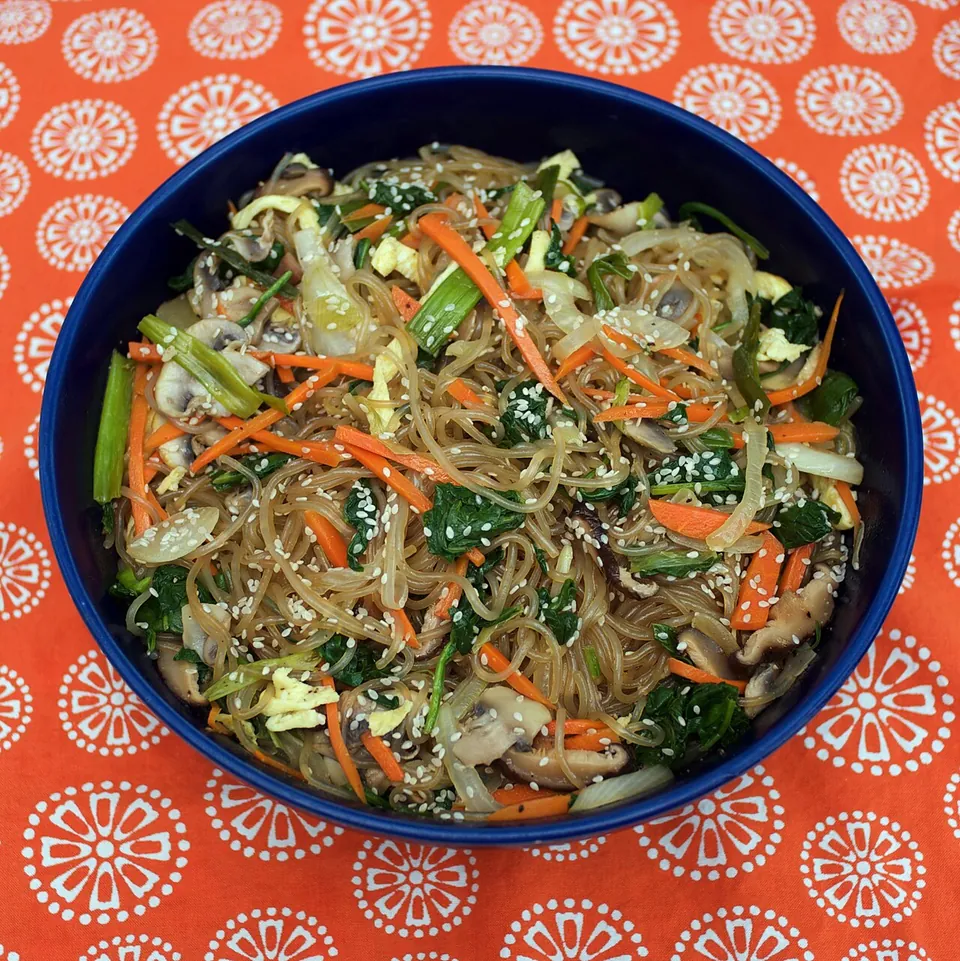
Japchae is a Korean dish whose name reaches back to the early 1600s, when it belonged to the royal court. But the glass-noodle version most people picture today did not take shape until the early 20th century. Under a single name live two distinct stages: a court vegetable dish, and a modern noodle stir-fry.
The name japchae (雜菜) first appears in writing in a late-17th-century Korean-language cookbook, the Eumsik dimibang (c. 1670). In its "chae" section, the author Jang Gye-hyang describes japchae as seasonal vegetables each cut into thin strips, stir-fried, and dressed with broth and with Sichuan pepper, black pepper, and ginger. The word means, quite literally, a mix of assorted vegetables. There are no glass noodles here, and meat is not essential. This is the older face of japchae.
The star of the modern dish is dangmyeon, glass noodles made from sweet-potato starch. The sweet potato is a New World crop, and it did not reach the Korean peninsula until 1763, when the envoy Jo Eom is said to have brought it back by way of Tsushima; cultivation began two years later on Yeongdo island near Busan. Noodles made from its starch took root on Korean tables even later, from the late 19th into the 20th century. When a dangmyeon factory began operating in Hwanghae province in 1919, sweet-potato noodles worked their way into japchae. A 1948 textbook still lists the noodles in the same one-spoonful measure as the other ingredients; the noodles swelling into the dish's centerpiece came later still.
The craft of making and drying the noodles, and the method of cooking each ingredient separately before tossing them together, form the backbone of the dish as it is made now. The setting shifted over time as well: a dish that appeared at Joseon court banquets spread, in the modern era, to ordinary tables. Japchae is a dish in which an old name for an assorted-vegetable dish and a modern ingredient, sweet-potato glass noodles, come together across separate stages, and it cannot be compressed into a single point of origin.
How we know
Japchae is often given a pedigree: that a courtier, Yi Chung (1568-1619), invented it at the 17th-century royal court. Read against the sources, that invention tale changes shape.
During the reign of Gwanghaegun, Yi Chung raised vegetables in an earth pit through the winter and presented them to the king morning and evening, earning himself official rank. The anecdote appears in the Veritable Records of the Joseon Dynasty (the Gwanghaegun ilgi of 1608 and the Injo sillok of 1624) and is repeated in later collections. But it is not a record of Yi Chung devising a dish called japchae. Mocking his purchase of office, people jeered him as "Japchae Panseo" (the Assorted-Vegetable Minister); the anecdote shows only that vegetable dishes of the assorted-vegetable kind were served at court. The claim that Yi Chung "invented" japchae mistakes this record of court service for a tale of origin.
The name of the dish itself first appears about half a century later, in the Eumsik dimibang (c. 1670). The japchae recorded there is julienned vegetables stir-fried together, with no noodles and no meat. What the sources reliably attest, then, reaches only as far as a vegetable dish called japchae at the 17th-century court, not the noodle dish of today.
That noodle form is a 20th-century style, arising only after sweet-potato glass noodles arrived in the late 19th century and began to be mass-produced in Hwanghae province in 1919. Because the noodles now carry the dish, it belongs to a different stage from the noodle-less court dish of the 1600s. What is old is a vegetable dish that bore the name japchae; the japchae of today, built around glass noodles, came into being in the modern age.
The full set of origin theories and the detailed verification log — traceable all the way to their sources — are available on the Japanese edition.
See the full origin theories and verification log (Japanese) →