All dishes / 東アジア
Dan dan noodles Period BOrigin theory CVerified
Some fields (dish name, region and gates) are shown from the Japanese-edition data.
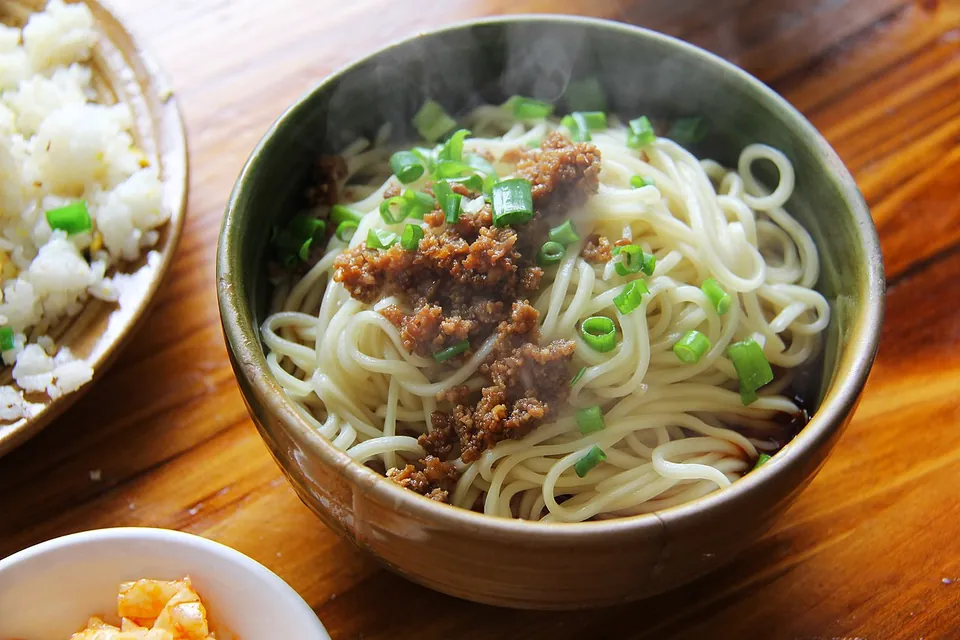
A sesame-and-chili noodle bowl born in the street corners of Chengdu, Sichuan. The name dan dan refers to the shoulder pole that hawkers once used to carry the whole kitchen from door to door.
Verification highlight popular claim → verdict → evidence
Popular claim: a single named inventor created dan dan noodles (Chen Baobao in Zigong, 1841, or Xu Laohan in Chengdu, Qianlong era). Verdict: unresolved — both are unverified oral traditions lacking solid primary sources, though the street-vendor shoulder-pole origin of the name and form is independently attested across Japanese, English, and Chinese sources, including a Sichuan provincial government account. Key sources: Sichuan Provincial Government website; Brian R. Dott, The Chile Pepper in China; 成都通览 (1909).
The three gates
- Ingredient-supply gate
- Wheat, sesame, and pork were native staples; chili pepper is a New World crop that reached Sichuan in the late Ming/early Qing.
- Cooking-technique gate
- Stir-frying minced pork (suzi) and blending it with chili oil and sesame paste.
- Venue gate
- Carried by shoulder-pole street vendors, later moving into everyday noodle shops.
Overview
The bowl the shoulder pole carried
Dandan noodles took shape in Sichuan in the late nineteenth century, under the closing decades of the Qing. Boiled wheat noodles are dressed with sesame paste and chili oil, then topped with stir-fried minced pork and preserved mustard greens; the heat of the chili and the richness of the sesame linger on the palate. Today it is a bowl served from a shop, but it began as a trade with no shop at all.
The word dan dan comes from the Sichuanese term for a shoulder pole, danzi. A hawker slung a small stove and pot on one end and noodles, seasonings, and bowls on the other, balanced the pole across the shoulder, and sold from street to street, assembling a bowl to order on the spot. Because it had to travel, the original form was dry: noodles tossed in a small amount of sauce rather than sitting in broth. In Chongqing and Zigong it spread as this dry, plain noodle, while in Chengdu it grew into a version with stir-fried crumbled pork (su saozi), and provincial records in Sichuan describe this regional branching in just those terms.
The chili at the heart of the seasoning was not originally Sichuanese. It crossed the sea from the Americas into China and settled into Sichuan's kitchens over the eighteenth century, appearing in the region's cookery texts by the middle of that century. Wheat, sesame, and pork were all long at hand; once the chili had worked its way into Sichuan, the shoulder pole on the street corner sent this bowl out into the world.
How we know
The origin of the name is one point on which the records broadly agree. That this was a street noodle carried and sold on a shoulder pole is echoed across Japanese, English, and Chinese sources alike, and a Michelin Guide piece on Hong Kong's dandan noodles traces the same beginning. A document from the Sichuan provincial government likewise records that the dish first earned its name by being hawked through the streets. On this much there is little doubt.
What wavers is the finer point: who made it first, and when. The best-known account holds that around 1841, in the reign of the Daoguang Emperor, a man from Zigong in Sichuan nicknamed Chen Baobao devised the dish and sold it through the streets of Chengdu. The provincial government document repeats this 1841 date and the Zigong and Chen Baobao attribution. Yet the English-language encyclopedia entries note that no firm source supports either the year or the individual creator.
Nor is this the only origin story. Chinese accounts set beside it a second tradition: that during the Qianlong reign (1736 to 1795), a Chengdu noodle-shop keeper named Xu Laohan, driven by some reversal in his business, began hawking with a stove and pot slung from a pole. This claims a date roughly half a century earlier than the Chen Baobao story, and it too lacks any solid contemporary source. The shape of the origin, the shoulder-pole street noodle, is firm, but the founder's name and year remain paired as "one account says... another says...," with no way to decide between them.
The period itself can be framed from another direction. The chili-laced bowl we know now could only have come after the chili had spread through Sichuan. Brian R. Dott's study of the chili pepper's arrival in China and its establishment in Sichuan points to arrival in the seventeenth century and settling in over the eighteenth. The early-nineteenth-century hawker origin stories sit comfortably within that frame.
The soup-based dandan noodle familiar in Japan, it should be added, is a separate line: the dry Sichuan noodle reworked in postwar Japan.
The full set of origin theories and the detailed verification log — traceable all the way to their sources — are available on the Japanese edition.
See the full origin theories and verification log (Japanese) →
Related dishes
Lineage Family, predecessor, variants
- Style variantTantanmen (Japanese dan dan noodles)JapanB
- Regional variantHiroshima soupless dandan noodlesHiroshima (Japan)B
Shares the key ingredient
- KimchiSouth KoreaC
- Mapo tofuSichuan (China)C
- Doro watEthiopian HighlandsB
- Indigenous molli (chilmolli, pre-Old-World-spice chili sauce proto-layer)MexicoC
- RendangMinangkabau, West Sumatra (Indonesia)C
- Tom yum goongThailandC
- SambalMalay Archipelago (Indonesia)C
- TteokbokkiKorean PeninsulaC
- Tandoori chickenNorth India (Punjab / Delhi)C
- LaksaPenang (Straits Settlements)C
- MuhammaraAleppo, SyriaC
- VindalooGoa (India)C
- Piri piri chickenMozambique (Portuguese colonial sphere)C
- HarissaTunisiaC
- BibimbapSouth KoreaC
- Twice-cooked pork (huiguorou)Sichuan (China)C
- LarbLaos / Isan (Thailand)C
- Chili con carneTexas, USA (San Antonio)C
- General Tso's chickenNew York (USA)C
- Pol sambolSri LankaB
- Chapli kebabPeshawar (Pakistan)C
- ShiroEthiopian HighlandsB
- Kung pao chickenSichuan (China)C
- Fuqi feipianSichuan (China)D
- Nasi lemakMalaysiaC
- LampraisSri LankaC
- Nigerian pepper soupNigeria (West Africa)C
- MerguezMoroccoB