All dishes / 東アジア
Bulgogi Period BOrigin theory BVerified
Some fields (dish name, region and gates) are shown from the Japanese-edition data.
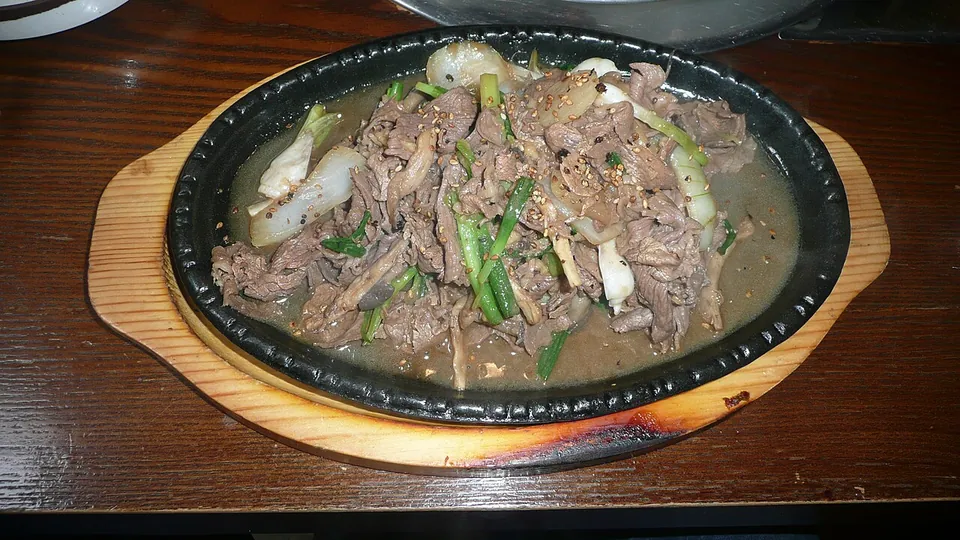
The claim that Bulgogi—thin slices of beef marinated in a sweet-savory sauce and grilled—carries on from the maekjeok of the Goguryeo kingdom, a dish of remote antiquity, is heard far more often than the sources will bear. The Bulgogi we have today is a new dish, one that took shape only after the turn of the twentieth century.
Verification highlight popular claim → verdict → evidence
Popular claim: a direct descendant of Goguryeo-era maekjeok (貊炙) skewered meat, tracing back to antiquity. Verdict: rejected — the source text Soushenji contains no mention of Goguryeo at all. The modern sweet-savory marinated sliced-beef dish is a 20th-century creation from court/yangban neobiani; the word bulgogi first appears in print in 1922. Key sources: Lee & Cho (2013), The Evolution of Bulgogi over the Past 100 Years, Korea Journal.
The three gates
- Ingredient-supply gate
- Beef, soy sauce, and sesame oil are all native/long-available; the dish is not bounded by any New World ingredient (native — no physical lower bound).
- Cooking-technique gate
- Thin-sliced meat marinated then grilled over direct fire or on a griddle.
- Venue gate
- Originated among the upper stratum, later spread to the general public.
Overview
Bulgogi is a Korean beef dish: thin-sliced beef seasoned with soy sauce, sugar, and sesame oil, then grilled over an open flame or on an iron plate. The word "bulgogi" appears in writing in 1922, an early instance being Hyeon Jin-geon's short story Tarakja, carried in the magazine Gaebyeok, and it keeps surfacing in print thereafter—1926, 1927, 1929, 1931. A 1947 Korean dictionary lists it as "meat grilled directly over charcoal." Trace how the word appears and the present style looks to have come together broadly from the 1920s on.
Beef, the dish's centerpiece, was a long-established food on the peninsula, on everyday tables from early on. Soy sauce, sesame oil, and sugar were all to be had locally. So the novelty of Bulgogi lies instead in the preparation—thin slices of beef steeped in a sweet-savory marinade and grilled—and in the shifting cast of who ate it.
Grilled thin-sliced beef had earlier belonged to the upper table as neobiani, a dish of the royal court and the yangban aristocracy. From the 1920s through the 1960s this broadened into Bulgogi as a commercial dish, and from the 1960s through the 1990s it came down to the popular table as a souped, brothier Bulgogi. On a base of local ingredients, the marinated-and-grilled preparation and the movement of the dish from the elite down to the common table came together, and modern Bulgogi took form.
How we know
The origin most fondly told for Bulgogi traces it to the maekjeok of Goguryeo—the skewered grilled meat of the Maek people—as a distant ancestor, with a single unbroken line running from there down to modern Bulgogi. The ring of reaching back to antiquity is a proud one.
Followed to its source, though, this direct-line story comes down to one writer's assertion. Choi Nam-seon (1890–1957) declared, with no argument offered, that "maekjeok is a Buyeo-style grilled meat," and cited nothing. Go to the primary sources and the Chinese old text Soushen Ji, often invoked to tie maekjeok to Goguryeo, in fact contains no mention of Goguryeo at all; it speaks only of the Maek people. Korean reporting that reexamined the original has pointed out this discrepancy. The earliest independent record of maekjeok itself is a single line in the Han-era dictionary Shiming (early third century): a nomad method of roasting the whole and each person cutting off a piece with a knife. There is no spice, no skewer, no marinade in it. It is a different thing from today's Bulgogi of sweet-savory marinated thin slices.
So the view of the origin has settled away from the ancient direct-line theory and onto a modern formation. The word "bulgogi" first appears in writing in 1922; food-culture research that has followed the shift from the court and yangban neobiani to commercial Bulgogi across a span of a century, together with an encyclopedia that records neobiani as a term of the court and the yangban, supports the modern side. With the first attestation of the word now fixed at 1922, placing the formation in the 1920s has become firmer than before.
None of this erases the old layer of native grilled meat—maekjeok, neobiani—itself. That there was a culture of grilled meat in antiquity is denied by no one. What has collapsed is the account that joins that old layer to modern Bulgogi in a single direct line.
The full set of origin theories and the detailed verification log — traceable all the way to their sources — are available on the Japanese edition.
See the full origin theories and verification log (Japanese) →
Related dishes
Lineage Family, predecessor, variants
Shares the key ingredient
- PhoVietnamC
- Beef StroganoffRussiaC
- Chicago Italian beefChicago (USA)C
- Salt beef (the layer before canning)Ireland (Cork / Dublin)C
- AsadoRío de la Plata (Argentina / Uruguay)C
- Lomo saltadoLima (Peru)C
- ĆevapčićiBalkans (Serbia, etc.)C
- Proto-goulash (pre-paprika herdsmen's meat stew proto-layer)HungaryC
- KharchoGeorgia (Caucasus)B
- Proto-rendang (pre-chili merendang proto-layer)West Sumatra (Minangkabau), IndonesiaC
- Nyama chomaEast Africa (Kenya, Tanzania)C
- Philly cheesesteakPhiladelphia (USA)B
- Pastel de chocloChileC
- NihariNorth India (Delhi / Awadh)C
- NikujagaJapanC
- Australian meat pieAustraliaC
- FajitasRio Grande Valley, Texas (USA)B
- Loco mocoHilo, Hawaii (USA)B
- KitfoGurage (Ethiopia)C
- Ropa viejaCubaC
- MachacaNorthern Mexico (Sonora / Sinaloa)C
- Ropa vieja (Iberian prototype)Canary Islands, SpainB
- TibsEthiopian HighlandsB
- BiltongSouth AfricaC
- Lok lakPhnom Penh (Cambodia)C
- Carne asadaNorthern Mexico (Sonora)C
- Hamburg steakHamburg (Germany)B
- Bò lúc lắc (Vietnamese shaking beef)Southern VietnamC
- Montreal-style smoked meatQuebec (Canada)D
- Kare-karePhilippinesC
- PastramiNew York (USA)D
- BraaiSouth AfricaC
- French dip sandwichLos Angeles, California (USA)C