All dishes / 東アジア
Bibimbap Period BOrigin theory CVerified
Some fields (dish name, region and gates) are shown from the Japanese-edition data.
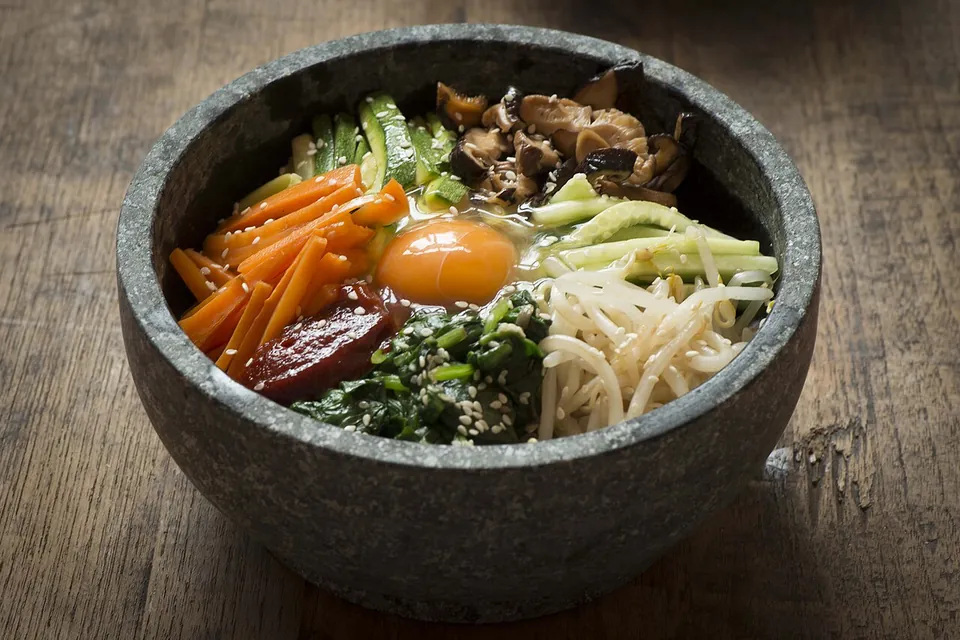
In this Korean dish, rice is topped with vegetables and meat, then stirred with a spoonful of sauce and eaten. Yet the deep red of gochujang that everyone pictures is far younger than the dish itself.
Verification highlight popular claim → verdict → evidence
Bibimbap is often given a court pedigree, or claimed for Jeonju as its birthplace. The written record supports neither. Mixed rice appears under Chinese-character names well before the chilli: hondon-ban in Pak Tong-nyang's Kijae chapgi (about 1590), goldong-ban in Kwon Sang-il's diary (1679-1760), and, in Yi Ik's collected works, a definition of goldong-ban as rice and soup mixed with fish, meat and vegetables, with Yi Gyu-gyeong noting that Pyongyang made the finest. Korean-script forms follow in 1810 and 1870, and the first cooking method that matches the dish as it is eaten now is in the Siuijeonseo of the late nineteenth century. None of these is tied to Jeonju, whose name as the home of bibimbap was made in the twentieth century by restaurants and tourism. The red gochujang bowl can only come after chillies reached Korea between 1590 and 1614 (Kwon, Jang and Kim, Journal of Ethnic Foods, 2014), and a 2015 study in the same journal finds none of the competing origin stories, the court one included, supported by strong evidence. A first appearance in writing marks the latest date by which a dish existed, not the date it was invented.
The three gates
- Ingredient-supply gate
- Rice is a long-established local grain. The version dressed with gochujang can only follow the arrival of the chilli, a New World plant, in Korea. That arrival came around 1600 (range 1590-1614; Kwon, Jang and Kim, Journal of Ethnic Foods, 2014), and it is the earliest possible date for the red bowl of bibimbap.
- Cooking-technique gate
- Cooking in a heated stone pot, mixing the bowl, and fermenting the gochujang. Mixed rice itself is long established locally and older than the chilli; the year in which serving it in a stone pot took its settled form has not been pinned down.
- Venue gate
- Two accounts stand side by side: one has offerings from ancestral rites mixed into a single bowl, the other makes it court food traced to Jeonju. Both are argued from sources, neither is decisive, and the origin is left as competing accounts.
Overview
An old mixed rice and a young red
Bibimbap is a bowl of rice piled with an array of toppings, stirred together and eaten. Today it is best known served sizzling in a hot stone bowl, with a spoonful of bright red gochujang stirred through as a matter of course.
But the habit itself of mixing several side dishes into one bowl of rice is much older. The name hondon-ban ("chaos rice") already appears in a text from the late sixteenth century, and a mixed rice called goldong-ban is recorded through the seventeenth and eighteenth centuries. Gathering the year's leftover greens into a single bowl, or taking down the offerings from an ancestral rite and mixing them to eat afterward: these everyday mixed rices form a long lineage. This older layer is now set apart as bibimbap's prehistory, the "white" mixed rice.
After the names written in Chinese characters come the names spelled in the Korean alphabet. Early in the nineteenth century the spelling beubwieum appears, and by mid-century bubaeban; in the cookbook Siuijeonseo, compiled near the century's end, the dish is written as goldong-ban and bubeumbap, with the earliest recipe that leads to today's bibimbap. The name resolves gradually, from Chinese characters to Korean script to a set-down method.
Between that old mixed rice and today's red bibimbap lies one gap. The chili that gochujang is made from is a New World plant that reached the peninsula only from the late sixteenth into the seventeenth century, and it took root there over that span. The rice at the heart of the dish, by contrast, was a long-established local staple, on Korean tables from far back. The mixed rice before chili was, in effect, a "white" bibimbap, dressed with soy sauce, salt, and sesame oil; chili joined later, and only then did the familiar red bowl take shape. Today's gochujang bibimbap is a new color laid over an old tradition of mixed rice.
How we know
There is no single, clear origin story that says "this is how bibimbap was born." Several accounts have been handed down. One holds that it began with the offerings from an ancestral rite, mixed into a single bowl and eaten after the ceremony. Another makes it a mixed rice for clearing away the greens left at year's end. Others trace it to a mixed rice served to the king at court, or tell of the town of Jeonju as its true home.
Set these accounts side by side and none of them carries enough firm evidence to be named the origin. Studies of food history judge that all of these accounts fall short of proof. The stories that bibimbap "was born at court" or that "Jeonju is its birthplace" in particular took shape largely later, as towns and dishes had their names raised in the modern era. The oldest surviving records -- hondon-ban (1590), goldong-ban, and Siuijeonseo (late nineteenth century) -- are none of them specific to Jeonju; they reflect a lineage of mixed rice rooted broadly in yangban households, at court, and on ordinary tables. Jeonju bibimbap became famous as the flagship of the modern form in the twentieth century, above all through postwar restaurant culture and tourism promotion, and no primary source names it as the birthplace. That Jeonju is famous and that Jeonju gave rise to the dish are two different matters.
What can be confirmed is plainer, and firmer. The old mixed rice, in which toppings and rice are stirred together and eaten, is recorded from before chili arrived. The red gochujang version, on the other hand, could only take its shape after chili crossed to the peninsula. Leave the origin story as several accounts, and keep two layers distinct -- the old stratum of mixed rice and the newer current form in red. That is the reading most faithful to the records we have.
The full set of origin theories and the detailed verification log — traceable all the way to their sources — are available on the Japanese edition.
See the full origin theories and verification log (Japanese) →
Related dishes
Lineage Family, predecessor, variants
Shares the key ingredient
- KimchiSouth KoreaC
- Mapo tofuSichuan (China)C
- Doro watEthiopian HighlandsB
- Indigenous molli (chilmolli, pre-Old-World-spice chili sauce proto-layer)MexicoC
- RendangMinangkabau, West Sumatra (Indonesia)C
- Tom yum goongThailandC
- SambalMalay Archipelago (Indonesia)C
- TteokbokkiKorean PeninsulaC
- Tandoori chickenNorth India (Punjab / Delhi)C
- LaksaPenang (Straits Settlements)C
- MuhammaraAleppo, SyriaC
- VindalooGoa (India)C
- Piri piri chickenMozambique (Portuguese colonial sphere)C
- HarissaTunisiaC
- Twice-cooked pork (huiguorou)Sichuan (China)C
- LarbLaos / Isan (Thailand)C
- Chili con carneTexas, USA (San Antonio)C
- Dan dan noodlesChengdu, Sichuan (China)C
- General Tso's chickenNew York (USA)C
- Pol sambolSri LankaB
- Chapli kebabPeshawar (Pakistan)C
- ShiroEthiopian HighlandsB
- Hiroshima soupless dandan noodlesHiroshima (Japan)B
- Kung pao chickenSichuan (China)C
- Fuqi feipianSichuan (China)D
- Nasi lemakMalaysiaC
- LampraisSri LankaC
- Nigerian pepper soupNigeria (West Africa)C
- MerguezMoroccoB