All dishes / 東アジア
Twice-cooked pork (huiguorou) Period BOrigin theory CVerified
Some fields (dish name, region and gates) are shown from the Japanese-edition data.
In Sichuan, twice-cooked pork means exactly that: pork boiled whole, then returned to the wok and fried again. But the fiery red coat of chili bean paste that defines it today is, by Sichuan's own timeline, a fairly recent arrival.
Verification highlight popular claim → verdict → evidence
One story derives twice-cooked pork from the Manchu bian bairou, itself a descendant of the sliced boiled pork (bai pian rou) in Yuan Mei's Suiyuan shidan (1792). Historians of Sichuan cooking reject that line of descent: bian bairou is more likely the later dish, and sliced boiled pork accounts only for the first half of the method, not for the return to the wok or the bean paste that make the dish what it is. Another story pushes a thrifty peasant dish back to the Song, which speaks to the age of the technique rather than to the red Sichuan dish. Under its own name the dish first appears in print in Fu Chongju's Chengdu tonglan (1909), read in a full transcription of the 1909 edition, where it is filed under everyday home cooking rather than court fare. The red version cannot be older than the chilli's arrival in Sichuan (1684-1749; Brian R. Dott, The Chile Pepper in China, 2020) and the making of Pixian douban, which began by accident with the Chen family about 1688 and went into large-scale production in 1803. The Japanese dish of the same name, created by Chen Kenmin on television in 1967 with sweet Hatcho miso and cabbage, is a different dish.
The three gates
- Ingredient-supply gate
- Pork was long at hand in Sichuan. The dish as eaten now is seasoned with doubanjiang, made with chilli, a New World plant, and can only follow the chillis arrival in Sichuan, a window running from 1684 to 1749 (Brian R. Dott, The Chile Pepper in China, 2020). The earliest possible date for the red version is the early end of that window, 1684, not the often-cited 1749.
- Cooking-technique gate
- Cooking the pork twice, boiled first and then returned to the wok, is an old technique older than the chilli. Pixian douban, the fermented broad bean and chilli paste the present-day dish cannot do without, began by accident with the Chen family about 1688 and went into large-scale production under the Shuntian hao in 1803.
- Venue gate
- Home cooking in Sichuan. The leading account has it begin with pork offered at ancestral rites and reheated afterwards, but the decisive source is missing and it stands among competing accounts.
Overview
The dish named for going back into the wok
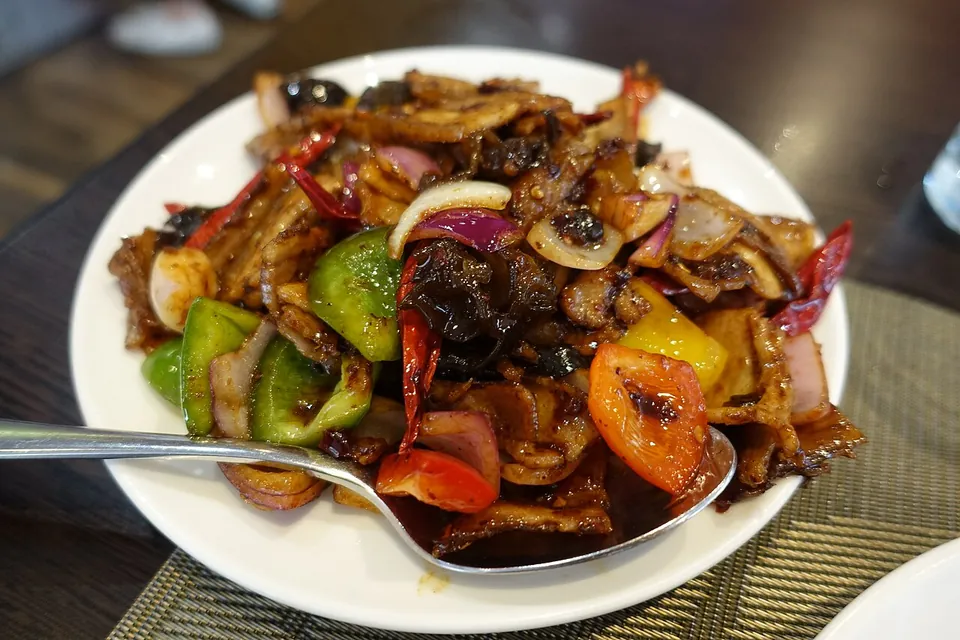
Hui guo rou is one of Sichuan's essential pork dishes. Its name means, quite literally, "back into the wok." A slab of pork is first boiled, then sliced thin and returned to the pan to be fried a second time. This double cooking is the backbone of the dish.
The sequence of boiling and then frying appears to have been rooted in Sichuan life for a long time. Boiled slabs of pork were offered at rites honoring one's ancestors. During the great resettlement known as huguang tian sichuan in the late Ming and early Qing, when people from many regions moved into a Sichuan ravaged by war, the newcomers laid out boiled pork to mourn their dead; once the ceremony was over, they took the meat down, sliced it thin, returned it to the wok, and fried it. The origin of hui guo rou has long been traced to that dish eaten after the rites.
Yet what comes to mind first today is the redness of the chili bean paste and the heat that spreads through the mouth. That red heat arrived far later than the old routine of double cooking. Chili peppers, at the heart of the bean paste, are a New World crop; they spread through Sichuan only from the end of the seventeenth century into the eighteenth. Pixian douban, the broad-bean-and-chili paste that represents Sichuan, took its shape later still. A paste that first arose by chance in the Chen family workshop was produced at scale in the nineteenth century, and the present method of adding salted chilies settled into place over time. Early in the twentieth century, Fu Chongju's Chengdu Tonglan, a record of Chengdu's ways, describes a "you bao rou" made with bean paste and garlic greens that looks much like today's hui guo rou. Only when that red heat was wrapped around the old fried boiled pork did the hui guo rou we know finally take form.
How we know
Many tales are told about how hui guo rou began. One that circulated for a long time traces it to the Manchus. The Suiyuan Shidan (1792) by Yuan Mei records a Manchu-style "bai pian rou," boiled pork cut into thin slices. Add scallion and soy sauce and fry it into "bian bai rou," some said, and there you have the direct ancestor of hui guo rou.
But research into the history of Sichuan cuisine sets this story aside. Bian bai rou more likely appeared after hui guo rou, not before, and no firm causal link joins the two. Bai pian rou is only the first half of the double cooking, the boiling and thin-slicing; it explains nothing of what makes hui guo rou itself, the return to the wok and the coat of chili bean paste. Tracing the dish to Manchu court cooking is a stretch with no documentary footing behind it.
So what origin can actually be traced? The strongest account points to the boiled pork offered in ancestral rites: the pork laid before the ancestors was returned to the wok and fried after the ceremony, and that custom became a dish. Sichuan food media favor this line. There is also a story that thrift-minded farmers refried pork they had boiled and set aside, one that would push the dish back to the Song dynasty; but its support rests mostly in surveys and blog posts, with little backing from old records.
One thing must not be confused here. What these tales describe is the age of a cooking method, the refrying of boiled pork, from a time when neither chili nor bean paste had yet reached Sichuan. The dish named hui guo rou first appears in writing at the very end of the Qing, in the 1909 Chengdu Tonglan. That work files it under "jia chang bian cai," everyday home cooking of ordinary people, which suggests a dish that rose from the kitchen rather than the court. Honor the lineage of the old method as lineage; the hui guo rou wrapped in the red of chili bean paste is newer than that. Reading it that way stays faithful to the record.
The full set of origin theories and the detailed verification log — traceable all the way to their sources — are available on the Japanese edition.
See the full origin theories and verification log (Japanese) →
Related dishes
Lineage Family, predecessor, variants
Cross-links Sister dishes & same-name dishes (separate lineage)
Shares the key ingredient
- KimchiSouth KoreaC
- Mapo tofuSichuan (China)C
- Doro watEthiopian HighlandsB
- Indigenous molli (chilmolli, pre-Old-World-spice chili sauce proto-layer)MexicoC
- RendangMinangkabau, West Sumatra (Indonesia)C
- Tom yum goongThailandC
- SambalMalay Archipelago (Indonesia)C
- TteokbokkiKorean PeninsulaC
- Tandoori chickenNorth India (Punjab / Delhi)C
- LaksaPenang (Straits Settlements)C
- MuhammaraAleppo, SyriaC
- VindalooGoa (India)C
- Piri piri chickenMozambique (Portuguese colonial sphere)C
- HarissaTunisiaC
- BibimbapSouth KoreaC
- LarbLaos / Isan (Thailand)C
- Chili con carneTexas, USA (San Antonio)C
- Dan dan noodlesChengdu, Sichuan (China)C
- General Tso's chickenNew York (USA)C
- Pol sambolSri LankaB
- Chapli kebabPeshawar (Pakistan)C
- ShiroEthiopian HighlandsB
- Hiroshima soupless dandan noodlesHiroshima (Japan)B
- Kung pao chickenSichuan (China)C
- Fuqi feipianSichuan (China)D
- Nasi lemakMalaysiaC
- LampraisSri LankaC
- Nigerian pepper soupNigeria (West Africa)C
- MerguezMoroccoB