All dishes / 東アジア
Kung pao chicken Period BOrigin theory CVerified
Some fields (dish name, region and gates) are shown from the Japanese-edition data.
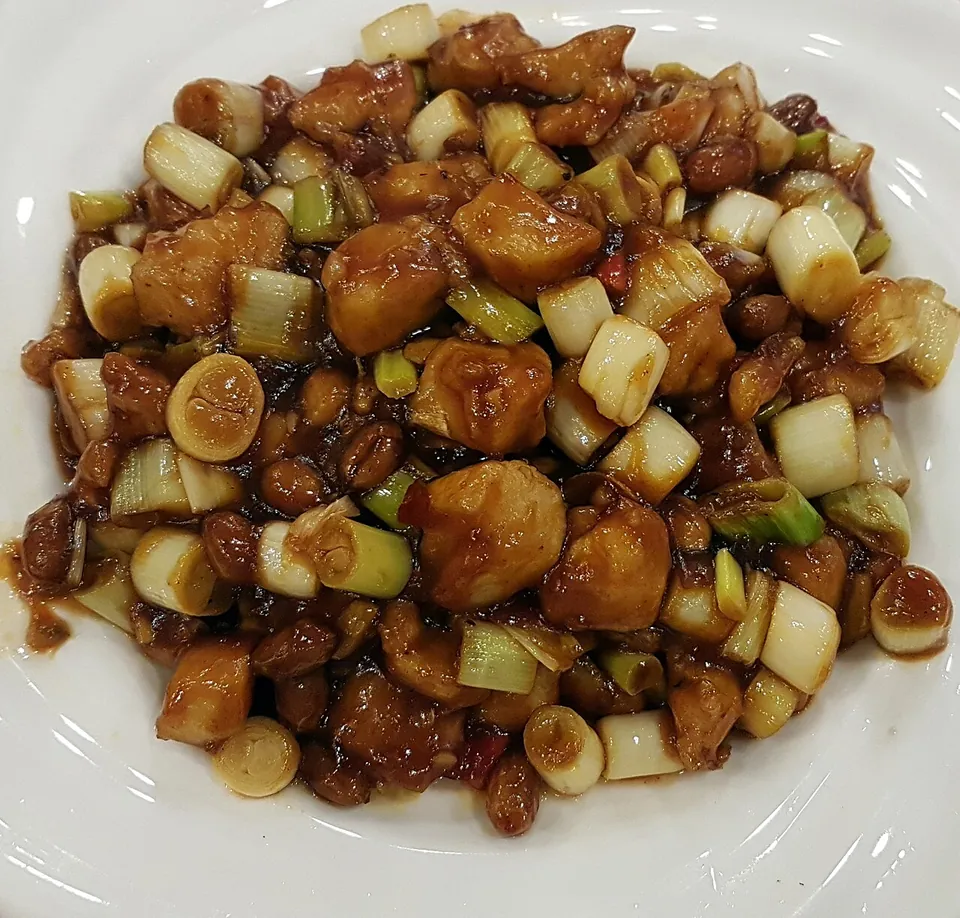
A stir-fry known worldwide as a signature of Sichuan cooking. That its name, gong bao, derives from the official title of the late-Qing statesman Ding Baozhen is certain, but the dramatic tale that he invented the dish finds no support in the records of his own time.
Verification highlight popular claim → verdict → evidence
The dish's name traces to Qing official Ding Baozhen's title 'Gongbao,' a naming link recorded in official Chinese sources -- but the popular legend that Ding or his household chef invented today's dish is not supported by the record. The dish does not appear in an 1899-era guide to Chengdu cuisine, and 'gong bao chicken' is not attested in print until 1950s cookbooks, with standardization only in the 1990s. The true inventor and date remain unidentified, and Guizhou, Shandong, and Sichuan each claim it as a native specialty since Ding served in all three (Fuchsia Dunlop, Land of Plenty; Chengdu Museum; Sichuan Provincial Gazetteer).
The three gates
- Ingredient-supply gate
- Chicken was a native ingredient; chili, which gives Sichuan cuisine its spicy character, only arrived after the Ming-Qing era New World exchange.
- Cooking-technique gate
- Quick stir-frying (baochao).
- Venue gate
- From official households' tables to popular Sichuan restaurants.
Overview
Gong bao chicken (kung pao chicken) is a Sichuan dish of diced chicken flash-fried over high heat with dried chilies and Sichuan pepper, tossed with peanuts. Chicken is a long-established ingredient of the region, but the chilies the stir-fry cannot do without are native to the Americas and reached China in the Ming and Qing periods. The chili-heat food culture of Sichuan took root only after the chili had established itself, and the peanut too was a crop that spread inland during the Qing. The ingredients that give the dish its present form were not all in place before the middle of the Qing dynasty at the earliest.
Gong bao is the abbreviated form of Taizi Shaobao, an honorary title granted to Ding Baozhen (1820-1886). Ding was born in Guizhou, served as governor of Shandong, and in 1876, the second year of the Guangxu reign, became governor-general of Sichuan. His surname, Ding, echoes the ding ('diced') in the dish's name, and that pun helped attach his title to it. Because Ding's career spanned the three provinces of Guizhou, Shandong, and Sichuan, each of these places claims the dish as its own local treasure, giving rise to variations such as the fermented-chili paste of Guizhou or the bean-paste-and-sugar version of Sichuan. With the technique of high-heat stir-frying and a setting that carried it from the official's table out into the city's Sichuan cooking, gong bao chicken took shape as a dish emblematic of Sichuan.
How we know
Gong bao chicken carries several origin tales built around Ding Baozhen's character. There is the story of gratitude, in which he served the dish to thank a household that had helped him, and the story in which, walking incognito among ordinary people, he came upon the taste at a street stall. Around six such folk legends have been handed down in Chengdu. Yet the plot in which Ding himself or his household cook created today's gong bao chicken never appears in the records of his own time.
A quarter century after Ding's term as governor-general of Sichuan, a 1902 travel guide to Chengdu lists roughly a hundred of the city's specialties. Nothing corresponding to gong bao chicken is among them. The dish name first appears in a cookbook in the 1950s, and the method given by a 1956 cookbook, which dices a whole chicken, deep-fries it in lard, and uses the liquid of fermented bean curd, differs considerably from today's; the standard method we know settled only in the 1990s. The year a name is first written down is not the year the dish was born. Gong bao chicken as a standardized dish bearing Ding's title was shaped over the course of the 20th century.
At the same time, the core claim that the dish's name derives from Ding Baozhen's official title is agreed upon across several public institutional records and does not waver. During the Cultural Revolution, the word gong bao, naming an old-regime high official, fell out of favor, and the dish was renamed for a time to things like hula chicken. It returned to its original name only in the 1980s. Who first made it, and when, is still unsettled; but once the dramatic invention anecdote is set aside, what remains is a firmer picture, of a dish assembled in 20th-century Sichuan under the borrowed name of a famous statesman.
The full set of origin theories and the detailed verification log — traceable all the way to their sources — are available on the Japanese edition.
See the full origin theories and verification log (Japanese) →
Related dishes
Shares the key ingredient
- KimchiSouth KoreaC
- Mapo tofuSichuan (China)C
- Doro watEthiopian HighlandsB
- Indigenous molli (chilmolli, pre-Old-World-spice chili sauce proto-layer)MexicoC
- RendangMinangkabau, West Sumatra (Indonesia)C
- Tom yum goongThailandC
- SambalMalay Archipelago (Indonesia)C
- TteokbokkiKorean PeninsulaC
- Tandoori chickenNorth India (Punjab / Delhi)C
- LaksaPenang (Straits Settlements)C
- MuhammaraAleppo, SyriaC
- VindalooGoa (India)C
- Piri piri chickenMozambique (Portuguese colonial sphere)C
- HarissaTunisiaC
- BibimbapSouth KoreaC
- Twice-cooked pork (huiguorou)Sichuan (China)C
- LarbLaos / Isan (Thailand)C
- Chili con carneTexas, USA (San Antonio)C
- Dan dan noodlesChengdu, Sichuan (China)C
- General Tso's chickenNew York (USA)C
- Pol sambolSri LankaB
- Chapli kebabPeshawar (Pakistan)C
- ShiroEthiopian HighlandsB
- Hiroshima soupless dandan noodlesHiroshima (Japan)B
- Fuqi feipianSichuan (China)D
- Nasi lemakMalaysiaC
- LampraisSri LankaC
- Nigerian pepper soupNigeria (West Africa)C
- MerguezMoroccoB