All dishes / 東アジア
Jajangmyeon Period BOrigin theory CVerified
Some fields (dish name, region and gates) are shown from the Japanese-edition data.
Korea's beloved black-sauce noodle dish traces back to the zhajiangmian that Shandong Chinese immigrants brought to the treaty port of Incheon, where it slowly took on a darker, sweeter caramel-tinged sauce and became something distinctly Korean.
Verification highlight popular claim → verdict → evidence
Myth: the Incheon restaurant Gonghwachun (founded 1905) was the sole inventor of jajangmyeon. Verdict: rejected — multiple Qing-Chinese restaurants were already selling the dish before Gonghwachun opened, so no single shop can be credited as the origin. The word 'jajangmyeon' first appears in print in the 1934 magazine Gaebyeok and the 1936 newspaper Dong-a Ilbo. The dish's black, sweet caramelized chunjang — the mark of the Korean style — was established when overseas-Chinese entrepreneur Wang Songshan founded Yeonghwa Soy Sauce in Seoul in 1948 and began mixing in caramel in the mid-1950s.
The three gates
- Ingredient-supply gate
- Wheat and soybean paste are both native Old World staples; the real key was developing the caramelized black chunjang (bean paste); onion and other vegetables are also used.
- Cooking-technique gate
- A sweetened, blackened adaptation of the Chinese Shandong-style fried-bean-paste sauce technique, poured over noodles.
- Venue gate
- Overseas-Chinese eateries in Incheon's Chinatown, later a nationwide, everyday Chinese-Korean dish.
Overview
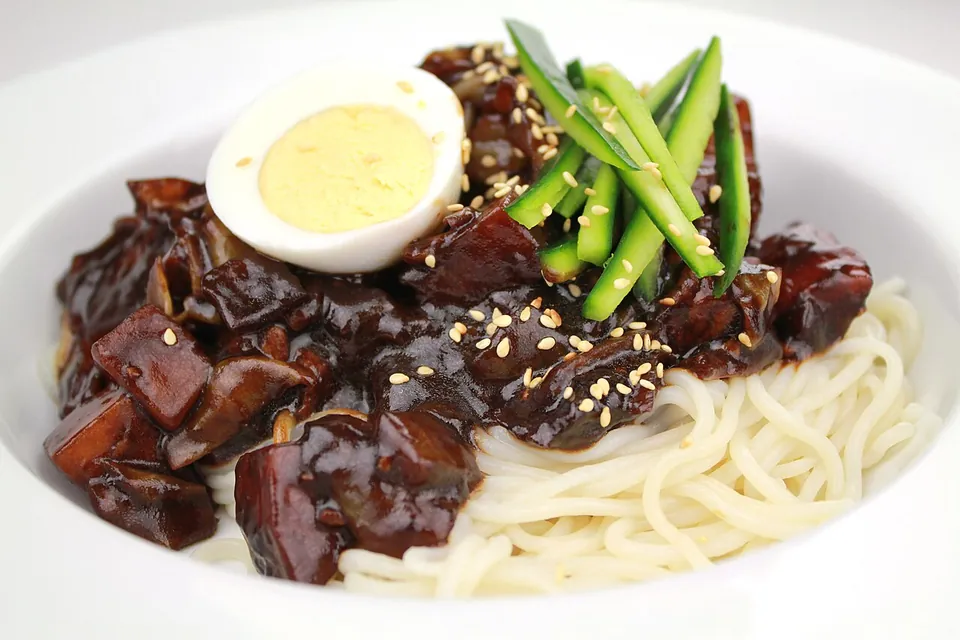
Jajangmyeon is a familiar sight in Korean-Chinese diners: thick wheat noodles tossed in a glossy, dark-brown sauce. The heart of that sauce is chunjang, a black, sweet fermented-bean paste, stir-fried with pork, onion, and potato. Wheat noodles and soybean paste were both long-established on the Korean table, so the noodles and the paste themselves were nothing new; what set this dish apart was how the paste was remade.
The stage for that change was Incheon's Chinatown, in the port town that opened to foreign trade at the close of the 19th century. Laborers who had crossed from Shandong province brought their hometown zhajiangmian with them and began serving it in the town's eateries. The Chinese original was salty and colored the plain brown of fermented bean paste, not the deep black it would later become. The word "jjajangmyeon" already appears in the magazine Gaebyeok in 1934 and in the newspaper Dong-a Ilbo in 1936, by which time it had settled in as an everyday food for ordinary people.
The dark, sweet chunjang came together only afterward. In 1948 the Chinese immigrant Wang Songshan founded the Yeonghwa soy-sauce works in the Yongsan district of Seoul and began making Korea's first noodle paste, sold under the Saja-pyo (Lion Brand) chunjang label. Around the mid-1950s, mixing caramel into it produced the glossy, sweet-black sauce. Darker and sweeter than its Chinese counterpart, this sauce is what sets Jajangmyeon apart from the parent zhajiangmian. Through the 1950s, in the years around and after the Korean War, it spread across the country as a cheap, filling Chinese-style meal, moving from street stalls to neighborhood diners until it became a dish everyone knew.
How we know
A well-worn story holds that Gonghwachun, a Chinese restaurant founded in Incheon's Chinatown in 1905, was where Jajangmyeon began. With its firmly dated founding, this venerable establishment made an easy and satisfying candidate for the birthplace of the dish.
But the attribution to one shop in one year does not hold up. Official records from the Seoul Metropolitan Government, surveys of Incheon's local heritage, and the testimony of first-generation Chinese immigrant cooks all indicate that Jajangmyeon was already being sold in several Chinese eateries in Incheon before Gonghwachun opened its doors. No record survives of who served it first. Gonghwachun came to be called the "original" only as the first shop to sell the dish under the name "jjajangmyeon"; it was not invented there. As a birthplace claim, it does not survive the sources, and the true beginning remains unresolved.
None of this denies the arrival from China. The larger arc, in which Shandong immigrants carried zhajiangmian to Incheon and localized it into the sweet black chunjang, is in fact the accepted view among food historians. What gets set aside is only the narrow claim that a particular shop invented the dish in a particular year, not the lineage of the dish itself. Jajangmyeon was not one restaurant's achievement but a dish that Incheon's Chinese community raised over time.
The full set of origin theories and the detailed verification log — traceable all the way to their sources — are available on the Japanese edition.
See the full origin theories and verification log (Japanese) →
Related dishes
Cross-links Sister dishes & same-name dishes (separate lineage)
Shares the key ingredient
- Mie gorengIndonesiaC
- Tantanmen (Japanese dan dan noodles)JapanB
- ThukpaTibet / NepalB
- SaiminHawaii (USA)C
- PancitManila (Philippines)B