All dishes / 東アジア
Hiroshima soupless dandan noodles Period BOrigin theory BVerified
Some fields (dish name, region and gates) are shown from the Japanese-edition data.
Unlike most local specialties, Hiroshima's soupless dandan noodles come with a named originator and a firm date. A ramen shop called Kisaku, which opened in central Hiroshima in 1999, put the dish on its menu in January 2001. It is a regional offshoot of dandan noodles, a dish born in late-Qing Sichuan, that branched off in a single Japanese city.
Verification highlight popular claim → verdict → evidence
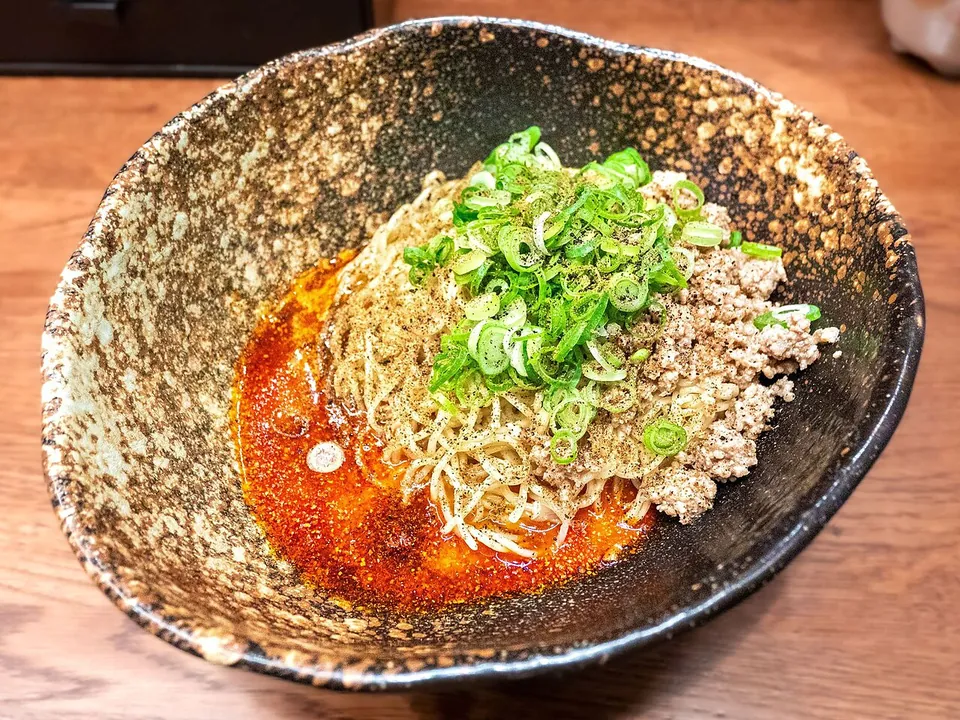
A regional take on Sichuan dandan noodles built around the numbing heat of Sichuan pepper instead of sesame paste. It was created around 2001 by the Hiroshima ramen shop Kisaku, and became a local specialty as a wave of imitators followed.
The three gates
- Ingredient-supply gate
- Wheat and pork were native, and chili peppers had already arrived (the same ingredient conditions as Sichuan dandan noodles — unchanged).
- Cooking-technique gate
- A broth-less preparation that tosses noodles in a sauce built on the numbing-spicy (mala) flavor of Sichuan pepper, without using sesame paste.
- Venue gate
- Local noodle shops in Naka-ku, Hiroshima (such as Kisaku), which became a Hiroshima specialty through the boom of its three founding shops.
Overview
What the dish is
As the name says, these dandan noodles come with no soup. Boiled noodles are tossed directly in a sauce rather than served in broth. What defines the Hiroshima version is that it leaves out sesame paste. Sichuan dandan noodles (its parent dish) and the postwar Japanese version reworked with soup both build on the richness of sesame paste, but the Hiroshima style puts something else at the center: the tingling ma of blended Sichuan pepper, the heat of chili oil, and a stock drawn from chicken and dried sardines. A generous heap of chopped local Kannon leek goes on top, and the eater mixes noodles and sauce thoroughly before slurping them up.
Why it took hold where it did
None of the ingredients is unusual. Wheat noodles and ground pork have long been on hand in Japan, and the Sichuan pepper and the chili in the chili oil were already the everyday materials of the parent Sichuan dandan noodles. What set the Hiroshima version apart as a dish of its own was a flavor design that dropped the sesame paste and built on the tingle of Sichuan pepper tossed through the noodles, and the story of the place where a single noodle shop in central Hiroshima created it and raised it.
Kisaku's owner, Hattori Koichi, was asked by a Chinese exchange student he knew for noodles to serve at a cooking class showcasing the food of her home region. That request sent him to Sichuan to study the local dandan noodles first-hand. He reworked what he brought back to suit his own shop, and in January 2001 he began serving it as a new menu item. This is where Hiroshima's soupless dandan noodles begin.
How we know
Origin claims for Hiroshima specialties often dissolve into a fog of ''no one really knows who was first.'' Soupless dandan noodles are a rare case where that fog lifts. The parent dish, dandan noodles, rose out of humble street peddling in late-Qing Sichuan, a dish steeped in oral tradition whose origin tales split into competing versions. The Hiroshima version is the opposite: its originating shop and year can be named from near-primary records.
The starting point is January 2001, at the ramen shop Kisaku in central Hiroshima (opened 1999, owner Hattori Koichi). A personal connection, a Chinese exchange student's cooking class, sent the owner to study in Sichuan, and out of it came a sesame-paste-free dish built on Sichuan pepper. An article in the Nihon Keizai Shimbun, a press release from Hiroshima Prefecture, and the prefecture's official tourism guide all name Kisaku as the originator, so the core of the origin is well attested.
Becoming recognized as a ''Hiroshima specialty'' in its own right took a second stage. In 2009 a later shop, Kunimatsu, released its recipe free of charge, and specialist shops began appearing one after another; in 2012 King-ken joined, and Kisaku, Kunimatsu, and King-ken came to be called the ''big three.'' King-ken's move into Tokyo in 2015 and a feature in the April 2018 issue of the magazine dancyu carried the name nationwide, until specialist shops in the prefecture numbered more than twenty-five and shops serving it more than two hundred. The origin was one shop's idea, but the rise to a local specialty was the product of this second wave of expansion. That two-part arc is the making of this dish.
The full set of origin theories and the detailed verification log — traceable all the way to their sources — are available on the Japanese edition.
See the full origin theories and verification log (Japanese) →
Related dishes
Lineage Family, predecessor, variants
- Umbrella categoryDan dan noodlesChengdu, Sichuan (China)C
- Same lineageTantanmen (Japanese dan dan noodles)JapanB
Shares the key ingredient
- KimchiSouth KoreaC
- Mapo tofuSichuan (China)C
- Doro watEthiopian HighlandsB
- Indigenous molli (chilmolli, pre-Old-World-spice chili sauce proto-layer)MexicoC
- RendangMinangkabau, West Sumatra (Indonesia)C
- Tom yum goongThailandC
- SambalMalay Archipelago (Indonesia)C
- TteokbokkiKorean PeninsulaC
- Tandoori chickenNorth India (Punjab / Delhi)C
- LaksaPenang (Straits Settlements)C
- MuhammaraAleppo, SyriaC
- VindalooGoa (India)C
- Piri piri chickenMozambique (Portuguese colonial sphere)C
- HarissaTunisiaC
- BibimbapSouth KoreaC
- Twice-cooked pork (huiguorou)Sichuan (China)C
- LarbLaos / Isan (Thailand)C
- Chili con carneTexas, USA (San Antonio)C
- General Tso's chickenNew York (USA)C
- Pol sambolSri LankaB
- Chapli kebabPeshawar (Pakistan)C
- ShiroEthiopian HighlandsB
- Kung pao chickenSichuan (China)C
- Fuqi feipianSichuan (China)D
- Nasi lemakMalaysiaC
- LampraisSri LankaC
- Nigerian pepper soupNigeria (West Africa)C
- MerguezMoroccoB