All dishes / サブサハラ・アフリカ
Sambusa Period BOrigin theory BVerified
Some fields (dish name, region and gates) are shown from the Japanese-edition data.
Sambusa, the triangular fried pastry rooted in the Indian Ocean port towns, is not something East Africa invented on its own. Its name reaches back to the Persian sanbosag, and it still carries the memory of dhow-borne trade to the Ramadan table.
Verification highlight popular claim → verdict → evidence
A myth of purely local East African invention does not hold up: the name traces to Persian sanbosag/Arabic sanbusaj, and the dish reached the Swahili Coast via Indian Ocean trade, most firmly attested in Omani-era Zanzibar. Main source: the 10th-century Baghdad cookbook Kitab al-Tabikh (al-Warraq).
The three gates
- Ingredient-supply gate
- Wheat for the wrapper is not native to East Africa; it came in as an Old World trade crop with Indian Ocean commerce (ledger: wheat flour in East Africa, 1100; the archaeobotany of Pemba Island, Walshaw 2010, shows Asian and trade crops established in the coastal towns in the 11th to 15th centuries). The physical lower bound on the ingredient side is thus the 11th to 12th centuries, which is consistent with the 1300-1700 window. The minced meat filling is local.
- Cooking-technique gate
- Wrapping a filling in thin pastry and frying it in oil.
- Venue gate
- A street snack of the Swahili Coast, and a fixture of Ramadan.
Overview
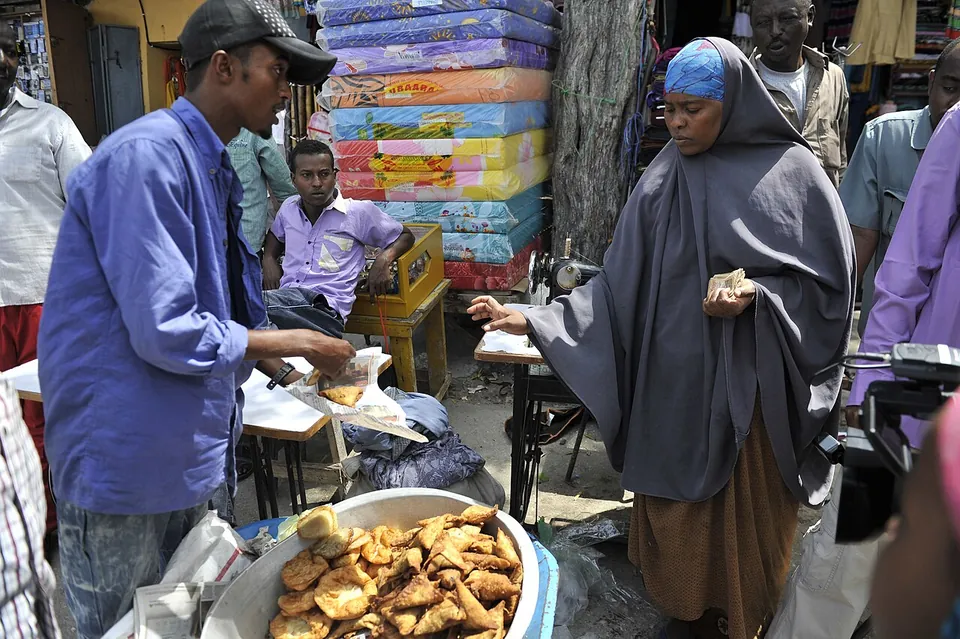
Sambusa is a Swahili coast street snack: thinly rolled wheat pastry folded into a triangle around minced meat or pulses and deep-fried. In port towns such as Mombasa, Zanzibar, and Lamu, it has been a fixture of Ramadan and of festivals.
Behind this dish lies the long history of Indian Ocean trade. The dhow routes that linked the Arabian peninsula, the Persian Gulf, and the west coast of India to the east coast of Africa carried not only spices and textiles but ways of cooking. When the craft of shaping a thin pastry, frying it, and turning it into a parcel you can carry in one hand crossed the sea and took root in the port towns, sambusa came into being.
Local spices worked their way into the filling—masala for pilau, berbere from the Horn of Africa—and it settled into the taste of each place. The wheat of the pastry and the minced meat or pulses of the filling were goods already found in the port-town markets. In this way an incoming style quietly became a local, everyday Swahili food.
How we know
The telling of sambusa as "a dish East Africa made for itself" still circulates, carried along with the pride of the port towns. But no primary source stands behind that founding story.
The clue is in the name itself. Sambusa goes back to the Persian sanbosag, a triangular fried parcel. Follow the record and its form turns out to be remarkably old. In the ninth century the Abbasid poet Ishaq al-Mawsili praised the sanbusaj in verse, and in the eleventh century the historian Bayhaqi's Tarikh-i Bayhaqi carries the name Sambosa. Further back, medieval Arab cookbooks—among them the tenth-century Kitab al-Tabikh of al-Warraq—set down fried parcels stuffed with minced meat and nuts as sanbusaj and sanbusak (Charles Perry's edited Medieval Arab Cookery is the standard guide to this lineage).
This lineage followed the Indian Ocean trade routes in the hands of Arab and Persian merchants and of migrants of Indian descent, reaching the Swahili coast and the Horn of Africa. On the East African side the clearest footprint is left at Zanzibar from the mid-seventeenth century on. After Oman took the island from Portugal, trade between Zanzibar and India came alive, and Indian dishes including samoosa flowed into the island's food culture. An earlier arrival by Arab merchants from around the year 1300 is a reasonable estimate, but the documentary backing for it is thin. The name, the earliest texts, and the route of arrival all trace their source to the Middle East and Central Asia. Food history treats this transmission as the settled account.
What is striking is that from the same sanbosag lineage the samosa grew up far to the east, on the Indian subcontinent. Sambusa and samosa can be called equal sisters sharing a common ancestor. Neither runs as parent to the other—rather than one giving rise to the other, both branched from the Persian triangular fry and grew, each wearing its own land's spices, into a separate specialty. One ocean left dishes of the same origin on both its shores.
The full set of origin theories and the detailed verification log — traceable all the way to their sources — are available on the Japanese edition.
See the full origin theories and verification log (Japanese) →
Related dishes
Cross-links Sister dishes & same-name dishes (separate lineage)
- Sister dish (shared ancestor)SamosaIndian subcontinent (Delhi Sultanate)B
- Sister dish (shared ancestor)EmpanadaRío de la Plata (Argentina)C
- Sister dish (shared ancestor)BrikTunisiaC
Shares the key ingredient
- PierogiPolandC
- BliniRussiaB
- PirozhkiRussiaB
- CheburekiCrimea (Crimean Tatar)C
- BelyashiVolga-Ural (Tatar / Bashkir)C
- JalebiNorthern IndiaB
- Fortune cookieCalifornia (USA)C
- StroopwafelGouda (Netherlands)C
- LamingtonQueensland (Australia)C
- ChimichangaTucson, Arizona (USA)C
- BuuzMongoliaB
- YantıkCrimea (Crimean Tatar)C
- VarenykyUkraineC
- MandaziEast Africa (Swahili Coast)C
- LángosHungaryC
- Daoxiaomian (knife-cut noodles)Shanxi (China)C
- KhuushuurMongoliaB
- Dobos torteHungaryB
- SarburmaCrimea (Crimean Tatars)B
- ThenthukTibet / NepalB
- ShumaiGuangzhou (China)B
- Jiaozi (gyoza)ChinaC
- Hohhot shaomaiHohhot (China)B
- OliebollenNetherlandsC
- MarquesitaYucatán (Mexico)D
- Halwa puriLahore (Pakistan)D
- Roti prataSingaporeB
- SopaipillaNew Mexico (USA)C
- CoyotaSonora (Northern Mexico)C
- RunzaMidwestern United StatesB
- BanshMongoliaC
- Kashyk-ash (къашыкъ-аш, Crimean Tatar spoon-dumpling soup)Crimea (Crimean Tatar)C
- KulebyakaRussiaB
- Spring roll (Chinese)ChinaC
- ChuchvaraUzbekistan (Samarkand / Fergana)C
- DamperAustraliaC
- SamsaCentral AsiaC
- HalushkyUkraineC
- BanitsaBalkans (Bulgaria)C
- Har gowGuangzhou (China)C