All dishes / ラテンアメリカ
Empanada Period BOrigin theory CVerified
Some fields (dish name, region and gates) are shown from the Japanese-edition data.
The Argentine empanada is often said to have been born in seventh-century Visigothic Galicia, yet not a single source survives from that era. Neither the word nor the recipe can be traced back further than the end of the thirteenth century.
Verification highlight popular claim → verdict → evidence
Popular claim: a 7th-century Visigothic Galician origin decreed by law. Verdict: rejected — no 7th-century source exists; the word's earliest attestation is the Cantigas de Santa María (c.1282), about 600 years later. The leading account is Galician/Iberian origin, carried to the Río de la Plata by settlers and developed into a beef-filled regional style; a competing account traces the folded-pastry form itself to medieval Arab/Persian sanbusaj, with Galicia only codifying it. Key sources: Cantigas de Santa María; Llibre del Coch (Robert de Nola, 1520).
The three gates
- Ingredient-supply gate
- Wheat and beef are both Old World foods; neither is native to the Americas, so their arrival via colonial trade sets the physical lower bound. The wheat dough is the limiting ingredient.
- Cooking-technique gate
- Kneaded dough wrapped around a filling, then baked or fried — a transplanted wheat-bread-making technique.
- Venue gate
- Market and home venue; common-people stratum; sold and home-made; settler and rural community.
Overview
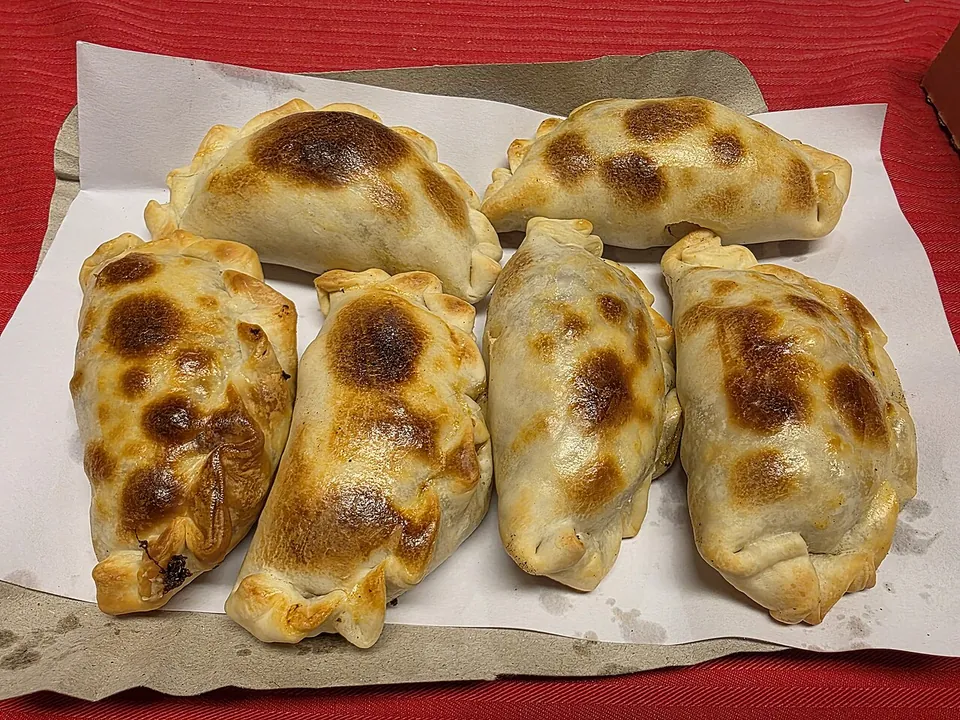
The empanada is a savory pastry of Argentina's Río de la Plata region: a filling of beef and onion wrapped in kneaded wheat dough and baked or fried. It was brought over from the Iberian Peninsula in the colonial period, in the sixteenth and seventeenth centuries, and the regional styles packed generously with beef took firm shape across the country in the nineteenth century.
Both wheat and beef were Old World crop and livestock, carried across the sea to the Río de la Plata. Until wheat could be had locally and the craft of kneading it into bread dough took root along with the settlers, the empanada in its present form was not baked on this land, because wrapping and baking in bread is itself a transplant of Iberian baking culture.
Its makers were ordinary people. It was made both at market stalls and in home kitchens, spreading from settlers to the rural population until it became an everyday snack to be bought or baked. In Tucumán and Salta in the north of Argentina, it took on local character in its filling and its dough.
The word and the recipe
The word empãada first appears in writing in a verse of the Cantigas de Santa María, the collection of Marian songs in Galician-Portuguese compiled under Alfonso X (c. 1282). The earliest surviving recipe reaches back only as far as the seafood empanada in Ruperto de Nola's Libro de guisados (composed c. 1490, printed 1520).
How we know
The origin most often told for the empanada, in tourist guides and local histories, is that "in the seventh century, in Visigothic Galicia, rules for cooking the empanada were proclaimed." But no contemporary document supporting that seventh-century date has ever been produced. The earliest appearance of the word empãada in writing is a verse of the Galician-Portuguese Cantigas de Santa María (c. 1282), compiled by Alfonso X, some six hundred years after the claimed seventh century. The recipe too can be traced no further back than the seafood empanada in Ruperto de Nola's Libro de guisados (composed c. 1490, printed 1520). The sculptures of the Pórtico de la Gloria at Santiago Cathedral, often brought forward as evidence, are of the twelfth century and say nothing of a seventh-century proclamation. Seen this way, the Visigothic-origin story is a legend without the support of any source.
So where does the wrapped pastry itself come from? The form of folding dough around a filling and baking it is far older than Galicia. The lineage of the sanbusak, whose name comes from the Persian sanbosag ("triangular parcel"), was praised in verse by the Abbasid poet Ishaq al-Mawsili and set down again and again in Arab cookbooks of the tenth to thirteenth centuries. Galicia was one stage that shaped this widely diffused craft of wrapped dough into its own style, which then crossed to the Río de la Plata with Iberian settlement and grew into the regional beef empanada. In northern Argentina, Lebanese and Syrian immigrants of the later nineteenth century also brought the same wrapped-dough culture by another route.
Galician, or Middle Eastern? The answer to that question changes depending on which stage one calls "the beginning." The ancestor of the general form lies in the wrapped dough of the medieval Arab and Persian world; Galicia is a waypoint that codified that style; and the beef empanada of the Río de la Plata is a regional style that developed further along still. It is precisely because the origin cannot be pinned to a single point that a story like the seventh-century Galician one, where a date alone runs off on its own, collapses before the sources.
The full set of origin theories and the detailed verification log — traceable all the way to their sources — are available on the Japanese edition.
See the full origin theories and verification log (Japanese) →
Related dishes
Cross-links Sister dishes & same-name dishes (separate lineage)
- Sister dish (shared ancestor)SamosaIndian subcontinent (Delhi Sultanate)B
- Sister dish (shared ancestor)SambusaEast Africa (Swahili Coast)B
- Sister dish (shared ancestor)Patties (Sri Lankan)Sri LankaC
Shares the key ingredient
- PierogiPolandC
- BliniRussiaB
- PirozhkiRussiaB
- CheburekiCrimea (Crimean Tatar)C
- BelyashiVolga-Ural (Tatar / Bashkir)C
- JalebiNorthern IndiaB
- Fortune cookieCalifornia (USA)C
- StroopwafelGouda (Netherlands)C
- LamingtonQueensland (Australia)C
- ChimichangaTucson, Arizona (USA)C
- BuuzMongoliaB
- YantıkCrimea (Crimean Tatar)C
- VarenykyUkraineC
- MandaziEast Africa (Swahili Coast)C
- LángosHungaryC
- Daoxiaomian (knife-cut noodles)Shanxi (China)C
- KhuushuurMongoliaB
- Dobos torteHungaryB
- SarburmaCrimea (Crimean Tatars)B
- ThenthukTibet / NepalB
- ShumaiGuangzhou (China)B
- Jiaozi (gyoza)ChinaC
- Hohhot shaomaiHohhot (China)B
- OliebollenNetherlandsC
- MarquesitaYucatán (Mexico)D
- Halwa puriLahore (Pakistan)D
- Roti prataSingaporeB
- SopaipillaNew Mexico (USA)C
- CoyotaSonora (Northern Mexico)C
- RunzaMidwestern United StatesB
- BanshMongoliaC
- Kashyk-ash (къашыкъ-аш, Crimean Tatar spoon-dumpling soup)Crimea (Crimean Tatar)C
- KulebyakaRussiaB
- Spring roll (Chinese)ChinaC
- ChuchvaraUzbekistan (Samarkand / Fergana)C
- DamperAustraliaC
- SamsaCentral AsiaC
- HalushkyUkraineC
- BanitsaBalkans (Bulgaria)C
- Har gowGuangzhou (China)C