All dishes / (未分類)
Char siu Period COrigin theory CVerified
Some fields (dish name, region and gates) are shown from the Japanese-edition data.
Char siu, the story goes, appeared three thousand years ago in a Zhou-dynasty court cookbook. No such ancient text can be found behind the claim. It is a founding legend grown fat over time. The real char siu is a relatively young Cantonese roast pork, raised by the roast-meat shops of Guangdong.
Verification highlight popular claim → verdict → evidence
A claim circulated in media reports holds that char siu appears in a royal Zhou-dynasty recipe book some 3,000 years ago, but no such source has ever been cited, and the earliest verifiable appearances are the word char siu in English print in 1952 and a recipe in Chan Kwok-yan's mid-20th-century Sik King -- conflating the long history of roasting meat in China in general with the specific Cantonese dish of char siu.
The three gates
- Ingredient-supply gate
- Pork, malt sugar, soy sauce, and red yeast rice were all native to China, so no imported ingredient acted as a bottleneck.
- Cooking-technique gate
- A roasting technique of skewering meat on forks and hanging it to grill over fire (siu mei).
- Venue gate
- Popularized through Cantonese roast-meat (siu mei) shops and later as a home dish.
Overview
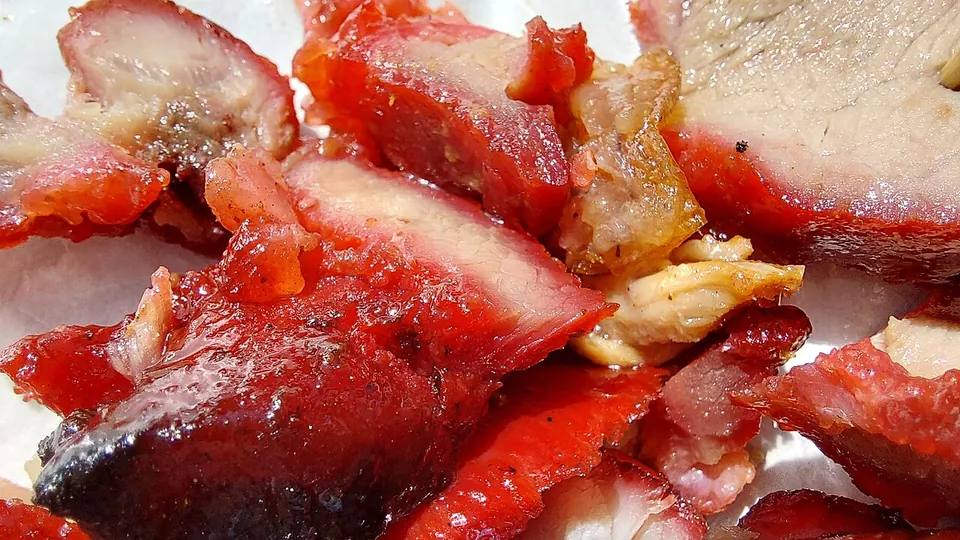
Char siu is a Cantonese roast pork: strips of meat are marinated, hung on a fork-shaped skewer, and roasted over charcoal. The name says as much—char (叉) is the skewer, siu (燒) is the roasting. Red yeast rice gives the surface its glossy red-brown color, malt sugar the sweet lacquer of the glaze, and soy sauce the savory base. All three had long been standard in Chinese kitchens; none needed to be carried from distant lands. In terms of ingredients, then, char siu was a dish that could have been made in any era.
What gave it shape as a single, named dish was the flowering of Guangdong's siu mei—the roast-meat shop trade. Ducks and pigs hung roasting in shopfronts, carved and sold by the piece; within that business the marinades and the heat of the hanging roast were refined, and the pork sweetened into the honey-glazed mat jap char siu. The shop culture matured in Guangzhou from the late Qing into the modern era, and char siu settled in alongside it, gradually, as an everyday dish. It was not invented in a single year by a single hand—it grew, little by little, under the eaves of the roast-meat shops.
By the early twentieth century the name is firmly in print, and it was in this same period that roast-meat cooks who had moved to Hong Kong refined the technique and spread the honey-glazed version.
How we know
Char siu is often given a grand pedigree: that it already appeared in a Zhou-dynasty court cookbook three thousand years ago. The claim turns up in food writing and in the press, yet not one source points to the actual Zhou text. The pedigree quietly folds two different things into one—the antiquity of roasting meat over fire in China, and the emergence of char siu as a distinct, finished Cantonese dish. Roasting meat is indeed old. That does not make a dish bearing the name char siu old.
The name enters the written record only in the twentieth century, and it is in this same period that roast-meat cooks who had moved to Hong Kong refined the craft and the honey-glazed char siu spread. There is no independent thread that carries the dish back in a single leap to the Zhou. The tale of a three-thousand-year court origin dresses the dish in a pedigree far older than the evidence allows; char siu's true face is a shop dish that Guangdong's roast-meat trade brought up in the modern age. Even so, the year the name first appears in print cannot simply be read as the year of its birth. Within the span from the late Qing into the modern era, as the roast-meat shop culture ripened in Guangzhou, char siu slowly took form—and that, for now, is the soundest line to draw.
The full set of origin theories and the detailed verification log — traceable all the way to their sources — are available on the Japanese edition.
See the full origin theories and verification log (Japanese) →
Related dishes
Shares the key ingredient
- TonkatsuJapanC
- Tacos al pastorMexicoB
- FeijoadaBrazilB
- Barbecue ribsSouthern United StatesC
- CurrywurstBerlin (Germany)B
- Twice-cooked reheated pork (Huiguorou precursor)Sichuan, ChinaC
- ChicharrónPeru / Latin AmericaB
- ChicharrónMexicoB
- ChicharrónColombiaB
- BaoziChinaC
- Chop sueyUSA (Cantonese diaspora) / Guangdong (China)C
- Cochinita pibilYucatán (Mexico)C
- LechonCebu (Philippines)C
- SaloUkraineC
- Bak kut tehSingaporeC
- GolonkaPolandC
- GyrosGreeceB
- EisbeinBerlin (Germany)C
- SchweinshaxeBavaria (Germany)C
- Japanese-style twice-cooked porkJapanB
- ManchamantelesPuebla (Mexico)C
- PernilPuerto RicoC
- ChoripánRío de la Plata (Argentina)C