All dishes / 東南アジア
Bak kut teh Period BOrigin theory CVerified
Some fields (dish name, region and gates) are shown from the Japanese-edition data.
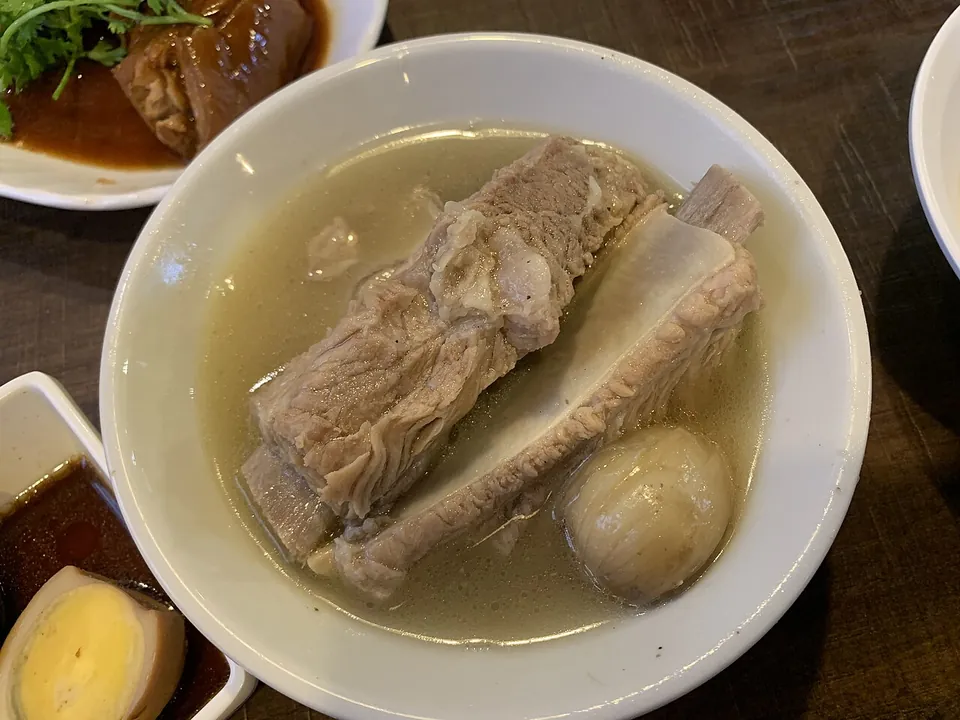
Bak kut teh is a restorative broth of pork ribs and pork simmered with medicinal herbs. A tidy story credits one shopkeeper with inventing both the dish and its name, yet newspaper records describe coolies slurping it in the port cities more than a decade before he supposedly did.
Verification highlight popular claim → verdict → evidence
Myth: the dish's name and creation are credited to Klang shopkeeper Lee Boon Teh, a story popularized around 2014. Verdict: refuted. A 1934 Nanyang Siang Pau newspaper article records bak kut teh already being sold to coolies in Singapore as early as 1925, well before Lee Boon Teh's postwar arrival in Klang. The name is more simply read as 'meat bone' (bak kut) plus 'tea' (teh), with no independent source tying it to any individual.
The three gates
- Ingredient-supply gate
- Pork and pork bones were a food custom carried by Chinese immigrants from southern China to the Straits Settlements; traditional Chinese medicinal herbs were obtained through trade.
- Cooking-technique gate
- Long, slow simmering to make a medicinal herbal broth.
- Venue gate
- A restorative dish for dockworkers and coolies in the Straits Settlements, later spreading to food stalls.
Overview
Bak kut teh took shape in the late nineteenth century in the Straits Settlements, the port towns of Singapore and Malaya. Despite the "teh" (tea) in its name, no tea leaves go into it: it is a fragrant pork broth, served either clear or dark.
Pork ribs and pork are the heart of the dish. The people of southern China, especially those from Fujian and Chaozhou, had long eaten pork and knew how to use every part of the animal down to the bone. When these southern Chinese migrants crossed the sea to settle in the Straits Settlements, they carried that habit of the table with them like so much luggage. Medicinal herbs such as dang gui, cassia bark, and star anise were easy to obtain at the trading ports, and white pepper and garlic sharpened the aroma.
Simmered slowly for hours, the rising steam and richness sustained the dock hands who hauled heavy loads, the laborers known as coolies. A bowl before a hard morning's work: out of that port life, bak kut teh grew into a hawker dish. A later newspaper recorded that by 1925 it was popular among Singapore coolies at a dollar eighty a bowl.
The dish wears different faces from place to place. The Fujian style is dyed dark with heavy soy sauce; the Chaozhou style is lighter in color and heavy on white pepper. That pale, pepper-forward version branched off later, once Sarawak white pepper circulated widely in the 1950s and 60s, while the darker Fujian version had taken root in the ports first. Under a single name, the origins of the people who migrated and the timing of when the spices arrived are written straight into the two lineages of flavor.
How we know
Bak kut teh comes with a well-made origin story. A shopkeeper in Klang (Port Klang) named Lee Boon Teh is said to have devised the broth, and the "teh" in its name is said to come from his. That account began circulating around 2014 and was added to shop signboards.
But the newspapers betray it. A 1934 article in the Nanyang Siang Pau records that in 1925, in Singapore, bak kut teh was a favorite among coolies at a dollar eighty a bowl. That is the earliest verifiable record so far. Lee Boon Teh is said to have moved to Klang only after the war, with dates given variously from 1938 to after 1945; either way, the newspaper mention runs more than a decade earlier. The very order of events forbids the claim that he named and invented it. The name is a plain compound of "bak kut" (pork bone) and "teh" (tea), and no independent record ties it to any one person. The tidy story was appended afterward as a shop's pedigree.
The question of the individual Lee Boon Teh is settled, but another remains open: where did it begin? Malaysia claims it was devised for the coolies of Klang, while Singapore holds up the Chaozhou-style version as its own. In 2009 a Malaysian tourism minister declared it a national dish, and the dispute flared. Records at the National Library Board of Singapore (Infopedia) and food-history checks even trace the arc of stylistic divergence: the dark Fujian version was already established by 1949, and the peppery Chaozhou version followed in the 1950s and 60s. Yet which port produced the first bowl is not settled, because the records of coolie life in those years are thin. What is certain is the lineage: this bowl is rooted in the restorative food of southern Chinese migrant coolies.
The full set of origin theories and the detailed verification log — traceable all the way to their sources — are available on the Japanese edition.
See the full origin theories and verification log (Japanese) →
Related dishes
Shares the key ingredient
- TonkatsuJapanC
- Tacos al pastorMexicoB
- FeijoadaBrazilB
- Barbecue ribsSouthern United StatesC
- CurrywurstBerlin (Germany)B
- Twice-cooked reheated pork (Huiguorou precursor)Sichuan, ChinaC
- ChicharrónPeru / Latin AmericaB
- ChicharrónMexicoB
- ChicharrónColombiaB
- BaoziChinaC
- Chop sueyUSA (Cantonese diaspora) / Guangdong (China)C
- Cochinita pibilYucatán (Mexico)C
- LechonCebu (Philippines)C
- SaloUkraineC
- GolonkaPolandC
- GyrosGreeceB
- EisbeinBerlin (Germany)C
- SchweinshaxeBavaria (Germany)C
- Japanese-style twice-cooked porkJapanB
- ManchamantelesPuebla (Mexico)C
- PernilPuerto RicoC
- ChoripánRío de la Plata (Argentina)C
- Char siuGuangdong (China)C