All dishes / 西欧
Schweinshaxe Period COrigin theory CVerified
Some fields (dish name, region and gates) are shown from the Japanese-edition data.
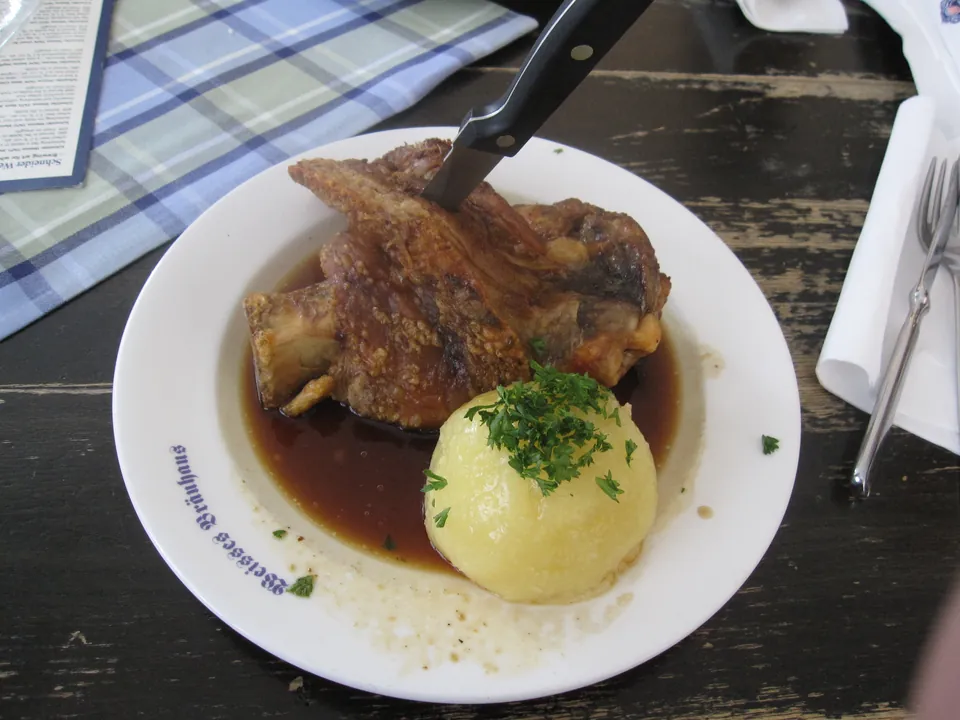
A thick rind roasted to a deep amber, and beneath it meat that falls apart at the touch — this hunk of roasted pork shank, the pride of the Bavarian beer hall, has no founding story about who first made it. It is a regional knack for using up a cheap, tough cut, grown up without leaving a name or a date.
Verification highlight popular claim → verdict → evidence
A pork shank roasted until the skin turns crackling-crisp, this Bavarian dish grew out of the region's long tradition of pig farming and nose-to-tail cooking rather than any single inventor. It belongs to a family of Central European pork-shank dishes that also includes Poland's golonka and northern Germany's Eisbein, distinguished by roasting rather than curing and boiling.
The three gates
- Ingredient-supply gate
- Pork shank was native (part of the pig-raising culture of southern Germany/Bavaria); no ingredient acted as a limiting factor, so the dish developed gradually without an ingredient constraint.
- Cooking-technique gate
- Skin-on pork shank is roasted until the surface turns crisp.
- Venue gate
- An everyday dish of southern Germany (Bavaria) that became a specialty of beer halls and taverns.
Overview
Schweinshaxe is a dish of southern Germany, from Bavaria: the shank of a pig's hind leg, from the shin up to the knee joint, roasted skin-on for two to three hours. The shank is sinewy and tough, a cheap cut that is hard to eat as it is; but cooked slowly at a low temperature, the stiff meat turns soft and yielding while the skin on the surface loses its moisture and bakes hard and glassy. The contrast between this crisp, browned crackling (the Kruste) and the moist meat within is the heart of the dish. It is served with a potato dumpling (Knödel) or sauerkraut, and with beer.
The pig was a familiar domestic animal kept from old times across central Europe, and the farming villages of southern Germany kept them as a matter of course. To use up the pig one had on hand from snout to tail, without waste — to bring even an awkward cut like the shank to the table by some contrivance — this dish belongs to that thrifty way of life. The word at the centre of the name Schweinshaxe, and of the Bavarian dialect form Haxn, is Haxe, an anatomical term for the sinews of the hind leg and the knee joint. It is said to come from the practice of hanging a slaughtered animal by the tendon of the hind leg. The name, in other words, is not a grand origin story but a plain word for the very cut of meat it uses.
An everyday farm dish, it came to be widely known only after the industrialisation and urbanisation of the nineteenth century. As people gathered into the cities and the beer hall and beer garden became the face of the town, Schweinshaxe changed its standing to a tavern specialty, and in time became a fixture of the Oktoberfest, known around the world.
How we know
This dish has no "drama of origins" — no anecdote of a famous restaurant, no tale of a celebrated cook's invention. That is not an oversight in the record; it is the nature of the dish itself. How to make a cheap, tough cut taste good was a question answered separately, with no one teaching anyone, in place after place across the pig-keeping lands of central Europe. Northern Germany has Eisbein, the same pork shank cured and boiled; Poland has golonka; the Czech lands have koleno. All handle the same cut — regional dishes that are, so to speak, siblings.
Did they, then, spread from one place to all the rest? It is tempting to think so, but no source shows it. It is more natural to see the knowledge of how to make a pork shank edible taking root separately in each part of central Europe, so that similar dishes came to stand side by side. The clue that tells the siblings apart lies in the method. Where Eisbein is cured and boiled, Schweinshaxe is prepared with salt or a marinade and then roasted, its skin crisped. The English-language Wikipedia, too, sets the two down together as the same cut treated by different methods, and does not claim that either is the ancestor of the other.
Trace the name, and the answer lands in the same place. Haxe is an old part-name for the tendons and joint of the hind leg, which German dictionaries (DWDS and Duden) carry back to Old High German hāhs(e)na, "the tendon of the foot." It is built exactly as the Polish golonka is, from goleń, "shin." What the name tells us is not a great inventor but only the fact that this is meat from the shank. The word Schweinshaxe appears at the latest in a Bavarian household cookbook of 1871 (Marie Schandri's Regensburger Kochbuch, fourth edition); but there the shank is thrown in to simmer with a stew — a record of the cut as an ingredient, not of the crisp-skinned roast as a showpiece. Naming a thing is not the same as inventing it, and the roasted specialty of the beer hall belongs, as the sources have it, to the urban age that came after. The question that seeks a single origin here simply hangs, quietly, in the air.
The full set of origin theories and the detailed verification log — traceable all the way to their sources — are available on the Japanese edition.
See the full origin theories and verification log (Japanese) →
Related dishes
Cross-links Sister dishes & same-name dishes (separate lineage)
Shares the key ingredient
- TonkatsuJapanC
- Tacos al pastorMexicoB
- FeijoadaBrazilB
- Barbecue ribsSouthern United StatesC
- CurrywurstBerlin (Germany)B
- Twice-cooked reheated pork (Huiguorou precursor)Sichuan, ChinaC
- ChicharrónPeru / Latin AmericaB
- ChicharrónMexicoB
- ChicharrónColombiaB
- BaoziChinaC
- Chop sueyUSA (Cantonese diaspora) / Guangdong (China)C
- Cochinita pibilYucatán (Mexico)C
- LechonCebu (Philippines)C
- SaloUkraineC
- Bak kut tehSingaporeC
- GyrosGreeceB
- Japanese-style twice-cooked porkJapanB
- ManchamantelesPuebla (Mexico)C
- PernilPuerto RicoC
- ChoripánRío de la Plata (Argentina)C
- Char siuGuangdong (China)C