All dishes / ラテンアメリカ
Feijoada Period BOrigin theory BVerified
Some fields (dish name, region and gates) are shown from the Japanese-edition data.
The most famous origin story for feijoada holds that enslaved people created it by simmering the scraps their masters threw away with black beans. It is a modern legend with no documentary support. The dish's real ancestry lies in the bean-and-pork stews of northern Portugal.
Verification highlight popular claim → verdict → evidence
The popular story that feijoada arose when enslaved people simmered a master's discarded pork scraps with black beans is a myth that culinary historians (Camara Cascudo, Ditadi) reject for lack of any supporting record. The stronger account: a Portuguese bean-and-pork stew tradition from northern Portugal (Tras-os-Montes, Extremadura), akin to cassoulet, was brought over and 'Brazilianized' by substituting the New World's native black bean. The dish is first documented in print in an 1827 Recife restaurant advertisement -- an urban dish from the start, not a plantation-kitchen invention, which further undercuts the leftover-scraps legend.
The three gates
- Ingredient-supply gate
- Black beans are native to South America; pork was brought by the Portuguese (from around 1500). Both ingredients being available together sets the floor at the colonial period
- Cooking-technique gate
- Long, slow simmering and salt-curing of meat for preservation
- Venue gate
- A stew that spread through colonial-era households and plantation tables
Overview
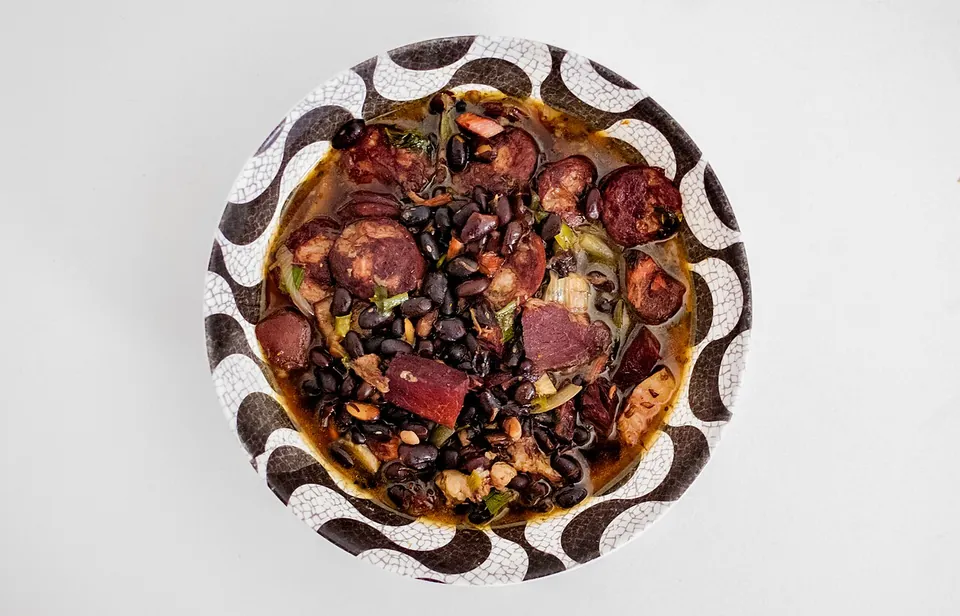
Feijoada, often called Brazil's national dish, is a long-simmered stew of black beans and various cuts of pork. It took shape during Brazil's colonial period, between the sixteenth and nineteenth centuries.
One of its two anchors, the black bean, is a crop long native to South America and a familiar presence on Brazilian tables from early on. The other, pork, arrived with the Portuguese from around 1500 onward. Until pigs crossed the Atlantic and settled onto the farms and into the households of the colony, a dish that simmers beans and pork together in one pot had no way of coming into being. Genetic research on Iberian-descended pigs confirms this crossing of Old World swine to Brazil.
Technically, the dish rests on two familiar practices: salting to preserve meat, and long, slow cooking to soften tough beans and humble cuts. Such stews spread first through the households and farms of colonial society, and later moved into the eateries of the cities. In the northeastern city of Recife in the early nineteenth century, inns and restaurants went so far as to advertise "feijoada à brasileira" in the newspapers as a signature dish.
Popular lore places the dish's birth in the slave kitchen, but the oldest form the records actually reach is a plate served for money in an urban restaurant.
How we know
Feijoada carries one widely circulated origin story. An enslaved cook, it is said, took the discarded parts of a slaughtered pig, the ears, feet and tail, and simmered them with black beans, and from this the dish was born. This "scraps" account has been repeated wherever Brazilian national identity is discussed, and it has worked its way into tourist guides and menu notes until it became firmly established.
Yet no contemporary record supports the anecdote. The food historian Luís da Câmara Cascudo, in his História da Alimentação no Brasil, and the National Archives scholar Ditadi found neither a documentary trace nor a culinary lineage placing feijoada in slave kitchens or on plantations. Both dismissed the story as a modern folkloric romanticization of slavery.
The name feijoada first appears in print on 2 March 1827, in an advertisement in the Recife newspaper Diário de Pernambuco for the inn Águia d'Ouro, promising "excelente feijoada à brasileira." An 1833 advertisement for a theater hotel sits in the same urban dining context. The earliest records come not from the plantation kitchen but from the city restaurant that charged its customers for the meal.
Where, then, can the origin be traced? Research points to the stews of northern Portugal, in regions such as Trás-os-Montes and Estremadura, where beans and humble cuts of pork are cooked together. A cousin of the French cassoulet, this stew was carried to Brazil and, with the black beans of the New World substituted in, became a dish of the land. Rodrigo Elias's study, Feijoada: a short history of an edible institution, supports this account.
The Old World pig reached Brazil through colonial trade around 1500, and feijoada can only be later than that. While the tale of the leftover scraps lacks any record, the lineage of the European stew and the oldest known plate, the one that surfaced in a city restaurant, tie the dish's origins back to the bean-and-pork stew of Portugal.
The full set of origin theories and the detailed verification log — traceable all the way to their sources — are available on the Japanese edition.
See the full origin theories and verification log (Japanese) →
Related dishes
Cross-links Sister dishes & same-name dishes (separate lineage)
Shares the key ingredient
- TonkatsuJapanC
- Tacos al pastorMexicoB
- Barbecue ribsSouthern United StatesC
- CurrywurstBerlin (Germany)B
- Twice-cooked reheated pork (Huiguorou precursor)Sichuan, ChinaC
- ChicharrónPeru / Latin AmericaB
- ChicharrónMexicoB
- ChicharrónColombiaB
- BaoziChinaC
- Chop sueyUSA (Cantonese diaspora) / Guangdong (China)C
- Cochinita pibilYucatán (Mexico)C
- LechonCebu (Philippines)C
- SaloUkraineC
- Bak kut tehSingaporeC
- GolonkaPolandC
- GyrosGreeceB
- EisbeinBerlin (Germany)C
- SchweinshaxeBavaria (Germany)C
- Japanese-style twice-cooked porkJapanB
- ManchamantelesPuebla (Mexico)C
- PernilPuerto RicoC
- ChoripánRío de la Plata (Argentina)C
- Char siuGuangdong (China)C