All dishes / 西欧
Eisbein Period COrigin theory CVerified
Some fields (dish name, region and gates) are shown from the Japanese-edition data.
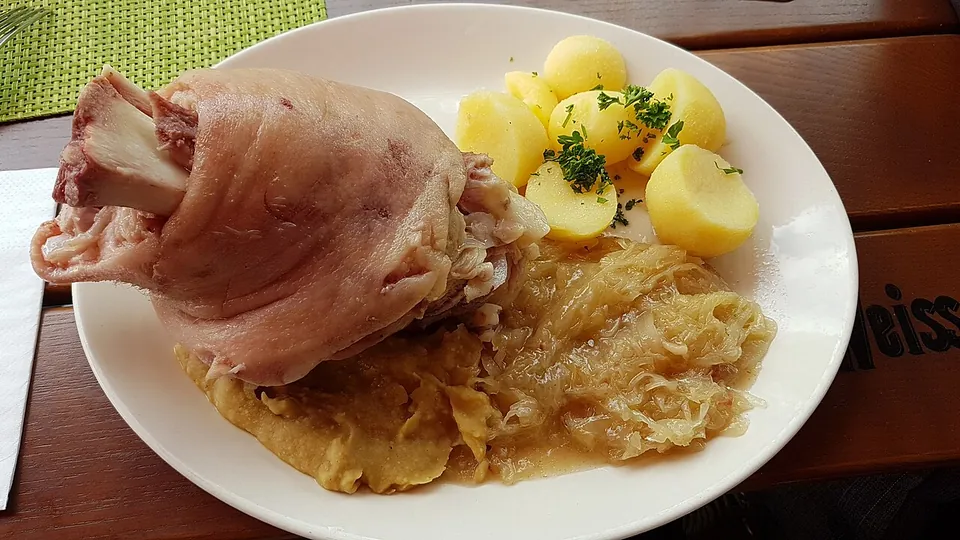
"Eisbein" — literally "ice leg." The odd name is often explained by the idea that the tubular bone of a pig's leg served as the blade of a primitive skate. But a strong rival reading holds it comes instead from an old technical word for the hip bone, and the matter is unsettled. The dish itself is a plain one: a lightly cured pork shank, simmered slowly — a staple of the Berlin tavern.
Verification highlight popular claim → verdict → evidence
Popular etymology traces the name Eisbein to skate blades once made from pig shin bones, but linguists trace it instead to a medieval term for the hip/pelvis. Either way, the dish itself is a gradual outgrowth of long-standing pork-shank husbandry rather than a single invention. (Main sources: DWDS etymological dictionary, Wikipedia)
The three gates
- Ingredient-supply gate
- Pork shank was already native to central Europe's traditional pig husbandry; with no ingredient acting as a bottleneck, the dish simply accreted over time.
- Cooking-technique gate
- The shank is lightly salted (brined), then simmered for a long time.
- Venue gate
- A common dish of northern Germany (Berlin and elsewhere), later a tavern specialty.
Overview
Eisbein is a north German dish of pork shank — the section from the lower leg to the joint — lightly cured and simmered for a long time until tender. In Berlin it is served with pease pudding (Erbspüree) or sauerkraut and has long been a signature of the beer tavern. The meat around the bone falls away easily, and the skin is smooth and gelatinous.
The pork shank at its heart is a long-established local ingredient. The pig has been kept in Europe since prehistoric times, and in the villages of central Europe people raised their own and ate every part of the animal, a way of life that lasted for centuries. The shank and the joint are tough, cheap cuts, but salted and simmered at length they turn into something remarkably smooth and rich. Curing and long simmering were both preserving and cooking skills that the kitchens of this region had always possessed. So Eisbein has no story of a single inventor. As a humble braise that used up a cheap cut without waste, it took shape gradually from the Middle Ages onward.
The name "Eisbein" is clearly attested in writing in the nineteenth century, when it earned its place as a specialty alongside the tavern culture of Berlin. When the name was written down and when the dish was eaten are two different things: cured, simmered shank had been on the table long before.
Dishes using the same pork shank are found across central Europe. Schweinshaxe in Bavaria to the south, golonka in Poland, koleno in the Czech lands — all are siblings to Eisbein. What sets them apart is the method. Where Eisbein is cured and boiled, Schweinshaxe is roasted, its skin on the shank crisped and browned. The same cut, in one place simmered soft, in another roasted crisp: here the character of the northern and southern kitchens divides plainly.
How we know
In talking about Eisbein, the best part may be less the dish than the argument over its strange name, "ice leg."
The widely known explanation traces it to a skate bone. The tubular bone of the pig's shank was used, it is said, as the blade of a primitive skate for gliding over ice — a word of the same family as Norwegian islegg and Swedish isläggor, both meaning "ice bone." The German etymological dictionary DWDS offers this as its main reading, and it has been retold often as a vivid origin.
But against it stands an explanation of an entirely different kind. The word īsbēn, in the old Low Saxon of the tenth century, was a technical term that hunters and physicians used for the region of an animal's hip bone (the ischium). On this account its true origin is a loanword that came in from Greek ischíon through Latin ischia, and the talk of ice bones is a later guess that grew up around the word once its first sense was forgotten. Both readings have dictionary support, and the question is still unsettled. The pleasure here lies not in awarding victory to one side but in the fact that two explanations stand together.
There is a second popular tale, this one about lineage: that a German cured-and-boiled pork like Eisbein came first, and that Poland took it up and made golonka. But no independent source shows such a one-way passage. What is closer to the truth is that the old pig-keeping of central Europe, and the humble wisdom of eating every part, each arrived on its own at similar dishes in place after place. Even an English-language encyclopaedia sets Eisbein and golonka side by side as "similar dishes," without saying which came first. Eisbein in the north, Schweinshaxe in the south, golonka in the east stand not as senior and junior but as equal siblings, each rooted in its own soil.
The full set of origin theories and the detailed verification log — traceable all the way to their sources — are available on the Japanese edition.
See the full origin theories and verification log (Japanese) →
Related dishes
Cross-links Sister dishes & same-name dishes (separate lineage)
- Sister dish (shared ancestor)GolonkaPolandC
- Sister dish (shared ancestor)SchweinshaxeBavaria (Germany)C
Shares the key ingredient
- TonkatsuJapanC
- Tacos al pastorMexicoB
- FeijoadaBrazilB
- Barbecue ribsSouthern United StatesC
- CurrywurstBerlin (Germany)B
- Twice-cooked reheated pork (Huiguorou precursor)Sichuan, ChinaC
- ChicharrónPeru / Latin AmericaB
- ChicharrónMexicoB
- ChicharrónColombiaB
- BaoziChinaC
- Chop sueyUSA (Cantonese diaspora) / Guangdong (China)C
- Cochinita pibilYucatán (Mexico)C
- LechonCebu (Philippines)C
- SaloUkraineC
- Bak kut tehSingaporeC
- GyrosGreeceB
- Japanese-style twice-cooked porkJapanB
- ManchamantelesPuebla (Mexico)C
- PernilPuerto RicoC
- ChoripánRío de la Plata (Argentina)C
- Char siuGuangdong (China)C