All dishes / サブサハラ・アフリカ
Moambe Period COrigin theory CVerified
Some fields (dish name, region and gates) are shown from the Japanese-edition data.
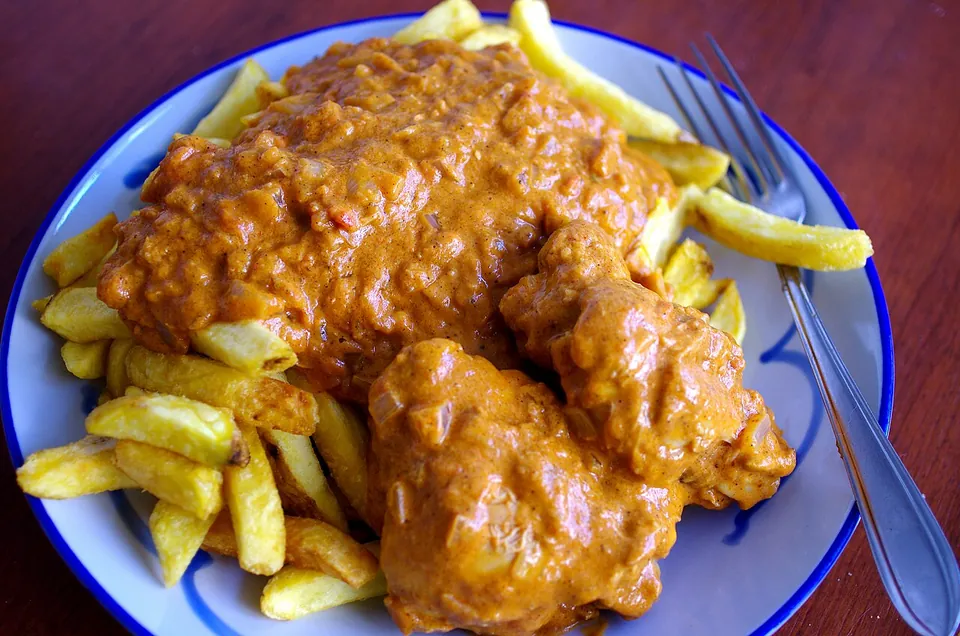
A Congolese stew that carries the persistent claim that "Belgian colonists invented it." Yet both the dish's name and its substance were rooted in Central Africa long before the colonial era.
Verification highlight popular claim → verdict → evidence
Popular claim: moambe was invented by Belgian colonists. Verdict: refuted — moambe is an indigenous Congo Basin stew of palm-nut pulp and native chicken; the word mwamba is independently rooted in multiple Bantu languages and attested in print by 1887 (Bentley's Kikongo dictionary), well before colonial cuisine could have introduced it. Colonial-era contributions are limited to later additions like peanut butter and New World chilies/tomatoes, not the dish's core. Key sources: Bentley, Dictionary and Grammar of the Kongo Language (1887); Iron Age plant subsistence in the Inner Congo Basin.
The three gates
- Ingredient-supply gate
- Oil palm (palm oil/palm nuts) and chicken are both native to Central Africa; chili pepper is a later New World addition.
- Cooking-technique gate
- Pressing and simmering palm nut pulp.
- Venue gate
- A home and festival stew.
Overview
When and where it took shape
Muamba (moambe) is a dish of chicken simmered in the thick sauce pressed from the pulp of oil-palm fruit (palm nuts). It spread from the Congo River basin across to Angola, and today holds the standing of a national dish in the Democratic Republic of the Congo, the Republic of the Congo, Angola, and Gabon.
What goes into it had all long been present in Central Africa. The oil palm is an old plant, deeply established in the land, and pressing oil from its fruit reaches back into the late Holocene, thousands of years ago; archaeobotanical remains show that Bantu-speaking peoples in the Congo basin used the oil palm from early times. Chickens too reached Central Africa within the first millennium CE and became a familiar farmyard bird kept in the villages. Both the base of the sauce and the meat to be simmered had long been at hand.
The heart of the method lies in a single sequence: pressing the palm-nut pulp to draw off a sauce, and slowly simmering the chicken in it. It is a home and festival stew, complete with what the land itself yields. Chili and tomatoes, ingredients of New World origin, are sometimes added, but these are a later layer that settled on top after the Atlantic exchange, distinct from the foundation of palm nuts and chicken.
The dish's very name is deeply rooted in the language of the land. In Lingala and Kikongo, mwamba means sauce, stew, or gravy, and in Kimbundu mu'amba likewise means a stew or gravy. That the same root lodges independently in several Bantu languages speaks to a stew that was no one person's invention but was long shared across a wide region.
How we know
Muamba often carries the claim that "Belgian colonists invented it" or that poulet à la moambe was a colonial-era creation. This notion does not hold.
The oil palm that gives the sauce its base and the chicken that is simmered in it were both present in Central Africa long before colonization arrived. Pressing palm nuts and simmering them is an old practice the people of the land handed down by word of mouth. That the name mwamba is rooted as "stew, sauce" in Kikongo, Lingala, and Kimbundu alike also shows that this was no dish brought in from outside. The first appearance in writing is in the Kikongo dictionary compiled by the missionary Bentley in 1887, where mwamba already stands as an entry meaning "gravy, soup, stew." The dish was on the land well before that.
What, then, did the colonial period bring? The spread of peanut butter, and the practice of adding chili and tomatoes, were additions of the modern age. But these were not the core of the dish, only ornament laid on top.
At the same time, no account survives of who first made it, or when. There is no single inventor, no year of origin, no founding anecdote, and nothing to be found either to support or to dismiss such a story. All that can be said is a range: sometime after the ingredients were on hand and before the written record begins. That the date cannot be fixed to a single point, and that no inventor can be named, is itself a sign that this dish was not a colonial invention but something that struck deep roots in the land.
The full set of origin theories and the detailed verification log — traceable all the way to their sources — are available on the Japanese edition.
See the full origin theories and verification log (Japanese) →
Related dishes
Lineage Family, predecessor, variants
Cross-links Sister dishes & same-name dishes (separate lineage)
Shares the key ingredient
- Chicken tikka masalaUnited KingdomC
- Wat (pre-chili Ethiopian stew, earlier layer)Ethiopian HighlandsC
- AjiacoBogotá, ColombiaB
- Jerk chickenJamaicaC
- Soto ayamJava (Indonesia)C
- ShkmeruliGeorgiaB
- Khao man gaiThailandB
- Hainanese chicken riceHainan (China) → SingaporeC
- Chicken yassaSenegalC
- Chicken KievKyiv (Ukraine)C
- Circassian chicken (Çerkez tavuğu)Turkey (Ottoman court) / CaucasusB
- Sopa de limaYucatán (Mexico)C
- White cut chickenGuangdong (China)C
- Ohn no khao swèMyanmarC
- Kedjenou layer (canari steam-braise)Côte d'IvoireC
- WaterzooiFlanders (Belgium)C
- Soup currySapporo (Japan)B