All dishes / 東南アジア
Soto ayam Period COrigin theory CVerified
Some fields (dish name, region and gates) are shown from the Japanese-edition data.
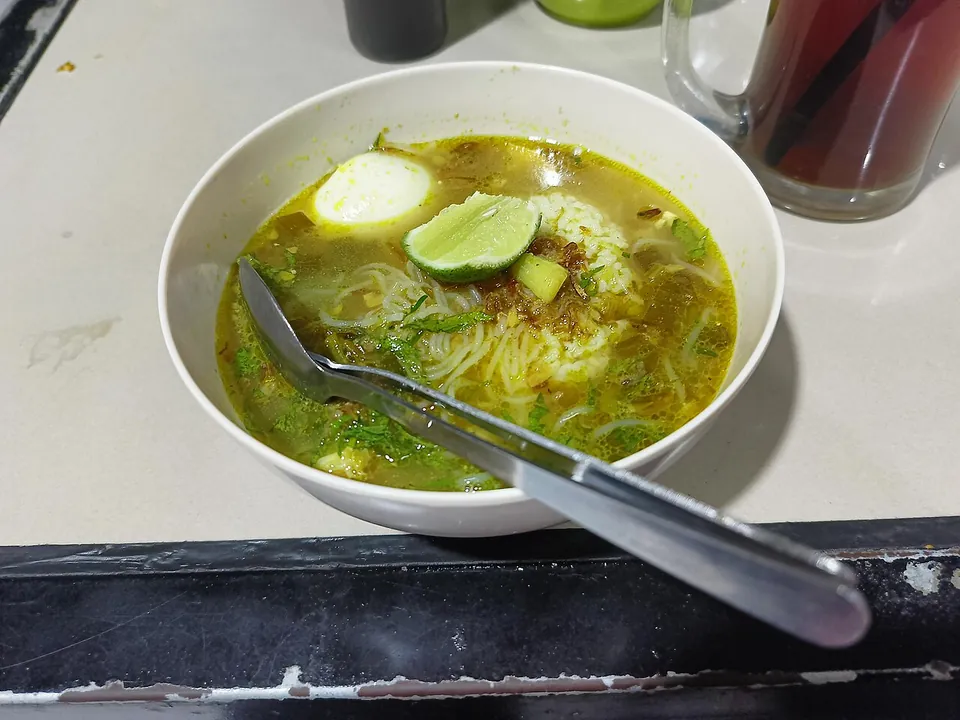
Steam rising from a Javanese street stall, a chicken soup stained golden with turmeric: this is soto ayam. It is sometimes billed as a dish with two thousand years of history, yet the oldest written record reaches back no further than the early twentieth century. No single inventor and no single birthplace can be named, and that very uncertainty mirrors the mingling of peoples who met across the seas.
Verification highlight popular claim → verdict → evidence
A viral claim of a '2,000-year history' (historycollection.com) has no independent primary-source backing and conflicts with both the earliest textual record (Van de Burg, 1904) and the documented transmission channel (Chinese immigrants, Semarang, VOC era 17th c.) -- rejected as clickbait exaggeration. Two scholarly theories remain open and unresolved: a Chinese origin from the Hokkien soup caudo (beef tripe), per Lombard, versus a Chinese-Indian-Javanese fusion (Journal of Ethnic Foods, 2020).
The three gates
- Ingredient-supply gate
- Chicken, turmeric, and lemongrass are all native to Southeast Asia; no limiting ingredient constrains the earliest possible date.
- Cooking-technique gate
- Sauteed spice paste (bumbu) simmered into a broth.
- Venue gate
- Street-stall (warung) and itinerant-vendor everyday food.
Overview
Soto ayam is a chicken soup especially beloved on the island of Java, in Indonesia. Within the broad family of soups called soto, it is the one made with chicken (ayam). A paste of ground spices, the bumbu, is fried to release its aroma, and chicken and water are added to draw a broth. Turmeric dyes the liquid a deep gold, and lemongrass lends a fresh scent.
The chicken, turmeric, and lemongrass this soup depends on are all long-established Southeast Asian ingredients, present in the markets and kitchens of the region from early on. Onto a land where the makings were already at hand, it was the movement of people that drew in today's golden soup. In the seventeenth century, in the era when the Dutch East India Company spread its trade, port towns on Java's north coast such as Semarang were home to people who had settled from China, many from Fujian. Their kitchens and the local market stood side by side in the same town, and daily food mingled through peddlers and stalls; out of that traffic of people, soto spread as a soup of the common table.
Behind soto taking root as everyday food through the stalls (warung) and street peddlers lies this crossing of peoples. The way of making soup that settlers from China carried in met the spices and herbs of Java, and spread while shifting shape to suit each place's ingredients and economy. The rice vermicelli (bihun) and fried garlic served with it keep the trace of that Chinese origin. In the heavy use of turmeric, some see an influence reaching from the direction of India.
Chicken soto, soto ayam, settled into daily life as street-stall food across the period from early modern times into the twentieth century. Rather than a single invention, today's golden soup is the outcome of several culinary traditions, gathered in port towns, dissolving into one another over a long stretch of time.
How we know
Reading pieces circulate on the internet that describe soto ayam as a dish with two thousand years of history. But no contemporary record supports that bold figure. The oldest written trace of soto is a good deal more modest. In 1904 the colonial-era physician Van de Burg set down a line noting that native Javanese made a broth they called soto, and that remains, for now, the earliest record of its kind. For soto ayam made with chicken specifically, the written appearances come later still, in a Sundanese cookbook of the 1930s and a cookery book of the 1940s. Yet these mark when the dish was written down, not when it was born. Long before it reached print, soto must have been made by word of mouth in kitchens and at stalls, and the figure of two thousand years is only an exaggeration taking advantage of that gap in the record.
Leaf through the Dutch cookbooks of the same colonial period and no recipe for soto turns up either. That it went unrecorded in the books of the ruling side speaks, in its own way, to the dish's character. Soto was passed hand to hand among the people of the market and the stall rather than through print, food of the common table rooted in the land.
Over its origin, two accounts stand side by side. One looks to China, tracing soto back to the offal soup of Fujianese settlers who lived in the port town of Semarang around the seventeenth century; that stew, meeting the local spices of Java, is said to have become today's soto. The Chinese remnants of rice vermicelli and fried garlic, and the name soto, which can be traced to Hokkien, lend weight to this view. The other does not assign soto to a single origin. Chinese technique, the use of turmeric said to come from India, and Java's own broth and herbs, these mingled in the coastal towns to make soto, on this reading. The countless soto that differ from region to region are explained as reflecting each place's ingredients and way of life.
Neither of these is a fake set against a true one. The difference is whether one emphasizes a Chinese soup as the starting point or takes the mingling of several traditions as the origin itself, and both point to the same ground: the crossing of peoples gathered in port towns. So for soto ayam, no single parent, no single homeland, and certainly no two-thousand-year age can be named. A bowl that people crossing the seas each brought a little to, that mingling is the true parentage of this golden soup.
The full set of origin theories and the detailed verification log — traceable all the way to their sources — are available on the Japanese edition.
See the full origin theories and verification log (Japanese) →
Related dishes
Shares the key ingredient
- Chicken tikka masalaUnited KingdomC
- Wat (pre-chili Ethiopian stew, earlier layer)Ethiopian HighlandsC
- AjiacoBogotá, ColombiaB
- Jerk chickenJamaicaC
- ShkmeruliGeorgiaB
- Khao man gaiThailandB
- Hainanese chicken riceHainan (China) → SingaporeC
- MoambeCongo (Central Africa)C
- Nyembwe chicken (Poulet nyembwe)Gabon (Central Africa)C
- Chicken yassaSenegalC
- Chicken KievKyiv (Ukraine)C
- Circassian chicken (Çerkez tavuğu)Turkey (Ottoman court) / CaucasusB
- Sopa de limaYucatán (Mexico)C
- White cut chickenGuangdong (China)C
- Ohn no khao swèMyanmarC
- Kedjenou layer (canari steam-braise)Côte d'IvoireC
- WaterzooiFlanders (Belgium)C
- Soup currySapporo (Japan)B