All dishes / 北米
Barbecue ribs Period BOrigin theory CVerified
Some fields (dish name, region and gates) are shown from the Japanese-edition data.
The word "barbecue" comes from the French for "beard to tail" (barbe à queue)—so goes a witty story often told, but it is a later pun, and the true origin lies in the language of the Indigenous peoples of the Caribbean. The technique of smoking and its name came from Native peoples, the pigs that were smoked came from colonists, and the skill that grew it into a Southern cuisine came from enslaved Black pitmasters.
Verification highlight popular claim → verdict → evidence
Myth: the word 'barbecue' derives from French barbe à queue ('beard to tail'). Verdict: rejected by the OED as an 'absurd conjecture'; the true origin is Taíno/Arawak barabicu, transmitted through Spanish barbacoa, with English usage first attested in 1657 and 1661. Enslaved Black pitmasters were the ones who built Southern barbecue into a cuisine. Key sources: OED (barbacoa); Robert F. Moss, Barbecue (2010/2020); Adrian Miller, Black Smoke (2021).
The three gates
- Ingredient-supply gate
- Pork is not native; colonists brought it from the 16th century onward (limiting factor). Spices and molasses for the sauce were trade goods.
- Cooking-technique gate
- The limiting factor is the smoking technique derived from the Caribbean Taíno's barbacoa (low, slow cooking over fire and smoke on a wooden frame).
- Venue gate
- outdoor community gatherings / common people / street stalls and specialty shops / rooted in the Southern Black community
Overview
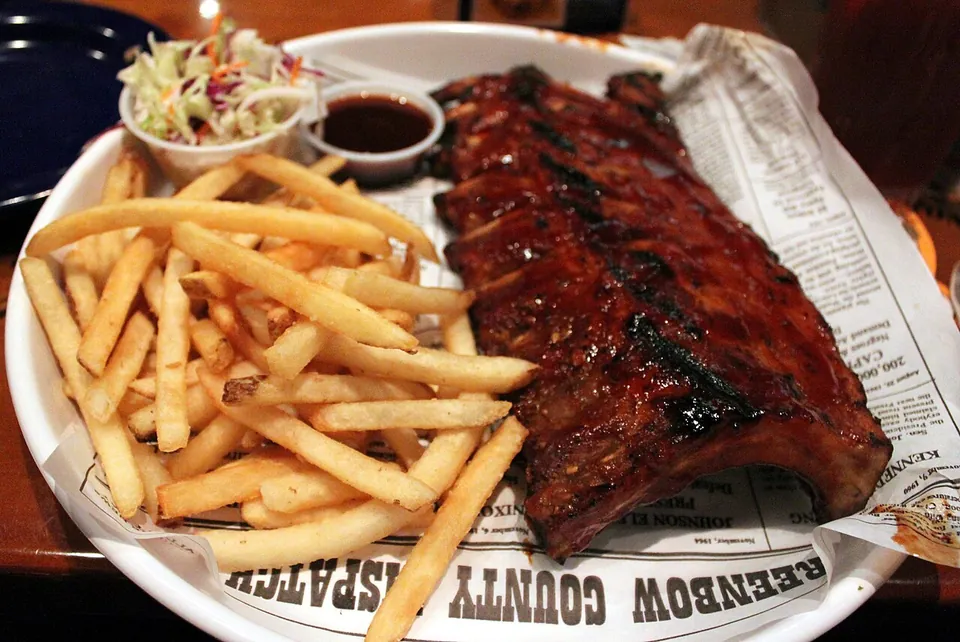
Barbecue ribs are an American Southern dish in which pork ribs are cooked slowly over low heat and smoke for a long time. Behind the single plate, three streams that came from entirely separate places meet.
The first is the pig itself. Pigs were not a livestock native to North America. They were brought by European colonists who crossed the sea, and by the time Hernando de Soto's expedition landed in Florida in 1539, pigs were already beginning to enter the Southeast. The molasses and spices for the sweet sauce were also carried in from outside through trade. Only once pigs had spread through the South was the ground laid for a dish built on roasting pork.
The second is the technique of smoking and the name "barbecue." This goes back to the Taíno people of the Caribbean, who built a wooden frame and cooked meat over it slowly with smoke and low heat. The Spanish saw and recorded this method, writing it down as "barbacoa." The word itself derives from the Taíno "barabicu," meaning the wooden frame. It entered English in barbacoa-type spellings, its form visible in Richard Ligon's account of 1657 and Edmund Hickeringill's of 1661. In time this smoking method blended with the Native North American practice of digging pits to roast meat.
The third is the people who raised this into a Southern culinary culture. It was enslaved Black pitmasters who, on the plantations, actually dug the pits, split the wood, and roasted whole hogs. From the late seventeenth into the eighteenth century, Native, European, and African techniques came together in their hands, and it was Black communities who carried the heart of Southern barbecue. The outdoor gathering where people crowded around a pit and shared the meat spread in time as soul food, and further as an American cookout eaten across the whole country.
How we know
There is a witty account of the word "barbecue" still fondly repeated. It comes, the story says, from the French 'barbe à queue,' "beard to tail"—because the hog is roasted whole from head to tail. It sounds good and seems plausible enough. But it is nothing more than a later pun.
The Oxford English Dictionary dismisses the idea as an "absurd conjecture" resting on nothing but the sound. When the food historian John Shelton Reed traced it, he found the pun originated in an 1829 political jab, mocking supporters of Andrew Jackson as men who went "whole hog" at their barbecues—a made-up back-formation. And since a pig has no beard, the very explanation of "beard to tail" does not hold together.
The real source lies not in French but in the language of the Taíno people of the Caribbean. "Barabicu," the word for the wooden frame, passed through Spanish "barbacoa" into English, its first English appearances confirmed in Ligon's account of 1657 and Hickeringill's of 1661. The smoking technique itself also comes from this barbacoa—the method of cooking meat slowly over a wooden frame with smoke and low heat.
Once the etymology is set right, there is a further question not to be forgotten: who raised this technique into a Southern culinary culture? In his book 'Black Smoke' (UNC Press, 2021), the historian Adrian Miller argues that it was the enslaved Black pitmasters who dug the pits, split the wood, and roasted the pigs on the plantations who made Southern barbecue into a cuisine of its own. Where the technique came from (a Native word and a smoking method) and who raised it into a dish (Black pitmasters) are questions of different layers. Set the witty invention aside and place the dish where three streams meet—the pig brought from outside, the technique and name from Native peoples, and the hands of the Black South—and that is the way to read the making of barbecue ribs without mistaking it.
The full set of origin theories and the detailed verification log — traceable all the way to their sources — are available on the Japanese edition.
See the full origin theories and verification log (Japanese) →
Related dishes
Shares the key ingredient
- TonkatsuJapanC
- Tacos al pastorMexicoB
- FeijoadaBrazilB
- CurrywurstBerlin (Germany)B
- Twice-cooked reheated pork (Huiguorou precursor)Sichuan, ChinaC
- ChicharrónPeru / Latin AmericaB
- ChicharrónMexicoB
- ChicharrónColombiaB
- BaoziChinaC
- Chop sueyUSA (Cantonese diaspora) / Guangdong (China)C
- Cochinita pibilYucatán (Mexico)C
- LechonCebu (Philippines)C
- SaloUkraineC
- Bak kut tehSingaporeC
- GolonkaPolandC
- GyrosGreeceB
- EisbeinBerlin (Germany)C
- SchweinshaxeBavaria (Germany)C
- Japanese-style twice-cooked porkJapanB
- ManchamantelesPuebla (Mexico)C
- PernilPuerto RicoC
- ChoripánRío de la Plata (Argentina)C
- Char siuGuangdong (China)C