All dishes / 東欧
Shopska salad Period BOrigin theory BVerified
Some fields (dish name, region and gates) are shown from the Japanese-edition data.
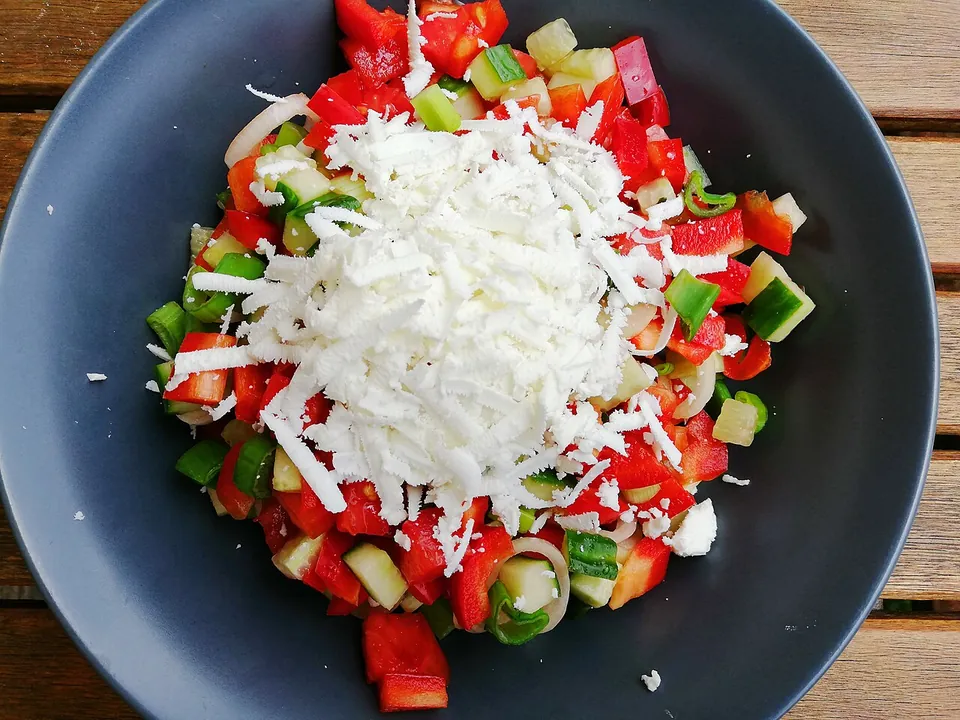
A plain salad whose red, white and green are said to mirror the Bulgarian flag — yet this is no old peasant dish. It was thought up in the 1950s by the state tourism board for the benefit of foreign visitors: a tradition made up after the fact.
Verification highlight popular claim → verdict → evidence
Shopska salad is often imagined as an old Balkan peasant dish, and its red-white-green colors are widely said to have been designed to echo the Bulgarian flag. Neither holds up: historical sources trace it to a 1950s invention by the state tourism agency Balkantourist, credited to Petar Doychev, and the flag-color match was a coincidence of using local ingredients, exploited for its patriotic appeal only after the fact.
The three gates
- Ingredient-supply gate
- Tomato and pepper are New World crops that only became established in the Balkans in the early modern period; the salad became possible once they took root there.
- Cooking-technique gate
- Raw vegetables chopped and dressed, topped with grated white cheese.
- Venue gate
- Popularized nationwide through state-run restaurants and tourism during the socialist era.
Overview
Shopska salad is a plainly built dish: diced tomato, cucumber and pepper, topped with white sirene cheese grated over it all. Its name is traced to the Shopi people of the region around the capital, Sofia, which lends it the air of a dish rooted in the peasant table.
But this simple plate rested on one precondition. Both the tomato at its heart and the pepper that colours it are New World crops. Only from the early modern period onward did they settle into the Balkans and become foods eaten raw and diced at the everyday table. Until the tomato had crossed the sea and taken hold in Balkan fields, a raw-vegetable salad of this kind had no way of coming into being. The preparation itself — chopping and tossing, grating on the cheese — asks little once the ingredients are at hand.
The dish in the form we know it actually appeared in the mid-twentieth century, and in socialist Bulgaria at that. The state tourism board built up resorts along the Black Sea coast and wanted a 'purely Bulgarian' dish to set before foreign guests. That setting is the stage on which the salad was raised to national prominence.
How we know
Shopska salad comes with a widely repeated story: that its three colours — red tomato, white cheese, green cucumber — were deliberately chosen to represent the Bulgarian flag, and that it is a good old peasant dish. But this origin tale is a later embellishment with no support in the sources.
Follow the food history and the dish turns out to be no ancient Balkan recipe but a creation of the socialist-era state tourism board, Balkantourist (ДСО Балкантурист), which devised it for foreign visitors around 1954 to 1956 at a restaurant, Chernomorets, at a resort near Varna on the Black Sea coast. Petar Doychev (1924–2019) is remembered as the man who invented and named it, giving the grated cheese a sharp kick and calling on 'the Shopi of Sofia to rejoice.' It first appeared in a state cookbook in 1956, and through the 1970s and 1980s it was officially embraced as a symbol of the national cuisine — a copybook case of what the historian Eric Hobsbawm called an invented tradition.
And the flag's three colours? The match of red, white and green is nothing more than a coincidence produced by using local ingredients that happened to be at hand. The tourism board seized on that coincidence after the fact as a convenient story to stir national feeling; it did not set out to reproduce the flag's colours from the start. The sources do not bear out the received notion of colour symbolism, and it falls away as a popular myth. The original aim of staging a 'purely Bulgarian' product, and the later fable of a flag-coloured design, are two things the sources keep clearly apart.
The full set of origin theories and the detailed verification log — traceable all the way to their sources — are available on the Japanese edition.
See the full origin theories and verification log (Japanese) →
Related dishes
Shares the key ingredient
- Pasta al pomodoroSouthern ItalyB
- Pizza MargheritaNaples (Italy)D
- ShakshukaMiddle East / North AfricaC
- Jollof riceWest AfricaC
- Butter chickenDelhi (India)C
- Khao SoiB
- GazpachoAndalusia (Spain)C
- LecsóHungaryC
- Chana masalaNorth India (Punjab)C
- RatatouilleProvence, France (Nice)C
- Thieboudienne (ceebu jën)SenegalC
- ChakalakaSouth AfricaC
- KedjenouIvory CoastB
- Caprese saladCapri (Italy)C
- SaloonaPersian Gulf (Bahrain and Kuwait)C
- Shan khauk hswè (Shan noodles)Myanmar (Shan State)C
- American pizzaUnited StatesC
- FrancesinhaPorto (Portugal)D
- ChakhokhbiliGeorgia (Caucasus)C
- KachumberGujarat (Western India)C
- SalmorejoAndalusia (Spain)C
- Greek salad (horiatiki)GreeceC
- Melanzane alla parmigianaItalyC