All dishes / 南アジア
Butter chicken Period AOrigin theory CVerified
Some fields (dish name, region and gates) are shown from the Japanese-edition data.
At Moti Mahal, the famed Delhi restaurant, one cook devised it—so the birth of butter chicken has been told. Yet neither that cook's name nor the exact year is backed by any contemporary record, and to this day a Delhi court is deciding who the parent of the dish really was.
Verification highlight popular claim → verdict → evidence
The widely told story credits Kundan Lal Gujral of Delhi's Moti Mahal (opened 1947) with inventing butter chicken by reworking leftover tandoori chicken in a tomato-butter-cream gravy, but no contemporary record documents the invention -- the founder never wrote down the recipe, and Madhur Jaffrey argues the dish was absent from the restaurant's opening menu, pointing instead to the 1950s. A rival claim from Daryaganj restaurant, co-founded with Kundan Lal Jaggi, holds joint invention there, backed by a handwritten 1949 partnership document; the matter is still contested in the Delhi High Court. Food historians such as Lizzie Collingham read the dish as an 'invented tradition' shaped for British tastes, structurally similar to chicken tikka masala -- a reading that can coexist with either restaurant's claim. Attribution remains unsettled.
The three gates
- Ingredient-supply gate
- Tomato is a New World crop that reached the Indian subcontinent via the Portuguese in the 16th-17th century -- the physical lower bound; chicken and dairy are indigenous.
- Cooking-technique gate
- Leftover tandoor-roasted chicken reworked into a gravy of tomato, butter, and cream.
- Venue gate
- Restaurant dining; urban middle class; commercially served; Punjabi community.
Overview
Butter chicken spread as a popular restaurant dish in the mid-twentieth century, in the Delhi of the independence years (roughly 1947 to 1960). About this period, a fair amount can be said with confidence.
The redness and tang of the gravy come from tomato, a New World crop that Portuguese hands carried to the Indian subcontinent in the sixteenth and seventeenth centuries; it reached northern India around 1600, and there is no conflict with a dish that spread in the mid-twentieth century, by which time tomatoes were coming to the everyday table between the 1950s and 1970s. Chicken, and dairy such as butter and cream, were long-established local staples, on everyday tables from early on.
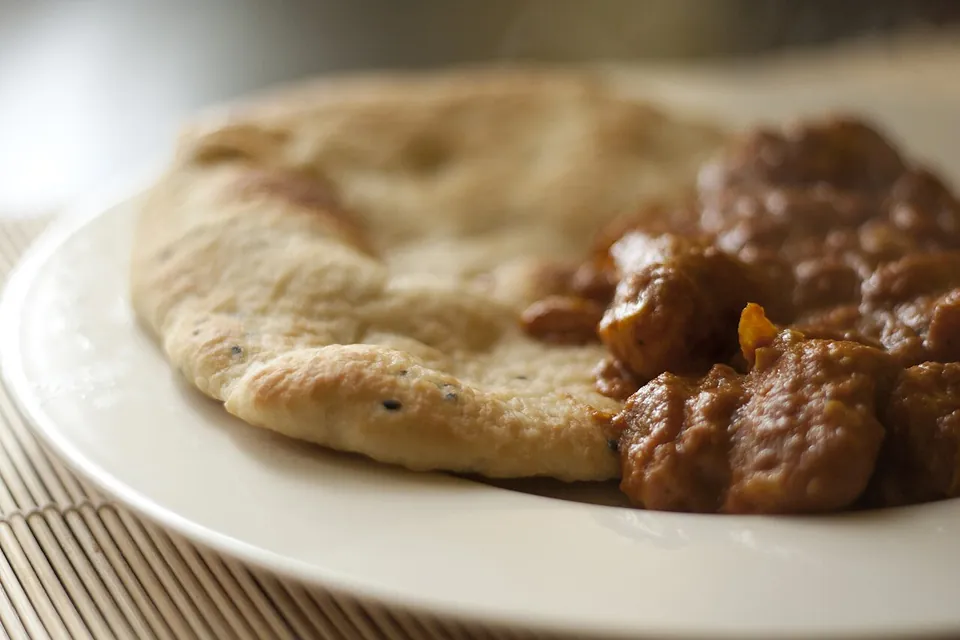
The heart of the method lies in a single stroke of ingenuity: rescuing the leftover meat of chicken roasted in the tandoor, the clay oven. Tandoori chicken, left as it is, tends to dry out; here it is simmered again in a gravy of tomato, butter, and cream. This extra step turned a dry roast into a rich braise.
The stage was the restaurant, the world of dining out, in the Delhi of the independence era. Served commercially to the urban middle class, it spread from Punjabi establishments into popular eating. In Britain, meanwhile, a sister-like dish softened for the customer's palate—chicken tikka masala—branched off.
How we know
The beginning of butter chicken is most widely told this way: in the Delhi of the independence years, at Moti Mahal, Kundan Lal Gujral simmered the leftovers of tandoori chicken in tomato, butter, and cream to devise the dish. But the contemporary record that would fix 'one inventor, in this year' is thin. The founder never wrote down a recipe in his lifetime. And the family's own account wavers. The 2013 family book placed the origin in 1950s Delhi; the 2024 lawsuit shifted both time and place, putting forward a Peshawar origin in the 1920s and 1930s. Within a single family's telling, the year and the land of birth alike drift.
The dispute over whose achievement it was continues as well. The line of Kundan Lal Jaggi—said to have co-founded, with Gujral, the restaurant that opened in Delhi in 1947, and now the restaurant Daryaganj—maintains that the two devised the dish together at that same establishment. As evidence they produced a handwritten partnership document registered in 1949, and in 2018 they registered a trademark as the 'inventor of butter chicken and dal makhani.' Moti Mahal objected, and the matter became a case in the Delhi High Court. One food anthropologist notes that with a restaurant family's shared recipes, each branch tends to claim ownership. Who came first stays without a deciding piece.
There is a reading from another angle. The food historian Lizzie Collingham sees the way of covering dry tandoori chicken in a creamy tomato-and-butter gravy as unusual in the northern India of the time—a dish adjusted, rather, to the palate of British residents and customers, an after-the-fact origin story of the same kind as chicken tikka masala, which was born in Britain. Collingham herself qualifies this as 'plausible, but not something one can assert.'
One year, at least, is clear. The oldest instance of the English phrase 'butter chicken' in print is from 1975, on the menu of the Gaylord Indian restaurant in New York. But this is the year the phrase entered the record, not the year the dish was born. Born in 1950s Delhi and carried in the 1970s to Indian restaurants abroad—read this way, it fits neatly with the 1975 first appearance in print and with the fact that tomatoes had long since arrived. Its year of birth and its parent still unsettled, the dish spread across the world.
The full set of origin theories and the detailed verification log — traceable all the way to their sources — are available on the Japanese edition.
See the full origin theories and verification log (Japanese) →
Related dishes
Cross-links Sister dishes & same-name dishes (separate lineage)
Shares the key ingredient
- Pasta al pomodoroSouthern ItalyB
- Pizza MargheritaNaples (Italy)D
- ShakshukaMiddle East / North AfricaC
- Jollof riceWest AfricaC
- Khao SoiB
- GazpachoAndalusia (Spain)C
- LecsóHungaryC
- Chana masalaNorth India (Punjab)C
- RatatouilleProvence, France (Nice)C
- Thieboudienne (ceebu jën)SenegalC
- ChakalakaSouth AfricaC
- KedjenouIvory CoastB
- Caprese saladCapri (Italy)C
- SaloonaPersian Gulf (Bahrain and Kuwait)C
- Shan khauk hswè (Shan noodles)Myanmar (Shan State)C
- American pizzaUnited StatesC
- FrancesinhaPorto (Portugal)D
- ChakhokhbiliGeorgia (Caucasus)C
- KachumberGujarat (Western India)C
- SalmorejoAndalusia (Spain)C
- Greek salad (horiatiki)GreeceC
- Shopska saladBalkans (Bulgaria)B
- Melanzane alla parmigianaItalyC