All dishes / 北米
General Tso's chicken Period BOrigin theory CVerified
Some fields (dish name, region and gates) are shown from the Japanese-edition data.
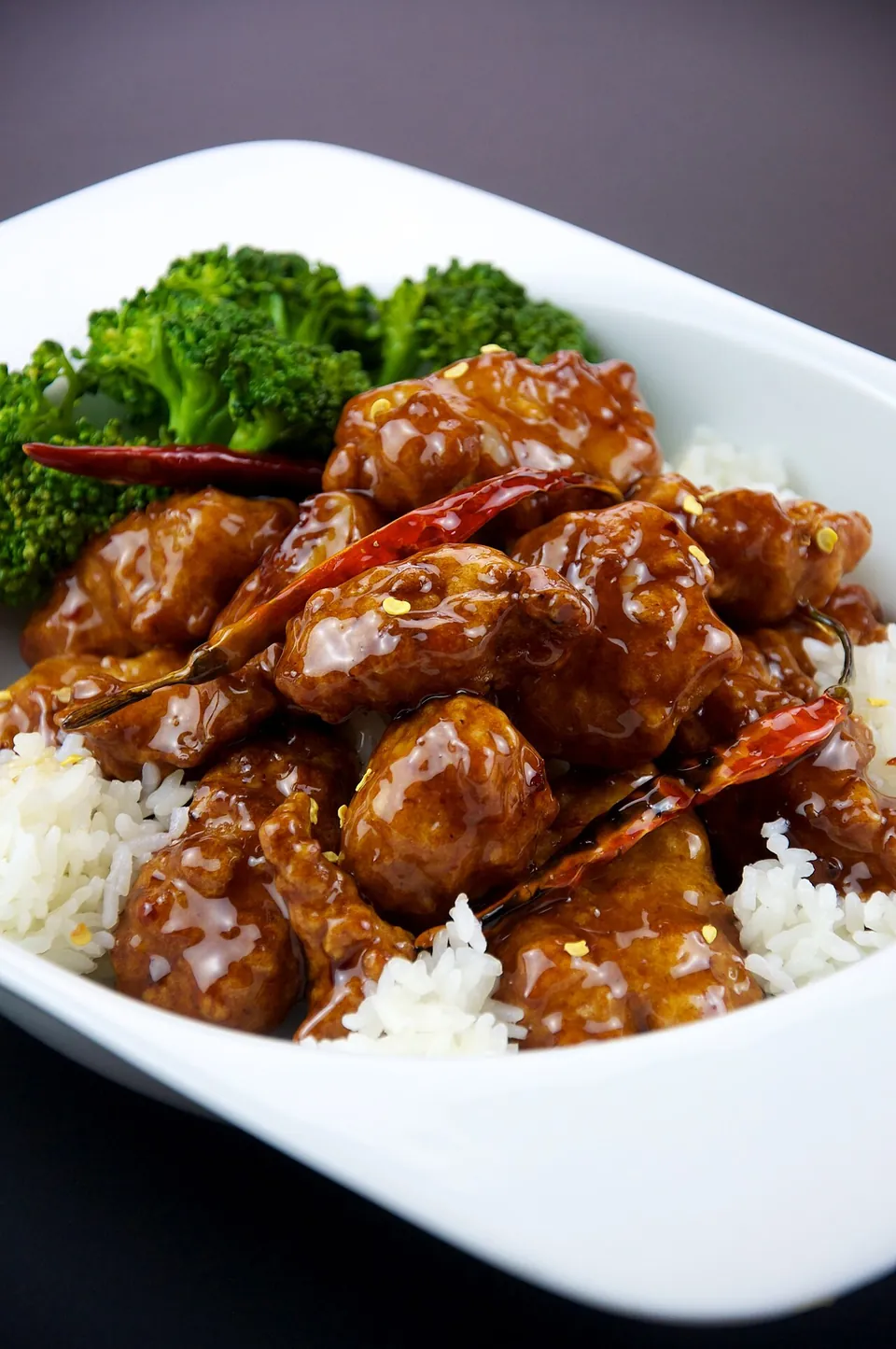
General Tso's chicken, the sweet-and-sour fried chicken that stands as an emblem of American Chinese food, is named for a Qing-dynasty general, Zuo Zongtang, who never once tasted it. The dish took shape almost seventy years after the general's death, in Taiwan and New York.
Verification highlight popular claim → verdict → evidence
Popular claim: the dish is named for, and was favored by, Qing general Zuo Zongtang. Verdict: refuted -- by his own account, chef Peng Chang-kuei invented the dish in Taiwan in the 1950s and named it for the general only as a nod to their shared Hunan origin; Zuo himself never ate it, and the naming came roughly 70 years after his death. Peng later brought a Hunanese, non-sweet version to New York around 1973, where it was reworked into the sweet, battered, deep-fried American-Chinese classic. Key sources: TIME interview with Peng Chang-kuei; the documentary The Search for General Tso (2014).
The three gates
- Ingredient-supply gate
- Chicken and soy sauce were already available locally. Chili peppers are a New World crop, but they reached East Asia early and were not the limiting factor — what actually limited this dish was the emergence of the American-style sweet-and-sour seasoning and technique.
- Cooking-technique gate
- American Chinese-style cooking that coats fried chicken in a thick sweet-and-sour sauce (an adaptation of Hunanese cuisine).
- Venue gate
- High-end Chinese restaurants in 1970s New York (Peng Chang-kuei's restaurant, later spread nationwide as American Chinese food).
Overview
General Tso's chicken is fried chicken tossed in a thick, sweet-and-sour sauce. Chicken and soy sauce are old ingredients in East Asia, and the chili used in the sauce had settled into East Asian cooking early, so the raw materials were on hand. Yet for this particular sweet-and-sour fried chicken to appear, it took a seasoning tuned to American palates and the New York Chinese restaurants of the 1970s that served it.
The starting point of the story is the Hunan-born cook Peng Chang-kuei. Having moved to Taiwan in 1949, he devised a new chicken dish for a banquet. Peng himself recalled it as a 1952 creation, though the visit of Admiral Radford, said to be the guest of honor at that banquet, is dated to June 1953 in American diplomatic records. Either way, the first General Tso's chicken was in the Hunan manner, hot and sharp with sourness, and made without sugar.
Around 1973 Peng opened a restaurant on East 44th Street in New York. There, to suit the tastes of American diners, the dish was remade into battered, deep-fried chicken coated in a sweet-and-sour sauce. This sweet-and-sour fried form appears in New York print in a 1977 restaurant review, which praises a dish as a stir-fried masterpiece. The plate born in Taiwan thus grew, in New York, into a defining dish of American Chinese cooking.
How we know
The dish's name has long been believed to come from the famed Qing general Zuo Zongtang (1812-1885): a plate he favored, the common notion holds, or one made in his honor, the name attached through the shared native province of Hunan.
But Zuo Zongtang never ate this dish. The naming was a later attribution, and the dish itself was made nearly seventy years after the general's death. Its creator, Peng Chang-kuei, left his own testimony: interviewed by TIME, he denied any connection to Zuo Zongtang and said he had improvised the name, borrowing the general's on the strength of their shared Hunan roots. Other accounts of the naming were floated as well, such as one reading Zuo's name into the sound of zongtang, the hall where ancestors are honored, but Peng's own testimony comes before them. The documentary The Search for General Tso (2014) likewise traces Peng's authorship and the fabricated tie to Zuo Zongtang.
The account of the Americanization in New York is not single either. Alongside the view that Peng's restaurant spread the dish, Michael Tong and others of Shun Lee Palace claim to have served a similar chicken dish in 1972, so a rival account over New York priority stands beside it. Even so, that a Hunan cook created the original form in a foreign land and rooted it on the American table is the settled trunk of the story, supported by his own testimony and by several food-history records. What remains, once the tale of the general is peeled away, is the clear trail of a dish born in Taiwan and transformed in New York.
The full set of origin theories and the detailed verification log — traceable all the way to their sources — are available on the Japanese edition.
See the full origin theories and verification log (Japanese) →
Related dishes
Shares the key ingredient
- KimchiSouth KoreaC
- Mapo tofuSichuan (China)C
- Doro watEthiopian HighlandsB
- Indigenous molli (chilmolli, pre-Old-World-spice chili sauce proto-layer)MexicoC
- RendangMinangkabau, West Sumatra (Indonesia)C
- Tom yum goongThailandC
- SambalMalay Archipelago (Indonesia)C
- TteokbokkiKorean PeninsulaC
- Tandoori chickenNorth India (Punjab / Delhi)C
- LaksaPenang (Straits Settlements)C
- MuhammaraAleppo, SyriaC
- VindalooGoa (India)C
- Piri piri chickenMozambique (Portuguese colonial sphere)C
- HarissaTunisiaC
- BibimbapSouth KoreaC
- Twice-cooked pork (huiguorou)Sichuan (China)C
- LarbLaos / Isan (Thailand)C
- Chili con carneTexas, USA (San Antonio)C
- Dan dan noodlesChengdu, Sichuan (China)C
- Pol sambolSri LankaB
- Chapli kebabPeshawar (Pakistan)C
- ShiroEthiopian HighlandsB
- Hiroshima soupless dandan noodlesHiroshima (Japan)B
- Kung pao chickenSichuan (China)C
- Fuqi feipianSichuan (China)D
- Nasi lemakMalaysiaC
- LampraisSri LankaC
- Nigerian pepper soupNigeria (West Africa)C
- MerguezMoroccoB