All dishes / 中央アジア
Kabuli palaw Period BOrigin theory CVerified
Some fields (dish name, region and gates) are shown from the Japanese-edition data.
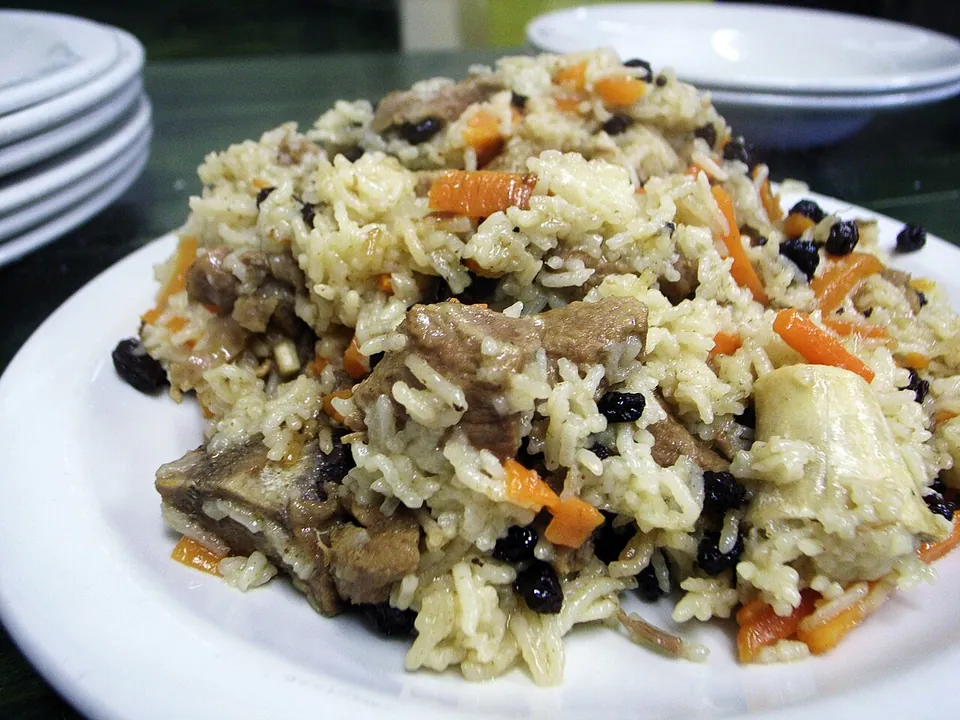
Sweetly caramelized carrots and raisins with tender lamb, layered over rice: this is Kabuli palaw, the national dish of Afghanistan. Yet the name it carries, Kabul, does not point to the place where the dish was born.
Verification highlight popular claim → verdict → evidence
Despite the English name, 'Kabuli' does not mark Kabul as the birthplace -- the dish more likely traces to the palaw tradition of northern Afghanistan near the Uzbek border, a point supported by Vamberi's 1860s travel account of Central Asia, while its Persian/Timurid-influenced style is first attested in the 1521 Persian cookbook Kar-nama.
The three gates
- Ingredient-supply gate
- Rice reached Afghanistan via Old World trade and became established there, requiring local rice cultivation and distribution.
- Cooking-technique gate
- Rice is simmered in stock and layered with sweetly caramelized carrots and raisins along with lamb, in the Kabuli-style presentation.
- Venue gate
- Began as an urban Kabul dish and grew into Afghanistan's national dish, served at festive occasions.
Overview
Kabuli palaw is the national dish of Afghanistan, built by layering sweetly caramelized carrots and raisins and slow-cooked lamb over rice cooked in stock. Served as the centerpiece of festive meals, it lets sweetness and savor answer one another in a single dish.
The main ingredient, rice, is a long-established grain on the Afghan table, an everyday staple from early on, shared across the Old World through cultivation and trade. That rice is cooked in stock, while carrots and raisins are fried until sweet and lamb is stewed apart, then the parts are layered together. This lavish presentation, generous with costly carrots, raisins, and nuts, was refined at the upper-class tables of Kabul into a distinctive dish. As the name suggests, tied to the Dari word Qabil (skilled, accomplished), it is a labor-intensive dish that calls for a capable cook.
Trace its lineage and Kabuli palaw belongs to the family of rice dishes carrying on the Persian and Timurid palaw tradition. Babur, who ruled Kabul, set down in the Baburnama the abundance of meat and dried fruit in the region, a hint of this land's taste for pairing sweet with salt. It is one branch of the pilaf family, mirroring the dried fruit and lamb culture of Central Asia.
How we know
This dish carries a received notion that grew straight out of its name. From the English name Kabuli it is often said to have originated in Kabul. But that name was attached later and does not point to the place of origin.
The Kabuli palaw style reaches back well before the nineteenth century. This qabili pilaf preparation, layering caramelized carrots and raisins over rice, has its earliest recipe in the cookbook Kar-nama (1521), written in the Safavid period by Ali Bavarchi Baghdadi. Known as the oldest surviving Persian cookbook (per the Encyclopaedia Iranica), it shows that the style already existed within the Central Asian and Persian palaw tradition before the modern era.
As for the place of origin, the image conjured by the name is not to be trusted either. According to specialist accounts, Kabuli palaw likely arose not within the city of Kabul but near the border of northern Afghanistan and Uzbekistan, in the palaw tradition of the old Bactrian region. The Hungarian orientalist Armin Vambery, in a travelogue (published 1865) based on his 1863 journey through Central Asia, recorded the palaw of this region as a national food and placed its origin in Central Asia (Turkistan). A contemporary traveler's firsthand record undercuts the naive reading of Kabul as the birthplace.
So when did it take its present form? The Central Asian palaw tradition was localized under the influence of Persian and Mughal (Timurid) cooking, and at the upper-class tables of Kabul a distinctive style was worked out with costly dried fruit and lamb, reaching its present qabili form by the late nineteenth century. The name bears Kabul, yet the dish's history will not fit inside a single city. Therein lies the depth of this dish's past.
The full set of origin theories and the detailed verification log — traceable all the way to their sources — are available on the Japanese edition.
See the full origin theories and verification log (Japanese) →
Related dishes
Cross-links Sister dishes & same-name dishes (separate lineage)
Shares the key ingredient
- BiryaniSouth Asia (Deccan / Mughal)C
- DosaSouth India (Tamil Nadu / Karnataka)C
- PaellaValencia, SpainC
- Risotto alla milaneseMilan (Lombardy, Italy)C
- Nasi gorengIndonesia (Java)C
- JambalayaNew Orleans (Louisiana, USA)C
- MujaddaraLevant (Syria, Lebanon, Palestine)B
- DoriaYokohama, JapanB
- IdliSouth IndiaC
- MaqlubaPalestine / LevantC
- White mixed rice (hondonban / goldongban — Bibimbap precursor)Korean PeninsulaC
- MandiHadhramaut (Yemen)C
- Rice and native-grain upma layer (sada upma, pre-semolina)South IndiaC
- KiribathSri LankaD
- KabsaSaudi ArabiaC
- PlovUzbekistan (Samarkand / Fergana)C
- MachboosPersian Gulf (Bahrain / Kuwait)B
- Gallo pintoCosta Rica / NicaraguaC
- Dal bhatNepalB
- KoshariEgyptC
- PilauEast Africa (Swahili Coast)C
- Rice-and-lentil koshari base layer (pre-pasta, pre-tomato)EgyptC
- Bánh cuốnVietnamB
- MahshiEgyptB
- PulaoNorth IndiaC
- PilavAnatoliaC
- Pilaf (French)FranceC
- Pilaf (Japanese-style)JapanC
- TahdigIranC
- Arroz de mariscoAlgarve (Portugal)C
- CasadoCosta RicaC
- Nan gyi thokeMyanmarC
- Mont diMyanmarC
- AranciniSicily (Italy)C
- Mazbi (madhbi)Yemen (Hadhramaut)C