All dishes / 東アジア
Tantanmen (Japanese dan dan noodles) Period BOrigin theory BVerified
Some fields (dish name, region and gates) are shown from the Japanese-edition data.
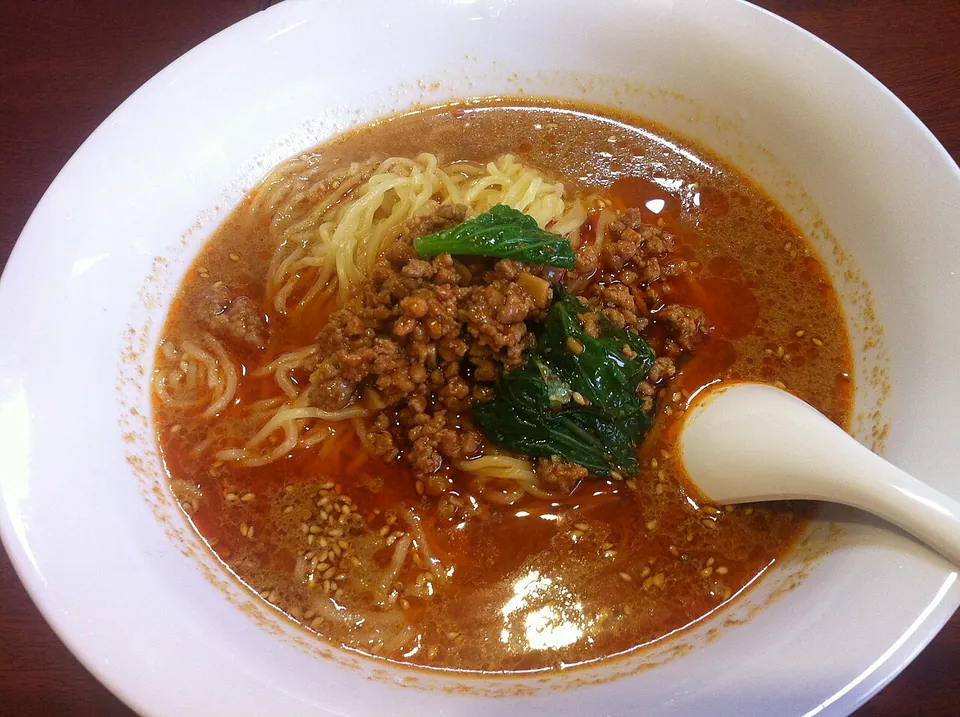
In Sichuan, dandan noodles were a dry dish with no broth. In postwar Japan, one cook reworked them into a sesame-rich soup. The Japanese conviction that dandan noodles mean a bowl of soup began with a single act of adaptation.
Verification highlight popular claim → verdict → evidence
Popular claim: none contested — Chen Kenmin (came to Japan in 1952, opened Shisen Hanten in 1958) adapted the originally dry Sichuan dan dan noodles into a soup-based version with sesame paste for Japanese tastes, popularizing it via NHK's Kyo no Ryori from 1966. Verdict: accepted as the settled account, with no competing origin story on record. Key sources: NHK Kyo no Ryori; Shisen Hanten (official); Japanese Wikipedia (Chen Kenmin).
The three gates
- Ingredient-supply gate
- Wheat, sesame, pork, and chili were all already available in postwar Japan; the food-supply gate is satisfied early and is not the limiting factor.
- Cooking-technique gate
- A soup-based style with noodles in a sesame-paste-laced broth, created and popularized in Japan by chef Chen Kenmin, originally from Sichuan.
- Venue gate
- Postwar Japanese Chinese restaurants, ramen shops, and home kitchens.
Overview
From dry to soup
The dandan noodles familiar in Japan are a bowl of steaming, sesame-scented broth with boiled noodles sitting in it, sharpened by chili oil. But Sichuan's dandan noodles were originally dry, with no broth at all. The soup version that a Japanese diner pictures at the word tantanmen was shaped in Japan in the second half of the twentieth century.
The man who reworked it was Chen Kenmin, a cook from Zigong in Sichuan who arrived in Japan in 1952. In the autumn of 1958 he opened the Szechwan restaurant Shisen Hanten in Tamura-cho, in what is now Nishi-Shinbashi, Tokyo. Dry noodles without broth were still unfamiliar to Japanese diners at the time. So Chen recast the dish in the manner of ramen, in a bowl of broth, and built that broth around sesame paste, an ingredient the original Sichuan dandan noodles do not use.
Wheat noodles, sesame, pork, and chili were all ordinary things in a postwar Japanese kitchen. What decided the form of this bowl was a cook's hand, steering the dish toward a Japanese table that liked its noodles in soup. One anecdote holds that the turn to broth was prompted by his wife Yoko, who suggested that since Japan has its own soup culture, from miso soup on, the dandan noodles too might be served in broth.
How we know
The image is so firmly fixed in Japan today, dandan noodles meaning a bowl of sesame soup, because one cook's adaptation simply took hold. Chen Kenmin reworked the dry noodle of its homeland into a soup bowl for Japanese diners; the person who reshaped the style and the course of events are told the same way by the restaurant's and NHK's own records and by several news pieces and encyclopedia entries, with almost no rival account. The three dates, arrival in Japan in 1952, the founding of Shisen Hanten in 1958, and the NHK appearance in 1966, are each pointed to by separate records.
What settled the matter was not only what he served in the restaurant. From 1966, through NHK's cooking program Kyo no Ryori and the like, Chen introduced this soup-based dandan noodle as a recipe for the Japanese home. Once it reached the household kitchen, the understanding of dandan noodles as a sesame-forward soup put down roots in Japan.
Its homeland's dandan noodles were the dry street noodle carried and sold on a shoulder pole, and this is a style that branched from it in Japan. The two noodles, sharing a name yet differing in form, are a sibling pair with a common ancestor, and together they trace how a dish is reworked as it crosses the sea.
The full set of origin theories and the detailed verification log — traceable all the way to their sources — are available on the Japanese edition.
See the full origin theories and verification log (Japanese) →
Related dishes
Lineage Family, predecessor, variants
- Umbrella categoryDan dan noodlesChengdu, Sichuan (China)C
- Same lineageHiroshima soupless dandan noodlesHiroshima (Japan)B
Shares the key ingredient
- Mie gorengIndonesiaC
- ThukpaTibet / NepalB
- JajangmyeonSouth KoreaC
- SaiminHawaii (USA)C
- PancitManila (Philippines)B