All dishes / 東南アジア
Mie goreng Period BOrigin theory CVerified
Some fields (dish name, region and gates) are shown from the Japanese-edition data.
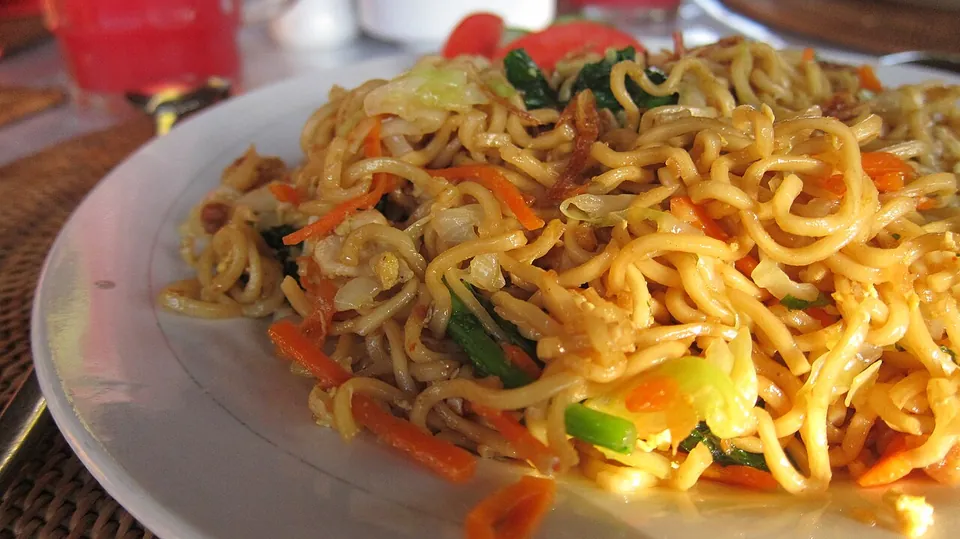
A fried noodle dish glossed with sweet soy sauce, found in every warung and street stall in Indonesia. It grew out of the stir-fried noodles that Chinese migrants carried across the sea from southern China, remade in the flavors of these islands. Just when and how it took root, though, is not clearly known.
Verification highlight popular claim → verdict → evidence
No fabricated origin myth was found for this dish. Two competing but undecided dating windows remain: an 18th-century introduction among Peranakan (mixed Chinese) communities versus 19th-century mass Hokkien migration and coastal noodle-stall expansion. Independent evidence lines converge on the 19th century: kecap manis itself was created around the 1850s in Java by Chinese immigrants sweetening soy sauce with palm sugar, and the words bami/mie trace etymologically to Hokkien bakmi, confirming the Chinese route.
The three gates
- Ingredient-supply gate
- Limiting factor: wheat noodles, brought by Hokkien Chinese immigrants from southern China and established in coastal cities (Batavia/Medan); dated at roughly 1750 (range 1600-1850, colonial-era trade) as the physical floor.
- Cooking-technique gate
- Chinese stir-frying technique (chow mein) localized with kecap manis (sweet soy sauce) and local spices; dried noodles (misoa) are documented in circulation from the 1870s.
- Venue gate
- Chinese food stalls and markets; common people; market; Peranakan Chinese, later the broader local population.
Overview
How a noodle that crossed the sea became a local dish
Mie goreng is Indonesia's stir-fried noodle. Wheat noodles are fried with sweet kecap manis (a sweet soy sauce) and local spices. Where nasi goreng, which shares the second half of its name, is a rice dish, this one is built on noodles.
Wheat noodles had no native place in these rice-eating islands. What brought them was migration from southern China across the sea. People from around Fujian carried the noodles of their homeland, and the Chinese way of stir-frying them, into coastal cities such as Batavia and Medan. The local words for noodle, mie and bami, are borrowed from the Hokkien bakmi, meaning meat noodle, and even that borrowing traces the route by which they arrived.
The stir-fried noodle did not stay as it had come. Set against the sweet soy sauce and spices of these islands, the Chinese chow mein was gradually remade into a local taste. The deciding note was kecap manis, the sweet soy sauce: in nineteenth-century Java, Chinese migrants brought soy brewing with them and sweetened the sauce with palm sugar. Once that sweet soy clung to the noodles, the dish took on the look of an Indonesian plate. What had been served at stalls in Chinese quarters crossed the line of its origins and became an everyday food eaten across the towns. A noodle that came from elsewhere, over a long stretch of time, became an Indonesian dish, and that passage is folded into mie goreng.
How we know
On the broad outline, the accounts largely agree: mie goreng arose when Chinese stir-fried noodles were remade in a local taste. The reading that places the dish within the wider Chinese noodle culture, as an extension of bakmi, is supported by a body of scholarship. That the very word for noodle comes from the Hokkien bakmi likewise points to southern-Chinese migrants as its source.
What is not clear is when that remaking happened. One reading holds that localization was already under way in the eighteenth century, within Peranakan society, where people of Chinese descent and locals had intermingled. Another sees it taking hold in the mid-nineteenth century, when Hokkien migrants arrived in large numbers and noodle stalls spread through the coastal cities. Records of dried noodles in circulation appear in the later nineteenth century, and are said to have furthered the localization.
Of these two windows, the nineteenth-century one has support from another direction. Kecap manis, the sweet soy sauce that gave the dish its decisive flavor, was itself made in mid-nineteenth-century Java, where Chinese migrants brought soy brewing and sweetened it with palm sugar, as a study tracing the history of soy brewing relates; a 1900 report from the Dutch East Indies also notes the sweet soy in use. If the very seasoning that remade the noodle belongs to the nineteenth century, it is natural to see the localization advancing then too. Even so, the possibility that the stir-fried noodle was already being localized in eighteenth-century Peranakan society has not been ruled out.
Which is right, or whether the two overlap gently, cannot be narrowed to a single date; the records to do so do not survive. When an everyday food came into being leaves little trace unless someone sets out to write it down, and mie goreng is no exception. What is certain is that a noodle carried across the sea took root in these islands over several centuries, and that its beginning cannot, for now, be fixed to a single year.
The full set of origin theories and the detailed verification log — traceable all the way to their sources — are available on the Japanese edition.
See the full origin theories and verification log (Japanese) →
Related dishes
Shares the key ingredient
- Tantanmen (Japanese dan dan noodles)JapanB
- ThukpaTibet / NepalB
- JajangmyeonSouth KoreaC
- SaiminHawaii (USA)C
- PancitManila (Philippines)B