All dishes / 東アジア
Zhajiangmian Period BOrigin theory CVerified
Some fields (dish name, region and gates) are shown from the Japanese-edition data.
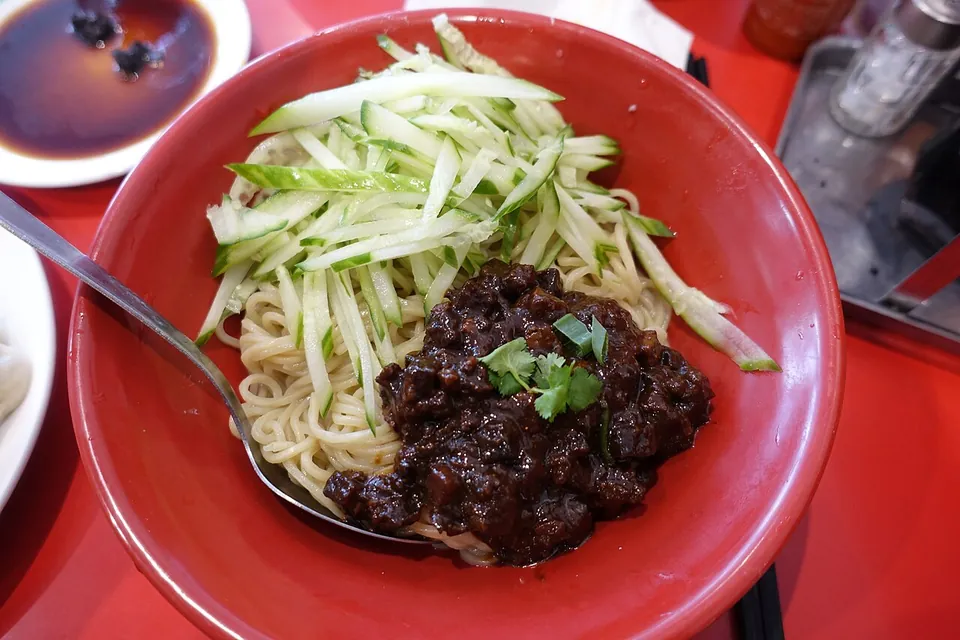
Boiled wheat noodles tossed with a rich, oil-fried meat-and-bean-paste sauce, zhajiangmian is a home dish rooted in the kitchens and street stalls of northern China. A popular origin tale has the Empress Dowager Cixi discovering it in Xi'an and bringing it back to the imperial court, but this is a later invention that ties a famous ruler to the dish, unsupported by any contemporary record.
Verification highlight popular claim → verdict → evidence
Myth: Empress Dowager Cixi discovered the dish while fleeing to Xi'an during the Boxer Rebellion (1900) and brought its cook back to the palace, spreading it nationwide. Verdict: rejected as an after-the-fact legend with no contemporary documentation. Scholars instead trace the dish to late-Qing North China, with two competing accounts — a Shandong origin (formed in Jinan, later spreading to Beijing) and a Beijing origin tied to the culture of impoverished Manchu Eight Banners households (per Deng Yunxiang's Yanjing Xiangtu Ji). The core ingredients (bean paste, noodles) are ancient, but the dish itself only took shape in the late 19th century.
The three gates
- Ingredient-supply gate
- Both wheat and soybeans have long been native to China; the bottleneck is not ingredient supply but the fried-paste cooking technique.
- Cooking-technique gate
- Yellow soybean paste (or sweet bean sauce) fried in oil into a savory sauce, tossed with boiled wheat noodles.
- Venue gate
- Homes and everyday eateries of North China.
Overview
Zhajiangmian is a northern Chinese noodle dish: boiled wheat noodles topped with a meat sauce made by stir-frying fermented soybean pastes such as huangjiang or tianmianjiang in oil, garnished with slivered cucumber and scallion. Wheat and soybeans were both long at home in the north, and making fermented-bean paste was deeply woven into ordinary kitchens. These everyday ingredients form the foundation of the bowl.
The core of the dish lies in the technique of frying the paste in oil to draw out aroma and savor, working it with meat into a thick sauce. Fermented bean paste is already named in the Han-dynasty glossary Jijiupian, and noodles too existed in prototype by the Han. Yet even with these ingredients and skills in place, zhajiangmian as a distinct dish appears much later; it was not yet present in Beijing in the early-to-middle Qing. It actually takes shape in the late Qing, in the closing years of the 19th century, and only becomes widely eaten from the 1960s onward. The blend of pastes varied by place, with Shandong favoring tianmianjiang and Beijing combining huangjiang with tianmianjiang, and each way of frying gave the sauce its local character.
The dish is broadly credited to northern China, but within that region two views compete. One holds that it originated in Shandong, taking form in Jinan before passing to Beijing around the Ming and Qing. The other traces it to the life of Beijing's Manchu Eight-Banner households; the folklorist Deng Yunxiang takes this view in his Yanjing Xiangtu Ji. In that telling, Banner descendants whose fortunes had declined in the late Qing kept up appearances by topping their noodles with oil-fried paste and seasonal vegetables. Memoirs left by old Beijing Bannermen of the Republican era, such as Tang Lusun's Guguo Qing and Suan Tian Ku La Xian and Bai Tiezheng's Lao Beiping de Gudianr, suggest that zhajiangmian existed by at least that time.
The home pot and the neighborhood eatery are this dish's stage. It spread as an ordinary food that the people of the north refined in their daily noodle-eating. This same zhajiangmian passed to the Chinese community on the Korean peninsula, where it became the parent of Korea's Jajangmyeon.
How we know
The origin most often told for zhajiangmian is a court tale involving the Empress Dowager Cixi. When she fled to Xi'an during the Boxer Uprising of 1900, the chief eunuch Li Lianying is said to have found a zhajiangmian shop on South Street; the Empress liked it so much that on returning to Beijing she took the cook into the palace and spread the dish. It is a dramatic story, easy to repeat, but no contemporary record supports it.
Chinese food history has a habit of tying well-known dishes and inventions to a famous ruler or a single episode at court. The Cixi tale looks like this kind of after-the-fact attribution. Zhajiangmian already existed as an ordinary northern food before the Empress's flight to Xi'an in 1900, so an origin located in a palace scene cannot stand. Scholars locate its actual beginnings in the everyday ingenuity of late-Qing Beijing's Eight-Banner households, following Deng Yunxiang's Yanjing Xiangtu Ji and others, and do not accept the court tale. The antiquity of the dish and its northern origin are not in doubt; only the palace attribution is set apart.
So how is the real origin to be understood? The earliest documented date, and whether Shandong or Beijing is the prototype, remain matters of disagreement. The view that it began in Shandong and spread to Beijing stands alongside the view that traces it to Beijing's Eight-Banner culture, and neither is settled. What is firm is that although the elements are old, going back to the Han, the dish itself takes shape only in the late Qing. Having set aside the dramatic court tale, we are still tracing the outline of a common noodle food rooted in the homes and streets of the north.
The full set of origin theories and the detailed verification log — traceable all the way to their sources — are available on the Japanese edition.
See the full origin theories and verification log (Japanese) →