All dishes / 東アジア
Khuushuur Period BOrigin theory BVerified
Some fields (dish name, region and gates) are shown from the Japanese-edition data.
Khuushuur—thin wheat dough folded around mutton and fried golden in oil—is often introduced, in tourist guides and popular write-ups, as a portable food that Mongolian herders devised on their own, owing nothing to the flour cookery of China. Yet the name of the dish is a borrowing from the Chinese huǒshāor, and the wheat for its skin reached the grasslands along the trade routes: a steppe-only origin finds support neither in the words nor in the ingredients.
Verification highlight popular claim → verdict → evidence
Guidebooks like to present khuushuur as a nomad's own invention, worked out on the steppe with no debt to Chinese flour cookery. The word argues otherwise. Mongolian khuushuur is a borrowing of Chinese huoshaor, one of a chain that also gave buuz from baozi, mantuu from mantou and bansh from bianshi. Wheat was no wild plant of the grasslands either, and the milling and dough-work a khuushuur needs came later than the grain itself, which arrived along the trade routes (Wilkin et al., Scientific Reports, 2020). The Yuan court dietary manual Yinshan zhengyao of 1330 already records wheat-dough parcels filled with mutton and tail fat, read here in the Sibu congkan facsimile and in Buell and Anderson's annotated translation, A Soup for the Qan (Brill, 2010). What is Mongolian is the remaking: mutton instead of pork, and frying instead of steaming. When the fried form first appears in a Mongolian text has yet to be established.
The three gates
- Ingredient-supply gate
- Lamb was locally available through nomadic herding. Wheat flour came via trade and local cultivation; a stable supply of wheat flour was the limiting factor.
- Cooking-technique gate
- Meat wrapped in kneaded dough and deep-fried.
- Venue gate
- nomadic households and festivals (Naadam, Tsagaan Sar), also markets and street stalls. common people. Mongolian nomads and urban residents.
Overview
What it is
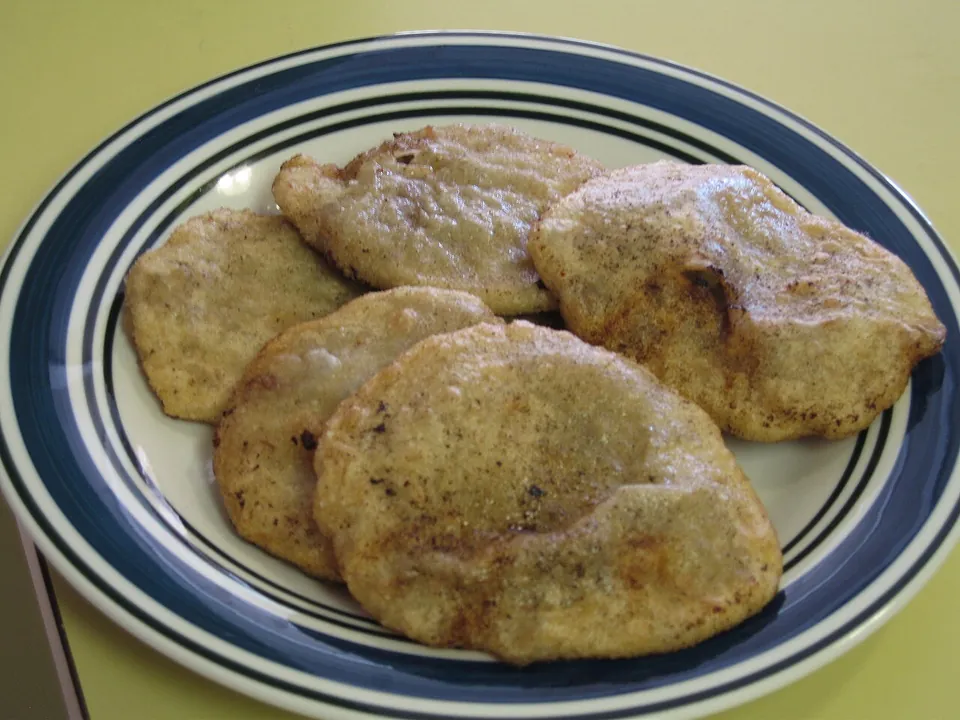
Khuushuur is a Mongolian dish of kneaded wheat dough wrapped around ground mutton or beef, often with chopped onion worked into the filling, and fried in plenty of oil. Shaped into half-moons or flat rounds, it browns to a deep gold, and the juices run at the first bite. It is festival food, eaten by hand at the stalls of the Naadam games, and just as much an everyday dish at the herder's table. In Mongolian Cyrillic it is written хуушуур; in English it appears as khuushuur or khuushur.
Steppe mutton, wheat off the trade routes
Two ingredients carry the dish: mutton and wheat flour. Sheep sustain the herding life itself and have long been plentiful on the steppe. Giving milk and meat without stint, they are the most familiar bounty of the Mongolian table.
Wheat came from beyond the grasslands. It travelled the trade routes onto the steppe, and with it came the practice of kneading flour into a skin. The Yuan court's dietary manual Yinshan Zhengyao (1330) sets down the flour foods eaten by the Mongol ruling class—noodles, cakes, and dumplings of the baozi kind—so that by the Yuan period at the latest, wheat-flour cookery had taken hold in the Mongol world. The half-moon pastry as it is eaten today seems to have reached the table only in the modern era, once wheat flour circulated widely.
The frying that sets it apart
What marks khuushuur out is the frying. The kneaded skin closes over a mutton filling, is flattened out, and browns through in hot oil. Take the same wheat skin around the same filling and steam it instead, and you have buuz, the steamed dumpling. Fried and steamed: khuushuur and buuz share skin and filling and part ways at the fire, and both still sit on the Mongolian table.
How we know
The "born on the steppe" telling
In tourist guides and popular introductions, khuushuur is often presented as something Mongolian herders worked out for themselves, long ago and quite apart from the flour cookery of China. One reason is offered for it, and only one: the pastry suits a life spent moving across wide grassland. Nothing from language or from the written record is put forward alongside.
What there is points the other way. The name хуушуур is a borrowing from the Chinese huǒshāor, a kind of shaobing, the baked wheat cake. The grain points the same way. Isotope analysis of excavated bone (Wilkin et al., 2020) indicates that the everyday grain in Mongolia was millet and grains of its kind, eaten by around 800 BCE at the latest. Wheat and barley are attested as well, at Iron Age sites in the Egiin Gol valley and at Ivolga, and charred grains of millet, barley and wheat come out of the pit-house village at Boroo Gol together. Neither millet nor wheat, though, was native to the grasslands. Both were crops carried onto the steppe from elsewhere, and by Xiongnu times they were being raised at permanent settlements, which have left plows, hoes and grinding stones behind. What came late to khuushuur was not the grain itself but the milling of it into flour, and the habit of kneading that flour into a skin came from outside as well.
The Chinese flour food that lingers in the name
The borrowing is not a one-off. Buuz, the steamed dumpling, comes from baozi; mantuu from mantou; bansh from bianshi. The Mongolian names for flour dishes lead back, one after another, to Chinese—a whole system of names telling of flour cookery that moved onto the steppe as a body.
The written record runs the same way. Yinshan Zhengyao (1330), the dietary manual of the Yuan court, lists dishes under Chinese names in which mutton and fat from the sheep's tail are chopped into a filling and closed in a skin of white wheat flour, then browned on a griddle or steamed. Buell and Anderson's scholarly reading of the manual, A Soup for the Qan, takes this as a trace of wheat-flour food drawn into nomadic Mongolian eating through trade with China and Central Asia. With the run of borrowed names and the court manual pointing to the same place, tracing khuushuur back to the flour cookery of China is now the settled view.
How far the telling gives way
What gives way is one claim only: that the dish arose on the steppe with no Chinese flour cookery behind it. That its present shape—mutton for a filling, fried in oil rather than steamed—took form in Mongolian life is another matter, and it stands. Chinese flour foods are more often filled with pork and steamed; on the steppe the meat is mutton and the pastry goes into oil, portable and built around meat. For some, that reworking counts heavily enough that khuushuur as it stands today is best read as a Mongolian development, not reducible to a single foreign starting point. Thin dough closed over minced meat and fried also puts the dish close to the Crimean Tatar cheburek, and a view that counts it among a family of fried meat pastries found across Eurasian herding peoples stands alongside.
Flour cookery that came in from outside, and the handling the steppe gave it: khuushuur carries both in one pastry.
The full set of origin theories and the detailed verification log — traceable all the way to their sources — are available on the Japanese edition.
See the full origin theories and verification log (Japanese) →
Related dishes
Cross-links Sister dishes & same-name dishes (separate lineage)
- Sister dish (shared ancestor)CheburekiCrimea (Crimean Tatar)C
- Sister dish (shared ancestor)BelyashiVolga-Ural (Tatar / Bashkir)C
- Sister dish (shared ancestor)BuuzMongoliaB
Shares the key ingredient
- PierogiPolandC
- EmpanadaRío de la Plata (Argentina)C
- BliniRussiaB
- PirozhkiRussiaB
- JalebiNorthern IndiaB
- Fortune cookieCalifornia (USA)C
- StroopwafelGouda (Netherlands)C
- LamingtonQueensland (Australia)C
- ChimichangaTucson, Arizona (USA)C
- YantıkCrimea (Crimean Tatar)C
- VarenykyUkraineC
- MandaziEast Africa (Swahili Coast)C
- LángosHungaryC
- Daoxiaomian (knife-cut noodles)Shanxi (China)C
- Dobos torteHungaryB
- SambusaEast Africa (Swahili Coast)B
- SarburmaCrimea (Crimean Tatars)B
- ThenthukTibet / NepalB
- ShumaiGuangzhou (China)B
- Jiaozi (gyoza)ChinaC
- Hohhot shaomaiHohhot (China)B
- OliebollenNetherlandsC
- MarquesitaYucatán (Mexico)D
- Halwa puriLahore (Pakistan)D
- Roti prataSingaporeB
- SopaipillaNew Mexico (USA)C
- CoyotaSonora (Northern Mexico)C
- RunzaMidwestern United StatesB
- BanshMongoliaC
- Kashyk-ash (къашыкъ-аш, Crimean Tatar spoon-dumpling soup)Crimea (Crimean Tatar)C
- KulebyakaRussiaB
- Spring roll (Chinese)ChinaC
- ChuchvaraUzbekistan (Samarkand / Fergana)C
- DamperAustraliaC
- SamsaCentral AsiaC
- HalushkyUkraineC
- BanitsaBalkans (Bulgaria)C
- Har gowGuangzhou (China)C