All dishes / 西欧
Oliebollen Period BOrigin theory CVerified
Some fields (dish name, region and gates) are shown from the Japanese-edition data.
The Dutch New Year's fritter oliebol is said to descend from a sacrifice to the pagan Germanic goddess Perchta—but that heroic legend was stitched onto Alpine folklore long after the fact. Its real form sits in the cookbooks and paintings of the seventeenth-century Golden Age.
Verification highlight popular claim → verdict → evidence
A tale linking oliebollen to Germanic Yule offerings for the goddess Perchta is unsupported: Perchta belongs to Alpine, not Dutch, folklore, no early Dutch source ties her to this pastry, and even the tellers of the legend call it something that 'may or may not have happened.' A theory that Sephardic Jewish immigrants brought the fried dough from Portugal, paralleling Hanukkah's sufganiyot, remains unconfirmed for lack of independent evidence. What is documented is a 17th-century Dutch lineage: a painting by Aelbert Cuyp (c.1652) already shows a fried dough ball resembling the modern form, and the 1667 cookbook De verstandige kock records the earliest known oliekoecken recipe with raisins.
The three gates
- Ingredient-supply gate
- Wheat and oil were both native; the dish was completed entirely with Old World ingredients, not dependent on any New World crop.
- Cooking-technique gate
- Dough is deep-fried in oil.
- Venue gate
- A home and street-vendor treat for New Year's Eve.
Overview
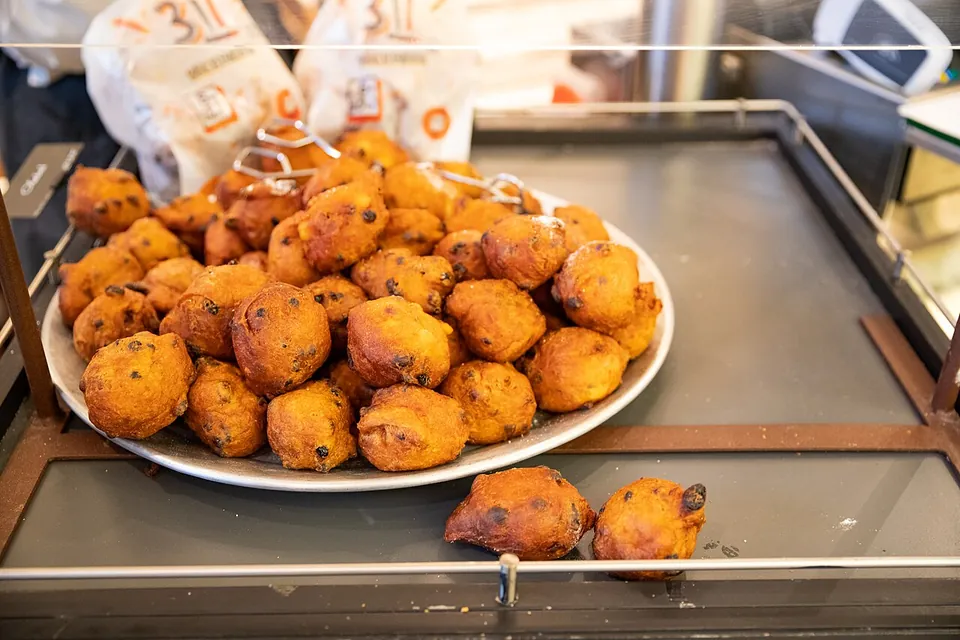
An oliebol is a ball of wheat dough deep-fried until crisp and dusted with powdered sugar, a Dutch festive treat. Made at home from New Year's Eve into the new year and sold from street stalls, it is a fixture of the Dutch winter.
The ingredients that make up this dish were all long present in the Low Countries. Wheat, the main component, was a local grain and on everyday tables from early on. The frying fat—rapeseed oil or lard—was likewise close at hand, and the whole fritter could be made from Old World materials alone. In terms of ingredients, the makings had been in place to prepare it through the Middle Ages.
Its shape shifted along with the craft of frying. At first, when oil and lard were not abundant, the dough was fried flat. Later, as deep-frying in a full pot of oil spread, the dough puffed round and came closer to today's ball form. Its tie to festive occasions can be traced from the seventeenth century onward, and its place as a New Year's treat sits on the continuation of records from that era. The word oliebol itself was recorded in the Van Dale dictionary of 1868.
How we know
A gruesome origin tale trails the oliebol. Pagan Germanic tribes, it is said, offered these fritters at the midwinter Yule to Perchta—told of as goddess or witch—either to escape being cut open, or so that oil coating the body would let her sword slide off. Bloody and mythic, the story sounds fitting for the pedigree of an old treat.
Set against the sources, though, the legend collapses from its foundations. Perchta belongs to Alpine tradition, to Austria and southern Germany, not to the Netherlands. In the medieval Low Countries no contemporary record links this offering custom to the oliebol. Indeed, the writer who spread the story admitted it was merely 'a pretext that may or may not have happened.' The alluring pagan origin was a tale built after the fact by grafting it onto Alpine folklore.
The certain picture lies in the records of the seventeenth-century Dutch Golden Age. Aelbert Cuyp painted, around 1652, fried balls of dough in a pan that closely resemble today's oliebol. The 1667 cookbook De verstandige kock (The Sensible Cook) gives a recipe for oliekoecken with raisins. A painting and a cookbook, two primary sources, fix the treat's form firmly in the seventeenth century. Yet this 1652 image and 1667 recipe are the earliest points at which it appears in the record, not the moment the treat was born. No line can be drawn on the sources from an ancient pagan offering centuries earlier down to this fritter. The oliebol's story begins not in myth, but in the kitchens of the Golden Age.
The full set of origin theories and the detailed verification log — traceable all the way to their sources — are available on the Japanese edition.
See the full origin theories and verification log (Japanese) →
Related dishes
Shares the key ingredient
- PierogiPolandC
- EmpanadaRío de la Plata (Argentina)C
- BliniRussiaB
- PirozhkiRussiaB
- CheburekiCrimea (Crimean Tatar)C
- BelyashiVolga-Ural (Tatar / Bashkir)C
- JalebiNorthern IndiaB
- Fortune cookieCalifornia (USA)C
- StroopwafelGouda (Netherlands)C
- LamingtonQueensland (Australia)C
- ChimichangaTucson, Arizona (USA)C
- BuuzMongoliaB
- YantıkCrimea (Crimean Tatar)C
- VarenykyUkraineC
- MandaziEast Africa (Swahili Coast)C
- LángosHungaryC
- Daoxiaomian (knife-cut noodles)Shanxi (China)C
- KhuushuurMongoliaB
- Dobos torteHungaryB
- SambusaEast Africa (Swahili Coast)B
- SarburmaCrimea (Crimean Tatars)B
- ThenthukTibet / NepalB
- ShumaiGuangzhou (China)B
- Jiaozi (gyoza)ChinaC
- Hohhot shaomaiHohhot (China)B
- MarquesitaYucatán (Mexico)D
- Halwa puriLahore (Pakistan)D
- Roti prataSingaporeB
- SopaipillaNew Mexico (USA)C
- CoyotaSonora (Northern Mexico)C
- RunzaMidwestern United StatesB
- BanshMongoliaC
- Kashyk-ash (къашыкъ-аш, Crimean Tatar spoon-dumpling soup)Crimea (Crimean Tatar)C
- KulebyakaRussiaB
- Spring roll (Chinese)ChinaC
- ChuchvaraUzbekistan (Samarkand / Fergana)C
- DamperAustraliaC
- SamsaCentral AsiaC
- HalushkyUkraineC
- BanitsaBalkans (Bulgaria)C
- Har gowGuangzhou (China)C