All dishes / 東アジア
Baozi Period COrigin theory CVerified
Some fields (dish name, region and gates) are shown from the Japanese-edition data.
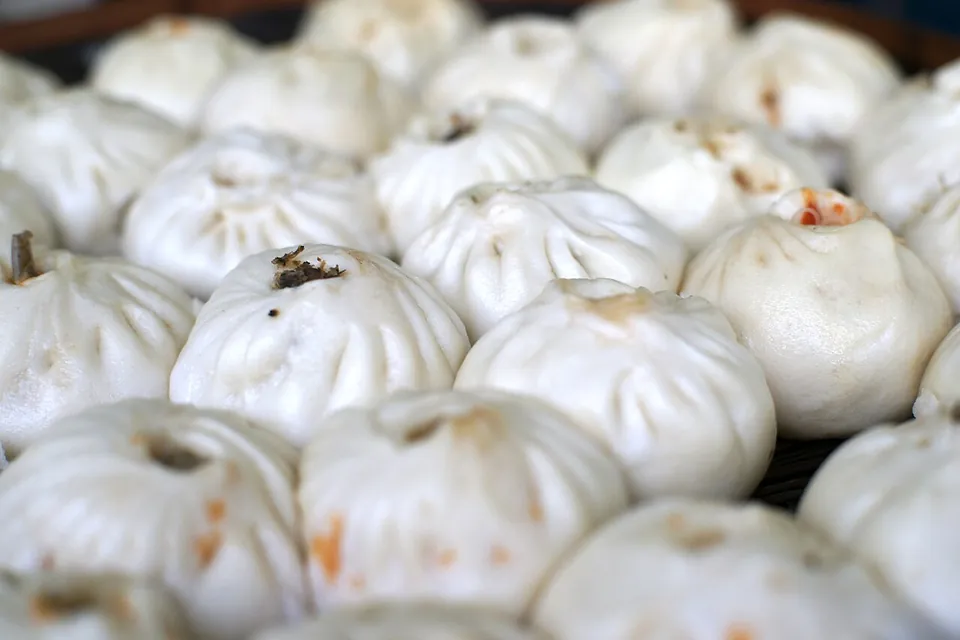
A Chinese steamed dumpling of leavened wheat dough wrapped around a filling of meat or vegetables. A famous legend credits its invention to the strategist Zhuge Liang in the Three Kingdoms period, but that story was written down some nine hundred years after the events it describes.
Verification highlight popular claim → verdict → evidence
Legend credits Zhuge Liang with inventing the stuffed steamed bun during a third-century campaign, but the earliest record of that story dates from some 900 years later (Song dynasty, 12th century), and scholars treat it as an invented tradition. The better-supported account is gradual formation: stuffed steamed buns already existed by the Western Jin dynasty (Shu Xi's Bing Fu, c. 300 CE), and the term baozi split off from mantou to denote the filled version by the Song dynasty.
The three gates
- Ingredient-supply gate
- Wheat and pork were both already native to China, so the ingredient side is not the binding constraint; the constraint is the leavened-dough steaming technique.
- Cooking-technique gate
- Wrapping filling in leavened wheat dough and steaming it in bamboo baskets, a technique that depends on milling, fermentation, and steaming traditions already in place; established as a teahouse snack by the Song dynasty.
- Venue gate
- From teahouses, snack shops, and market stalls to home cooking and restaurants; a staple snack food of ordinary people.
Overview
A dim sum shaped by the cultures of milling, leavening, and steaming
Baozi is a Chinese steamed bun made by wrapping a filling in leavened wheat dough and steaming it in a bamboo basket. The filling may be pork, but also fish, vegetables, and much else. From teahouses and dim sum shops to market snacks and the family table, it has long been eaten widely as a snack that doubled as a staple food for ordinary people.
Both wheat and pork are foods long present in China. Milling wheat into flour, leavening it, wrapping a filling, and steaming it in a basket -- this way of making the dish rests on the overlapping cultures of milling, of leavening, and of steamed food. Once these were in place, it took its form as a dim sum by the Song dynasty.
The name baozi itself reached a turning point in meaning during the Song. What had been called mantou, whether filled or not, gave way to the word baozi for the filled kind. This method of steaming would later become the ancestral form of wrapped dishes across Eurasia, among them the Mongol buuz.
How we know
Baozi has a founding story everyone knows. During his southern campaign in the Three Kingdoms period, the strategist Zhuge Liang, to put an end to human sacrifice to a river god, is said to have wrapped meat in wheat dough to model a human head and called it mantou, the barbarian's head; from this, the legend goes, the mantou got its name.
Yet the earliest surviving record that ties this anecdote to Zhuge Liang is Gao Cheng's Shiwu Jiyuan of the Southern Song -- the twelfth century. That places it some nine hundred years after the events it describes, with no contemporary support to be found. Isaac Yue of the University of Hong Kong and others say only that people of the Song believed it to be Zhuge Liang's invention, and treat it as a later literary attribution, an origin tale composed after the fact. The story that binds the invention to a single man does not hold up as a specific founding account. None of this denies the antiquity of the genre itself -- the filled steamed bun.
The actual making of it was far more gradual. Shu Xi of the Western Jin wrote in his Rhapsody on Cakes of a mantou served at spring feasts, and this is its oldest surviving appearance in writing. By the Tang there were small leavened dim sum, and in Northern Song Kaifeng, steamed buns with fillings of meat, fish, and vegetables spread as a snack for students; Meng Yuanlao's Dongjing Meng Hua Lu records them among the foods of the market. In time the word baozi split off from mantou to name the filled kind. There was no single inventor. Against the background of milling, leavening, and the steaming basket, this dish drew close to its present shape over many generations.
The full set of origin theories and the detailed verification log — traceable all the way to their sources — are available on the Japanese edition.
See the full origin theories and verification log (Japanese) →
Related dishes
Cross-links Sister dishes & same-name dishes (separate lineage)
- Sister dish (shared ancestor)MomoTibet / NepalC
- Spread from hereBuuzMongoliaB
- Spread from hereXiaolongbaoShanghai (Nanxiang, China)C
- Sister dish (shared ancestor)Jiaozi (gyoza)ChinaC
Shares the key ingredient
- TonkatsuJapanC
- Tacos al pastorMexicoB
- FeijoadaBrazilB
- Barbecue ribsSouthern United StatesC
- CurrywurstBerlin (Germany)B
- Twice-cooked reheated pork (Huiguorou precursor)Sichuan, ChinaC
- ChicharrónPeru / Latin AmericaB
- ChicharrónMexicoB
- ChicharrónColombiaB
- Chop sueyUSA (Cantonese diaspora) / Guangdong (China)C
- Cochinita pibilYucatán (Mexico)C
- LechonCebu (Philippines)C
- SaloUkraineC
- Bak kut tehSingaporeC
- GolonkaPolandC
- GyrosGreeceB
- EisbeinBerlin (Germany)C
- SchweinshaxeBavaria (Germany)C
- Japanese-style twice-cooked porkJapanB
- ManchamantelesPuebla (Mexico)C
- PernilPuerto RicoC
- ChoripánRío de la Plata (Argentina)C
- Char siuGuangdong (China)C