All dishes / 東南アジア
Lechon Period BOrigin theory CVerified
Some fields (dish name, region and gates) are shown from the Japanese-edition data.
Lechón, the whole roast pig at the heart of Filipino celebrations, is often taken for a dish the Spanish brought. Yet the custom of roasting a pig whole was already there in 1521, when Magellan's men first reached the islands.
Verification highlight popular claim → verdict → evidence
Myth: whole-pig roasting itself was introduced by Spain. Verdict: refuted — pigs arrived in the Philippines about 4,000 years ago and whole-roasting is a pre-Hispanic Austronesian tradition; Spain contributed the name lechón and the suckling-pig style. Key source: Antonio Pigafetta's 1521 eyewitness account (Blair & Robertson, The Philippine Islands 1493-1898, Vol. 33), recording pig sacrifice and roasting in Cebu/Visayas before Spanish colonization.
The three gates
- Ingredient-supply gate
- Pigs are a native livestock, but the whole-roasting style is attributed to Spain; the bottleneck is when the colonial-era roasting style became established.
- Cooking-technique gate
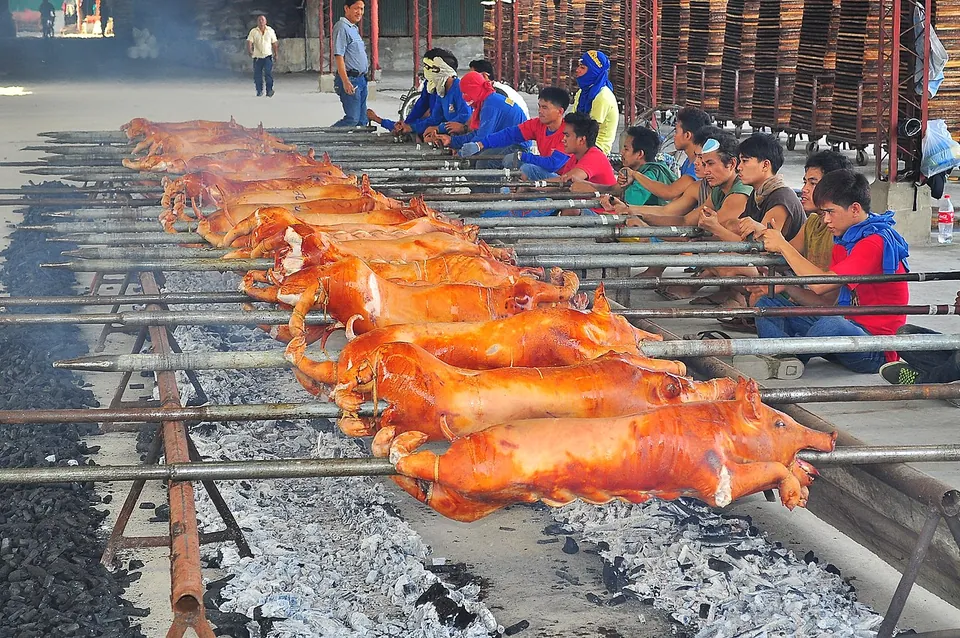
- A whole piglet is skewered and slow-roasted over charcoal for hours.
- Venue gate
- The centerpiece dish of festivals and fiestas.
Overview
Lechón is a Filipino dish of a whole pig, skewered on a spit and turned slowly over charcoal for hours until done. The skin crisps to a lacquered amber while the flesh stays moist, and it takes pride of place at feasts and celebrations, the fiesta, where people gather to carve and share it. The Filipino version uses a weaned adult pig and stuffs the cavity with native aromatics such as lemongrass, a form of its own.
The pig at its center is an animal long rooted in the islands. According to archaeological research, pigs had already been introduced as domestic animals into the archipelago some 4,000 years ago, in the Neolithic. Roasting a pig whole, too, is a native Austronesian tradition that predates the Spanish arrival.
So what did the Spanish bring? The name lechón, and the suckling-pig form. The word descends from Spanish leche, milk, and originally denoted a suckling pig; in the Philippines it broadened to name the whole roasting of a weaned adult pig. Onto a spit-roast pork already rooted in the land, a colonial-era name and form were laid, and reworked into a distinct dish stuffed with native herbs.
How we know
The tidy claim that lechón is simply a dish the Spanish brought is widely repeated, but incomplete.
It is true that the suckling-pig form entered in the 16th-century Spanish colonial period, and that the name traces to Spanish. Seen only from this angle, it looks like a foreign import. But that view overlooks how old the whole-roast pig itself is.
Spain did not formally colonize the Philippines until 1565. Forty-four years earlier, Antonio Pigafetta, the chronicler traveling with Magellan, recorded islanders in Cebu and the Visayas roasting pigs and offering them in sacrifice in 1521 (Report of the First Voyage Around the World). Roast pork was there long before colonization. A study in the Cambridge journal Antiquity further shows that pigs were introduced into the archipelago as domestic animals around 4,000 years ago.
Set these accounts side by side and it becomes clear that what Spain contributed was not the dish itself but the name lechón and the suckling-pig form. Rather than crediting its origin to Spain alone, or calling it purely indigenous, the reading closest to the record is a native roast pig onto which a foreign name and form were laid.
The full set of origin theories and the detailed verification log — traceable all the way to their sources — are available on the Japanese edition.
See the full origin theories and verification log (Japanese) →
Related dishes
Shares the key ingredient
- TonkatsuJapanC
- Tacos al pastorMexicoB
- FeijoadaBrazilB
- Barbecue ribsSouthern United StatesC
- CurrywurstBerlin (Germany)B
- Twice-cooked reheated pork (Huiguorou precursor)Sichuan, ChinaC
- ChicharrónPeru / Latin AmericaB
- ChicharrónMexicoB
- ChicharrónColombiaB
- BaoziChinaC
- Chop sueyUSA (Cantonese diaspora) / Guangdong (China)C
- Cochinita pibilYucatán (Mexico)C
- SaloUkraineC
- Bak kut tehSingaporeC
- GolonkaPolandC
- GyrosGreeceB
- EisbeinBerlin (Germany)C
- SchweinshaxeBavaria (Germany)C
- Japanese-style twice-cooked porkJapanB
- ManchamantelesPuebla (Mexico)C
- PernilPuerto RicoC
- ChoripánRío de la Plata (Argentina)C
- Char siuGuangdong (China)C