All dishes / 東南アジア
Kare-kare Period COrigin theory CVerified
Some fields (dish name, region and gates) are shown from the Japanese-edition data.
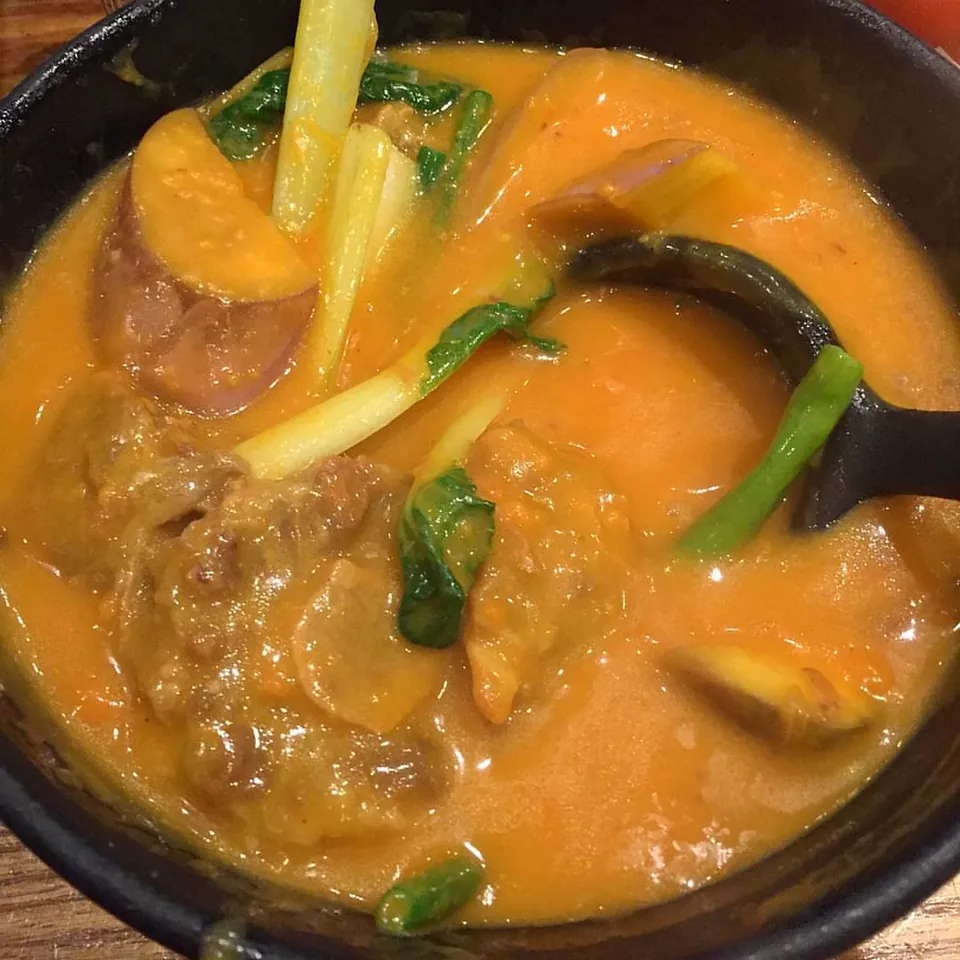
Kare-kare is a rich stew of oxtail in a thick peanut sauce. Because the name resembles "curry," a widely told account holds that British-Indian soldiers brought curry to the Philippines—but this appealing story lacks decisive sources. The true origin remains unknown.
Verification highlight popular claim → verdict → evidence
The story told most often has kare-kare invented by sepoys, the South Indian soldiers brought over during the British occupation of Manila in 1762-64, who settled at Cainta after discharge and recreated kari from whatever lay to hand, kari-kari becoming kare-kare. No primary source supports it, the name cannot be traced in Philippine sources to that period, and peanuts are rare in Indian curry while a peanut sauce is a Malay and Indonesian signature. Other accounts have Kapampangan cooks taking up a Malay kari by way of Mindanao and making it their own with peanuts and annatto, or derive the word from Tamil kari, or from cari for the golden-brown colour annatto gives. Food history has not settled between them, and no claim of invention can be checked. What is certain is the floor beneath them all: peanuts and annatto both came from the Americas and took hold in the Philippines through the galleon trade of 1565 to 1815, so the peanut sauce eaten today can be no older than that.
The three gates
- Ingredient-supply gate
- Peanuts and annatto are New World crops brought in by the galleon trade, with a window of 1565 to 1700 for their arrival (Amano et al. 2021, The Holocene). Cattle, the dishs other key ingredient, were established livestock in the Philippines by 1600. Taking both together, the earliest possible date for the peanut sauce as it is made now is 1600, not the often-cited 1620, since 1600 is when both ingredients were first jointly on hand.
- Cooking-technique gate
- Stewing.
- Venue gate
- Pampangan cooking, from the household table to the feast.
Overview
Kare-kare is a dish in an orange sauce, made by stewing oxtail, beef shank, and tripe until tender and thickening it with ground peanuts for body and sweetness. Achuete (annatto) seeds provide the color, lending a golden-brown sheen across the plate. It is served with bagoong (fermented shrimp paste) alongside to add salt and savor, the Filipino way. It has long been a home dish of the Kapampangan region of central Luzon, and a plate that graces the festival table.
Two ingredients of New World origin are central to this dish: the peanut that leads the sauce, and the achuete that gives its vivid color, both native to the Americas. They crossed the Pacific through the galleon trade that began in the late sixteenth century and took root in Philippine soil and on Philippine tables. The thick sauce of ground peanuts that defines kare-kare today took form only after these ingredients had settled in. By around 1600 the conditions were in place.
Cattle were introduced under Spanish rule and became naturalized, and stewing cuts like tail and offal long and slow called for no special technique. What gave kare-kare its shape was the way these assembled ingredients crystallized into a peanut sauce with a distinctly Southeast Asian character. Echoing the Malay-style stews that use ginger and turmeric, it grew into a dish all its own.
How we know
The origin most often cited for kare-kare is the sepoy theory. During the British occupation of Manila from 1762 to 1764, sepoys (mercenaries) brought from southern India are said to have settled around Cainta after discharge. They recreated the curry (kari) of their homeland with local ingredients, and it turned from kari-kari into kare-kare—so the account goes. The echo of the names lines up, and it has circulated widely as a plausible-sounding story.
But no contemporary record supports this theory. When the word first appeared in a Philippine language cannot be pinned down either. And a sauce of ground peanuts is rare in Indian curry, closer instead to the dishes of the Malay and Indonesian world. Appealing as the etymological tale is, it does not rise above an origin legend unsupported by independent evidence.
As for the true origin, one can only say honestly that it is not known. Beyond the sepoy account stand others: that Kapampangan cooking of Pampanga took in Malay-style kari by way of Mindanao and the Moro peoples and made it its own; that the name derives from calling the golden-brown of achuete cari (tawny). None commands a decisive primary source, and none converges on a single answer—this is where food history has arrived (Datiles & Acabado 2019; Amano et al. 2021).
What can be said for certain is limited. Only after peanuts and achuete, New World ingredients, settled in the Philippines through the galleon trade could the peanut-sauce kare-kare we know come into being. This single point is the one fixed marker in time, and beyond it—who first made the dish—remains an open question to this day.
The full set of origin theories and the detailed verification log — traceable all the way to their sources — are available on the Japanese edition.
See the full origin theories and verification log (Japanese) →
Related dishes
Shares the key ingredient
- PhoVietnamC
- Beef StroganoffRussiaC
- Chicago Italian beefChicago (USA)C
- Salt beef (the layer before canning)Ireland (Cork / Dublin)C
- AsadoRío de la Plata (Argentina / Uruguay)C
- Lomo saltadoLima (Peru)C
- BulgogiKorean Peninsula (South Korea)B
- ĆevapčićiBalkans (Serbia, etc.)C
- Proto-bulgogi (native grilled-meat proto-layer)Korean PeninsulaC
- Proto-goulash (pre-paprika herdsmen's meat stew proto-layer)HungaryC
- KharchoGeorgia (Caucasus)B
- Proto-rendang (pre-chili merendang proto-layer)West Sumatra (Minangkabau), IndonesiaC
- Nyama chomaEast Africa (Kenya, Tanzania)C
- Philly cheesesteakPhiladelphia (USA)B
- Pastel de chocloChileC
- NihariNorth India (Delhi / Awadh)C
- NikujagaJapanC
- Australian meat pieAustraliaC
- FajitasRio Grande Valley, Texas (USA)B
- Loco mocoHilo, Hawaii (USA)B
- KitfoGurage (Ethiopia)C
- Ropa viejaCubaC
- MachacaNorthern Mexico (Sonora / Sinaloa)C
- Ropa vieja (Iberian prototype)Canary Islands, SpainB
- TibsEthiopian HighlandsB
- BiltongSouth AfricaC
- Lok lakPhnom Penh (Cambodia)C
- Carne asadaNorthern Mexico (Sonora)C
- Hamburg steakHamburg (Germany)B
- Bò lúc lắc (Vietnamese shaking beef)Southern VietnamC
- Montreal-style smoked meatQuebec (Canada)D
- PastramiNew York (USA)D
- BraaiSouth AfricaC
- French dip sandwichLos Angeles, California (USA)C