All dishes / 西欧
Currywurst Period AOrigin theory BVerified
Some fields (dish name, region and gates) are shown from the Japanese-edition data.
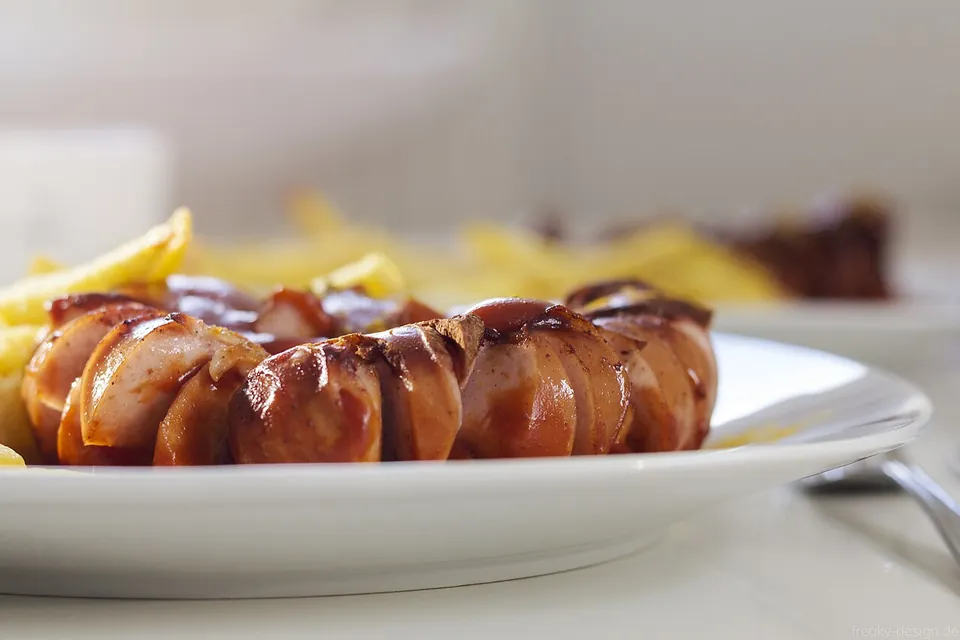
Grilled sausage sliced and dressed with a tomato-based sauce and a dusting of curry powder: a Berlin street-food staple that traces back to a single stall run by one woman in the rubble of the postwar city.
Verification highlight popular claim → verdict → evidence
The best-documented account has Herta Heuwer inventing currywurst in Berlin on 4 September 1949, using ketchup (or Worcestershire sauce) and curry powder obtained from British soldiers; she later trademarked 'Chillup' (filed 1958, registered 1959, No. 721319), as recorded by the German Patent and Trademark Office (DPMA) -- which also corrects Wikipedia's inaccurate claim of a '1951 patent.' Competing Hamburg (a 1947 novel) and Duisburg (1936) claims are unsubstantiated and do not overturn the main account; the DPMA itself notes that who truly invented the dish is not definitively known.
The three gates
- Ingredient-supply gate
- Pork is a native staple; the tomatoes used for ketchup are New World in origin but had long been established in Europe by the 19th century and are not limiting.
- Cooking-technique gate
- Grilled or boiled sausage topped with a ketchup-and-curry-powder blend.
- Venue gate
- Postwar street stalls (Imbiss) and working-class snack food.
Overview
Currywurst is a German street food of grilled (or boiled) sausage, cut into pieces, doused in a tomato-based sauce, and finished with a scattering of curry powder. It has long been eaten the way it was meant to be: standing at an Imbiss, cheap and quick.
It was born in Berlin after the Second World War. In a city battered by the fighting, people wanted something filling that could be had with little to spare. Grilled sausage was already a familiar food here, and neither the tomato sauce nor the curry that went over it had to be fetched from far away. Tomatoes had long since settled into European kitchens, and the curry powder came by way of the British soldiers who occupied the city after the war.
Factory workers and passersby ate it on their breaks, and Currywurst spread from one street corner to the next. It remains, to this day, one of the everyday tastes that Berlin is known for.
How we know
Unlike most dishes, Currywurst has a beginning that can be followed with some precision.
On 4 September 1949, at a stall in Berlin-Charlottenburg, a woman named Herta Heuwer put this dish on sale. She took ketchup (or Worcestershire sauce) and curry powder obtained from the occupying British soldiers and poured them over grilled sausage. She named the sauce Chillup. She applied to register it as a trademark only in 1958, and it was granted the following year, in 1959, under registration number 721319. The record is kept in good order by the German Patent and Trade Mark Office, which gives her claim the firmest documentary footing of all the stories told about the dish.
For a long time, though, the date of that registration circulated in a garbled form: that she had taken out a patent in 1951. Encyclopedias repeated it. But the office's own records put the application in 1958 and the registration in 1959, not 1951. The widely believed date was at odds with the primary record. What the correction does not touch is the heart of the matter: that Heuwer devised the dish on 4 September 1949.
There are, to be sure, rival voices claiming to have come first. One holds that it was served in Hamburg in 1947; another that a Dutch-born man served it in Duisburg in 1936. But the first of these began as an episode in a novel, and the author himself has acknowledged that it is fiction. The second is thin on the records that would confirm it. Neither carries enough weight to overturn the view that the dish began at Heuwer's stall. Among the origin tales handed down, the one the sources firmly support remains the story of one woman standing at a stall in the rubble of the city.
The full set of origin theories and the detailed verification log — traceable all the way to their sources — are available on the Japanese edition.
See the full origin theories and verification log (Japanese) →
Related dishes
Shares the key ingredient
- TonkatsuJapanC
- Tacos al pastorMexicoB
- FeijoadaBrazilB
- Barbecue ribsSouthern United StatesC
- Twice-cooked reheated pork (Huiguorou precursor)Sichuan, ChinaC
- ChicharrónPeru / Latin AmericaB
- ChicharrónMexicoB
- ChicharrónColombiaB
- BaoziChinaC
- Chop sueyUSA (Cantonese diaspora) / Guangdong (China)C
- Cochinita pibilYucatán (Mexico)C
- LechonCebu (Philippines)C
- SaloUkraineC
- Bak kut tehSingaporeC
- GolonkaPolandC
- GyrosGreeceB
- EisbeinBerlin (Germany)C
- SchweinshaxeBavaria (Germany)C
- Japanese-style twice-cooked porkJapanB
- ManchamantelesPuebla (Mexico)C
- PernilPuerto RicoC
- ChoripánRío de la Plata (Argentina)C
- Char siuGuangdong (China)C