All dishes / ラテンアメリカ
Tacos al pastor Period BOrigin theory BVerified
Some fields (dish name, region and gates) are shown from the Japanese-edition data.
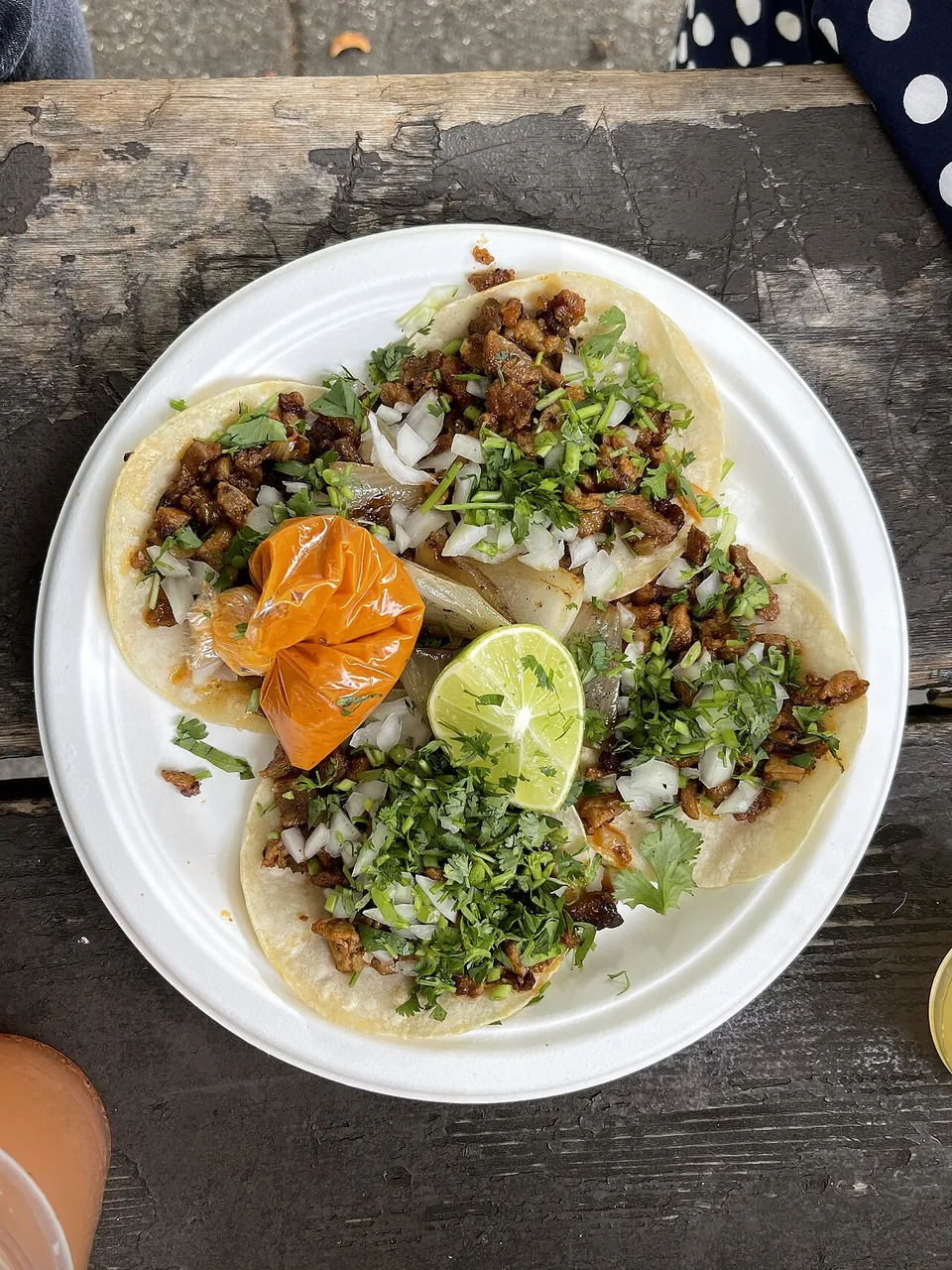
Mexico's beloved taco al pastor comes trailed by an origin story with a named owner: that a taquería in Mexico City invented it in 1966. Food history sets that lone-inventor tale aside and describes something slower instead—a Lebanese immigrant way of roasting meat that, over several decades, folded itself into Mexican pork and tortillas.
Verification highlight popular claim → verdict → evidence
Popular claim: El Tizoncito in Mexico City (Concepcion Cervantes) invented tacos al pastor in 1966. Verdict: refuted as a single-inventor myth -- La Tacopedia documents that El Huequito (Guillermo Buendia, founded 1950/1959) served the al pastor style earlier. The scholarly consensus traces a gradual fusion: Lebanese immigrants' shawarma spit-roasting technique, adapted into Puebla's tacos arabes (pork on pita, 1930s), then reworked in 1950s-60s Mexico City into corn tortillas with achiote/adobo-marinated pork. Key sources: La Tacopedia: Enciclopedia del Taco (Escalante, 2012); Mexico News Daily.
The three gates
- Ingredient-supply gate
- Pork plus the vertical spit-roasting method
- Cooking-technique gate
- Shawarma spit-roasting technique brought by Lebanese immigrants
- Venue gate
- Street stalls / popular-class food / Lebanese immigrant community
Overview
Taco al pastor took on its present form in Mexico around the middle of the twentieth century, roughly between 1940 and 1966. Both its timing and its immigrant lineage are relatively clear.
The meat is stacked in thin layers on a vertical spit, then roasted and shaved off as the spit turns. This way of cooking was not old to Mexico; it arrived from the Middle Eastern shawarma. It was carried by Lebanese immigrants who settled in Mexico in the first half of the twentieth century, and what they brought was not a new ingredient but the craft of roasting meat upright.
The path by which that craft reshaped itself on Mexican ground can be traced in stages. First, in 1930s Puebla, the Lebanese shawarma gave rise to tacos árabes—spit-roasted pork tucked into pita bread. La Oriental, founded in 1933, is remembered as one of its early carriers. Then, through the 1950s and 60s in Mexico City, the pita gave way to a corn tortilla, and the seasoning shifted to pork dressed in adobo and achiote, the annatto seed that stains it red. Both the pork and the corn were already at home in this land. A foreign way of roasting landed on Mexico's staple grain and seasonings, and became the al pastor we know.
How we know
Taco al pastor comes with a story about who made it and when: that the Mexico City taquería El Tizoncito invented it in 1966. Complete with the name of the shop, the street, and the founder, this anecdote has long circulated as the accepted account.
But food history sets that single-inventor story aside. According to the specialist encyclopedia La Tacopedia (Alejandro Escalante, 2012), the first taquería to serve the al pastor style was not El Tizoncito but El Huequito, founded in the 1950s and thus earlier on the timeline. What El Tizoncito did was introduce the showmanship—tossing a slice of pineapple into the air to catch it on the taco—and help popularize the vertical spit (the trompo); it did not conjure the dish from nothing. The verification by foodpolice.mx likewise treats the invention tale as a fabricated origin story.
Where food historians settle is that no single inventor and no single year of invention can be pinned down. Out of the tacos árabes of Puebla, across the Mexico City of the 1950s and 60s, the dish took shape little by little—a cultural blending that put down roots. Before the vertical roast the Lebanese brought met Mexican pork and tortillas and fused into one thing, several decades had passed that no one person's credit can contain.
The full set of origin theories and the detailed verification log — traceable all the way to their sources — are available on the Japanese edition.
See the full origin theories and verification log (Japanese) →
Related dishes
Shares the key ingredient
- TonkatsuJapanC
- FeijoadaBrazilB
- Barbecue ribsSouthern United StatesC
- CurrywurstBerlin (Germany)B
- Twice-cooked reheated pork (Huiguorou precursor)Sichuan, ChinaC
- ChicharrónPeru / Latin AmericaB
- ChicharrónMexicoB
- ChicharrónColombiaB
- BaoziChinaC
- Chop sueyUSA (Cantonese diaspora) / Guangdong (China)C
- Cochinita pibilYucatán (Mexico)C
- LechonCebu (Philippines)C
- SaloUkraineC
- Bak kut tehSingaporeC
- GolonkaPolandC
- GyrosGreeceB
- EisbeinBerlin (Germany)C
- SchweinshaxeBavaria (Germany)C
- Japanese-style twice-cooked porkJapanB
- ManchamantelesPuebla (Mexico)C
- PernilPuerto RicoC
- ChoripánRío de la Plata (Argentina)C
- Char siuGuangdong (China)C