All dishes / 北米
Loco moco Period AOrigin theory BVerified
Some fields (dish name, region and gates) are shown from the Japanese-edition data.
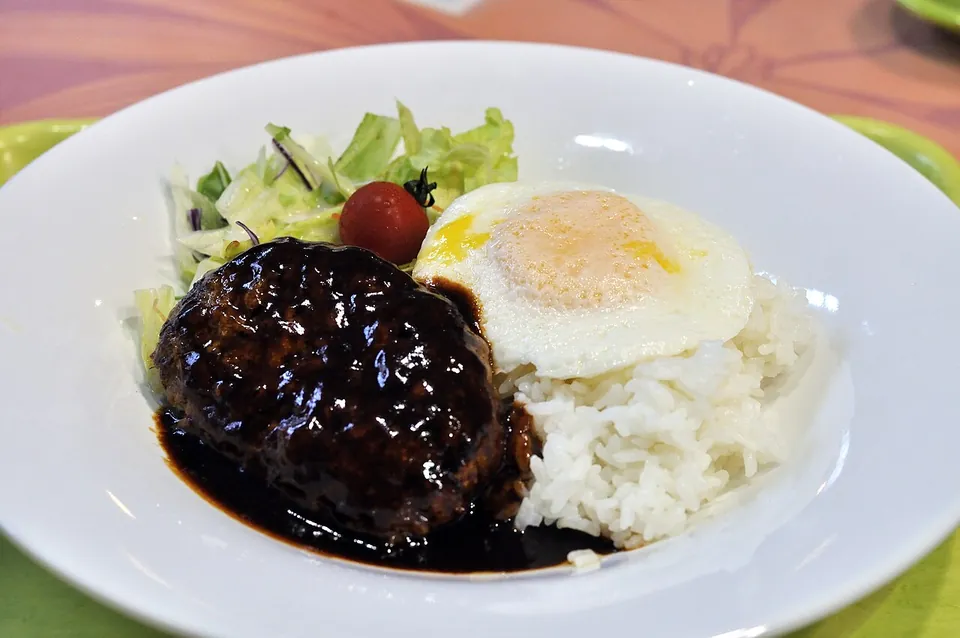
The loco moco, the Hawaiian bowl of rice topped with a hamburger patty, a fried egg, and gravy. Its beginning traces to a single couple in Hilo in 1949. It is a rare dish whose year, whose shop, and even the story of its naming are all known.
Verification highlight popular claim → verdict → evidence
Café 100 markets itself as the 'home of the loco moco,' but food historians (Kelly 1983, Laudan 1996, Hiura 2009) do not credit it as the originator. The documented origin is the Lincoln Grill in Hilo, where Richard and Nancy Inouye created the dish around 1949 for the local Lincoln Wreckers youth club: rice topped with a hamburger patty and gravy (the fried egg was added later), a cheap, fast meal.
The three gates
- Ingredient-supply gate
- Beef, rice, and eggs were all locally available through settlement and immigration.
- Cooking-technique gate
- Rice topped with a hamburger patty, a fried egg, and gravy, served as a rice bowl.
- Venue gate
- A postwar student diner in Hilo, serving a cheap one-plate meal.
Overview
The loco moco is a Hawaiian plate of white rice topped with a hamburger patty and a fried egg, poured over with plenty of gravy. Cheap and quick, filling in one plate, it took root in postwar Hawaii.
Beef, rice, and egg were all things a cook in Hawaii could get on the islands, through settlement and migration. Cattle had crossed to Hawaii by the end of the eighteenth century, and rice and eggs settled on the islands along with the lives of the migrants. The ingredients were there.
What makes the dish its own is the idea of arranging them into a bowl: a hamburger patty and a fried egg over rice, drawn together as one plate by the gravy. It is a plain assembly, but a satisfying one. The place where it was born was a students' diner in postwar Hilo. That it was served as something the young could eat cheaply and quickly says a great deal about the plainness of the loco moco.
How we know
The beginning of the loco moco is found at the Lincoln Grill in Hilo, on the island of Hawaii, in 1949.
The owners, Richard and Nancy Inouye, devised it for the teenaged members of the Lincoln Wreckers, a barefoot football club, as a cheap and quick plate priced at twenty-five cents at the time. It was rice topped with a hamburger patty and gravy; the fried egg was added in later years. The story of the name has come down as well. A member, George Okimoto, went by the nickname Crazy, and George Takahashi, who was studying Spanish at Hilo High School, proposed loco, the word for crazy. To that they added moco for the sound of it, and so loco moco.
This account comes down in agreement from the studies that have traced Hawaiian food. The earliest record is Loco Moco: A Folk Dish in the Making, written by the sociologist James L. Kelly in 1983 (Social Process in Hawaii, volume 30); it was carried on by the food historian Rachel Laudan in The Food of Paradise (1996) and by the Hawaiian food historian Arnold Hiura in Kau Kau (2009). Three sources agree, independently, on a 1949 Lincoln Grill origin.
A second shop, Cafe 100, is also well known for calling itself the home of the loco moco. Cafe 100 is indeed an old establishment that has served the dish since 1949, but food historians do not recognize it as the shop that devised it. Its claim to be the home is a matter of the shop's own billing; that the Lincoln Grill served it first is the settled conclusion today.
The full set of origin theories and the detailed verification log — traceable all the way to their sources — are available on the Japanese edition.
See the full origin theories and verification log (Japanese) →
Related dishes
Shares the key ingredient
- PhoVietnamC
- Beef StroganoffRussiaC
- Chicago Italian beefChicago (USA)C
- Salt beef (the layer before canning)Ireland (Cork / Dublin)C
- AsadoRío de la Plata (Argentina / Uruguay)C
- Lomo saltadoLima (Peru)C
- BulgogiKorean Peninsula (South Korea)B
- ĆevapčićiBalkans (Serbia, etc.)C
- Proto-bulgogi (native grilled-meat proto-layer)Korean PeninsulaC
- Proto-goulash (pre-paprika herdsmen's meat stew proto-layer)HungaryC
- KharchoGeorgia (Caucasus)B
- Proto-rendang (pre-chili merendang proto-layer)West Sumatra (Minangkabau), IndonesiaC
- Nyama chomaEast Africa (Kenya, Tanzania)C
- Philly cheesesteakPhiladelphia (USA)B
- Pastel de chocloChileC
- NihariNorth India (Delhi / Awadh)C
- NikujagaJapanC
- Australian meat pieAustraliaC
- FajitasRio Grande Valley, Texas (USA)B
- KitfoGurage (Ethiopia)C
- Ropa viejaCubaC
- MachacaNorthern Mexico (Sonora / Sinaloa)C
- Ropa vieja (Iberian prototype)Canary Islands, SpainB
- TibsEthiopian HighlandsB
- BiltongSouth AfricaC
- Lok lakPhnom Penh (Cambodia)C
- Carne asadaNorthern Mexico (Sonora)C
- Hamburg steakHamburg (Germany)B
- Bò lúc lắc (Vietnamese shaking beef)Southern VietnamC
- Montreal-style smoked meatQuebec (Canada)D
- Kare-karePhilippinesC
- PastramiNew York (USA)D
- BraaiSouth AfricaC
- French dip sandwichLos Angeles, California (USA)C