All dishes / 北米
Philly cheesesteak Period BOrigin theory BVerified
Some fields (dish name, region and gates) are shown from the Japanese-edition data.
Thin-sliced beef griddled and stuffed into a roll, the signature snack of Philadelphia. That it began at a single street cart around 1930 is clear enough. But who first laid a slice of cheese on top to make it a cheesesteak, and exactly when, and with what cheese, has never been settled.
Verification highlight popular claim → verdict → evidence
Myth: Geno's founder Joey Vento is sometimes credited with 'perfecting'/inventing the cheesesteak in 1966. Verdict: the Olivieri brothers' 1930 steak sandwich in South Philadelphia predates Geno's by 36 years; Vento's claim conflates later refinement with actual invention. Main sources: Library Company of Philadelphia / Historical Society of Pennsylvania exhibition catalog (1987); National Geographic.
The three gates
- Ingredient-supply gate
- Beef (Old World cattle) was introduced to North America in the colonial period (Jamestown, 1611) and was already a native staple in 1930s Philadelphia, so although it's the limiting ingredient, its long-established local availability doesn't gate the modern dish's formation. Cheese was likewise already available. The real limiting factor was 1930s urban street-vendor culture.
- Cooking-technique gate
- Griddle-frying thinly sliced beef (chopped steak) on an Italian roll. Adding cheese (American/provolone around 1951, Cheez Whiz in the late 1950s) completed the 'cheesesteak.'
- Venue gate
- Street stand / working-class eatery, common-people stratum, eating-out access, urban immigrant (Italian) community.
Overview
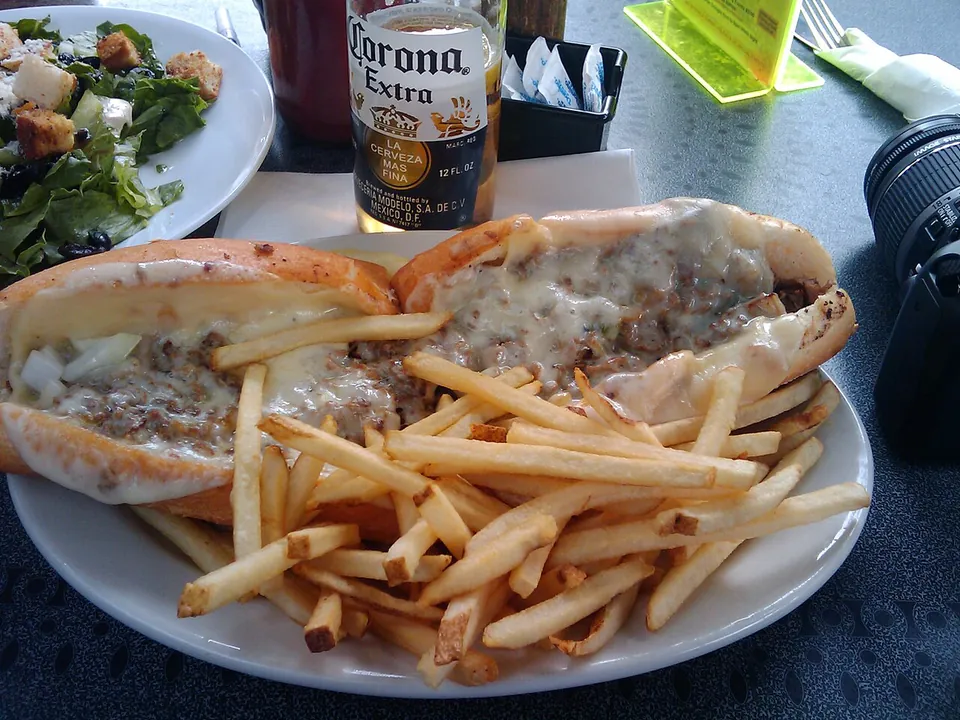
The Philly cheesesteak is one of Philadelphia's defining quick meals. Thin-sliced beef is griddled with onions and packed into a long Italian roll, with melted cheese running through it: cheap, filling, eaten standing up.
The beginning of the story is clear. Around 1930, the Olivieri brothers, Pat and Harry, ran a hot dog cart in South Philadelphia and began selling thin-sliced beef and onions in a roll. It caught on, and became the starting point of the shop later known as Pat's King of Steaks. In time a second famous shop opened across the street, and South Philadelphia made its name as the home of the cheesesteak.
What made this dish possible was not a new ingredient but the life of the city itself. Beef and cheese were both everyday goods in the Philadelphia of that era, with no need to send away for them. The backdrop was an urban street-food culture sustained by immigrants, Italian-Americans prominent among them. The demand of working people for something cheap and fast to eat out is what rooted this griddled sandwich on the street corners. The first item was a beef sandwich; the cheese that would turn it into a cheesesteak came a little later.
The 'beefsteak sandwich', thin beef in bread, does appear by name in nineteenth-century American cookbooks. But that was a different thing, with a different bread and different seasoning, and not a direct ancestor of the plate we eat now. That an old name existed is one matter; that the dish we know today came into being is another.
How we know
That the Olivieri brothers began selling a beef sandwich around 1930 has settled into a well-known and stable account. A 1987 exhibition catalogue from the Library Company of Philadelphia and the Historical Society of Pennsylvania records that this snack developed in the early twentieth century, combining thin-sliced beef, onions, and cheese in a roll, so that not only street lore but the research of local specialist institutions supports this beginning.
The trouble comes at the next step: when, by whom, and with what cheese the sandwich was made into a cheesesteak. Here several claims stand side by side. One holds that in 1951 Joe Lorenza, manager of the Ridge Avenue shop, first added cheese, said to be American, or perhaps provolone. Another has it that in the late 1950s Frank Olivieri brought in Cheez Whiz, the jarred melting cheese. The original steak sandwich of 1930 and the cheese that took hold in the 1950s clearly belong to separate stages, yet the records of that transition are thin. The dates split between the 1940s and 1951 depending on who is telling it, and the type of cheese differs too.
One reason the matter stays open is that many of these anecdotes come from shops claiming to be the origin. A claim that one's own shop was the beginning has to be taken with a grain of salt. The clearest case is Joey Vento, who opened the rival shop Geno's in 1966 and asserted that he, spending two thousand dollars on thin-sliced ribeye, was the one who perfected the cheesesteak. But Geno's opened fully thirty-six years after the Olivieri beginning of 1930; this is not the story of inventing the dish but of later polishing one's own house style. It is a promotional claim that confuses invention with improvement, and it does nothing to unsettle the 1930 beginning.
What is certain is the broad outline of the start, a beef sandwich born from a single cart in the South Philadelphia of around 1930, while the slice of cheese that finished it into the famous cheesesteak remains, for now, a matter of storytelling rather than record.
The full set of origin theories and the detailed verification log — traceable all the way to their sources — are available on the Japanese edition.
See the full origin theories and verification log (Japanese) →
Related dishes
Shares the key ingredient
- PhoVietnamC
- Beef StroganoffRussiaC
- Chicago Italian beefChicago (USA)C
- Salt beef (the layer before canning)Ireland (Cork / Dublin)C
- AsadoRío de la Plata (Argentina / Uruguay)C
- Lomo saltadoLima (Peru)C
- BulgogiKorean Peninsula (South Korea)B
- ĆevapčićiBalkans (Serbia, etc.)C
- Proto-bulgogi (native grilled-meat proto-layer)Korean PeninsulaC
- Proto-goulash (pre-paprika herdsmen's meat stew proto-layer)HungaryC
- KharchoGeorgia (Caucasus)B
- Proto-rendang (pre-chili merendang proto-layer)West Sumatra (Minangkabau), IndonesiaC
- Nyama chomaEast Africa (Kenya, Tanzania)C
- Pastel de chocloChileC
- NihariNorth India (Delhi / Awadh)C
- NikujagaJapanC
- Australian meat pieAustraliaC
- FajitasRio Grande Valley, Texas (USA)B
- Loco mocoHilo, Hawaii (USA)B
- KitfoGurage (Ethiopia)C
- Ropa viejaCubaC
- MachacaNorthern Mexico (Sonora / Sinaloa)C
- Ropa vieja (Iberian prototype)Canary Islands, SpainB
- TibsEthiopian HighlandsB
- BiltongSouth AfricaC
- Lok lakPhnom Penh (Cambodia)C
- Carne asadaNorthern Mexico (Sonora)C
- Hamburg steakHamburg (Germany)B
- Bò lúc lắc (Vietnamese shaking beef)Southern VietnamC
- Montreal-style smoked meatQuebec (Canada)D
- Kare-karePhilippinesC
- PastramiNew York (USA)D
- BraaiSouth AfricaC
- French dip sandwichLos Angeles, California (USA)C