All dishes / 北米
Spam musubi Period BOrigin theory CVerified
Some fields (dish name, region and gates) are shown from the Japanese-edition data.
Spam musubi is a Hawaiian staple, and yet the question of who first made it still has no answer that narrows to a single person.
Verification highlight popular claim → verdict → evidence
SPAM became ubiquitous in Hawaii through WWII-era U.S. military Pacific shipping and rationing (1941-45), when fishing restrictions made fresh protein scarce and canned meat filled the gap; after the war, Hawaii's Japanese community folded it into the onigiri tradition to create the modern musubi. No single inventor is established: competing accounts credit Barbara Funamura (Kauai, 1983), Mitsuko Kaneshiro (Honolulu, early 1980s), and even a mainland internment-camp precursor, and multiple independent sources name different people without converging -- so the inventor question stays an open, unresolved account.
The three gates
- Ingredient-supply gate
- Rice and nori are native staples in Hawaii; the limiting ingredient is canned meat (SPAM), whose local availability depended on WWII military shipping and rationing infrastructure, which made it ubiquitous in Hawaii by 1941-45
- Cooking-technique gate
- SPAM sliced and pan-fried, layered on a rice block, and wrapped with nori -- a simple repurposing of canned provisions that requires no special equipment and does not itself limit the date
- Venue gate
- Household, convenience store, and bento staple; everyday and portable food across Hawaii's Japanese and multiethnic communities
Overview
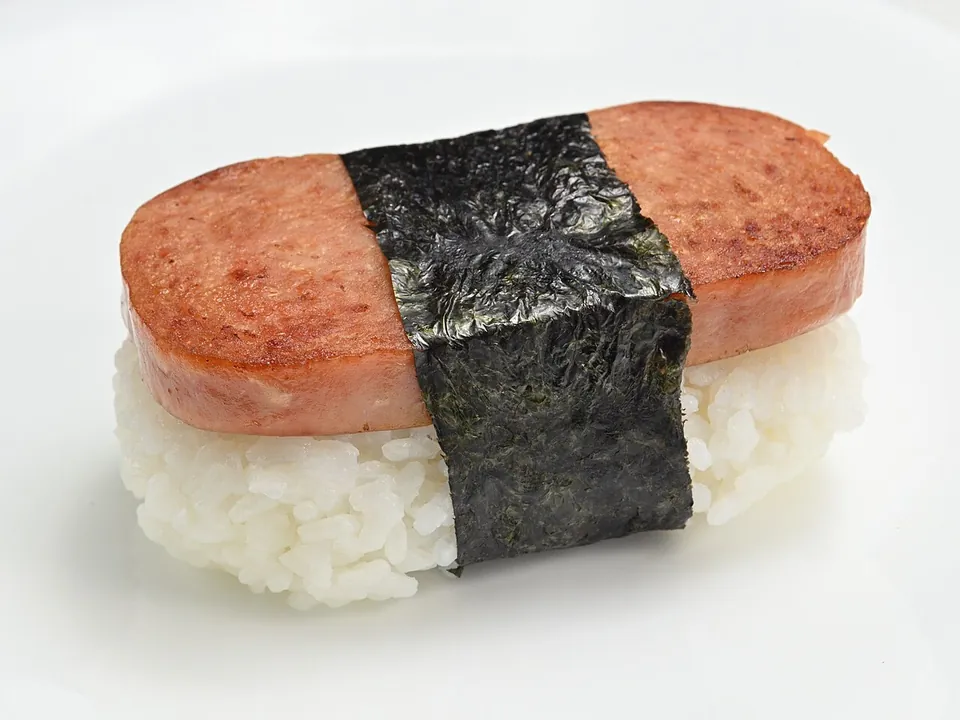
A slice of canned Spam, seasoned sweet and salty, sits atop a block of pressed rice, wrapped with a band of nori. That is all there is to spam musubi, a portable everyday food of Hawaii. It came into being in Hawaii from the years of the Second World War into the postwar period, and that timing is clear enough.
Rice and nori, the everyday makings of the dish, were long-established staples of the islands, on the table from early on. Canned Spam had been on the market since 1937. Even so, until Spam had crossed the Pacific and spread through the kitchens of Hawaii, this rice ball had no way of appearing on the islands. That came after the United States entered the war at the end of 1941. The shipping and military rationing the U.S. laid across the Pacific brought canned meat to Hawaii in great quantity, until it was everywhere as a matter of course. Wartime limits on fishing thinned the supply of fresh protein, and that too pushed canned meat toward the center of the table.
The place where it was made was the kitchen of ordinary people, the Japanese Americans of Hawaii among the islands many communities. You cut the Spam thin, grilled it, laid it over pressed rice, and wrapped it in nori. Nothing about that called for special tools; it could be made at home as it was. The form settled in the postwar years and later spread to become a fixture of convenience stores and packed lunches.
How we know
People often ask who first made this dish. But from the records that survive, no single inventor can be pinned down.
Several names come up. The earliest to appear in a newspaper is from 1983, in the local Garden Island of Kauai, which reported that Barbara Funamura had turned it into a product at her shop using a mold. At first it was triangular, a shape meant to set it apart from a similar wrapped item. In Honolulu, meanwhile, Mitsuko Kaneshiro is recorded as opening a shop in the early 1980s and selling five hundred a day. Going back further, there is a story that people who survived the Japanese American internment camps on the mainland made a forerunner, laying seasoned Spam over white rice. Funamuras obituary calls her "the creator of spam musubi," but another paper writes that "there is no definitive history for this aberration," and a cookbook names Kaneshiro as a candidate. Each points to a different person, and the accounts do not converge.
Within that, the broad course is not in dispute. Arnold Hiuras Kau Kau, a history of Hawaiian food, describes how, under the wartime breakdown of shipping and the rationing that followed, Spam became the islands main protein and settled into local cooking in the postwar years. What carried Spam into every corner of the islands was not the canning technique born in 1937 but the military rationing that shipped the cans across the Pacific. The camp forerunner, seasoned Spam over white rice, differs in form from todays nori-wrapped version and lacks a primary source to fix its date. The first person lies somewhere in the fog of the record, yet the path by which a can the war brought turned into a rice ball remains plainly visible.
The full set of origin theories and the detailed verification log — traceable all the way to their sources — are available on the Japanese edition.
See the full origin theories and verification log (Japanese) →