All dishes / 北米
Jucy Lucy Period BOrigin theory CVerified
Some fields (dish name, region and gates) are shown from the Japanese-edition data.
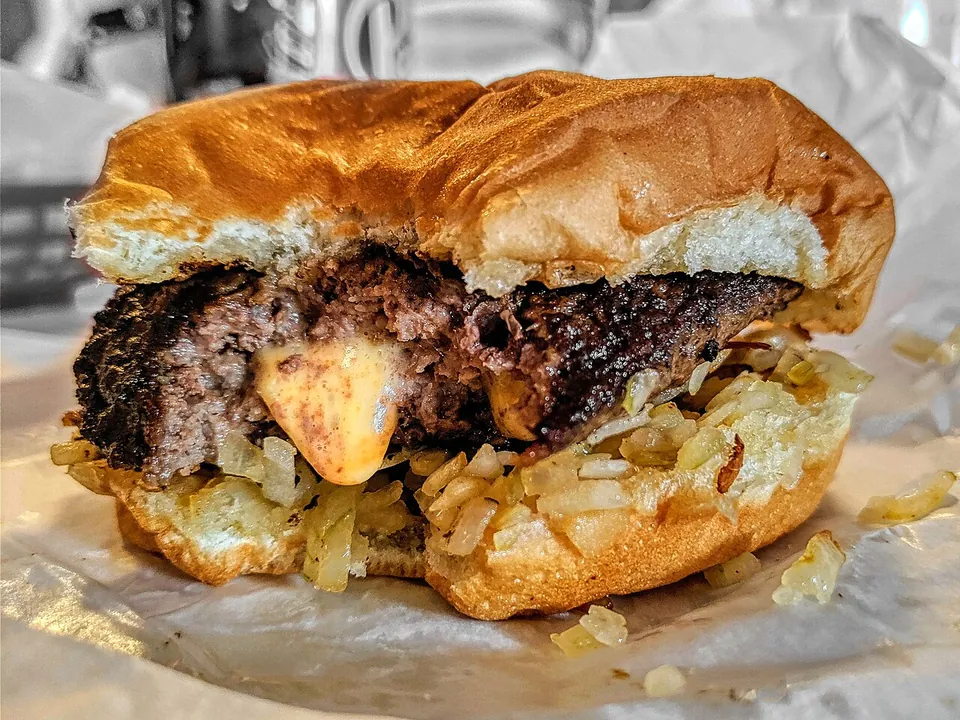
The Jucy Lucy, the Minneapolis burger that seals molten cheese inside the meat and grills it shut. Two bars have claimed to have invented it, refusing to yield for more than half a century, yet no primary source can settle who truly did.
Verification highlight popular claim → verdict → evidence
Competing claims remain unsettled. Matt's Bar says a regular customer in 1954 asked for cheese inside the patty, and when the melted cheese overflowed exclaimed 'Wow, that's one Juicy Lucy!', with a later printing error dropping the 'i' to give the 'Jucy Lucy' spelling. Burger historian George Motz (Hamburger America), however, suggests the dish may predate Matt's Bar's founding, crediting it only with popularizing rather than inventing it. The earliest documented reference to the dish dates no earlier than 1998, well after the claimed 1954 origin.
The three gates
- Ingredient-supply gate
- Beef and cheese were both already naturalized ingredients.
- Cooking-technique gate
- Grilling a beef patty stuffed with cheese.
- Venue gate
- Minneapolis bars, Matt's Bar and the 5-8 Club, both claim the origin.
Overview
The Jucy Lucy is a cheeseburger in which cheese is wrapped inside a beef patty and grilled shut. The cheese, hidden from view, melts inside, and the point of the thing is the rush of hot cheese that spills out at the first bite. It is a signature of Minneapolis, Minnesota.
Beef and cheese were both ordinary sights in the kitchens and barrooms of mid-twentieth-century Minneapolis, where the burger was born. The dish is really nothing more than those on-hand ingredients remade into a single trick: shutting the cheese inside the patty and grilling it.
And the Jucy Lucy grew up not in the home but in the bar. Minneapolis taverns were its stage, and two bars that each claim to have started it still stand at the center of the story.
How we know
The origin of the Jucy Lucy is claimed by two bars in South Minneapolis, each naming itself the source, a quarrel they have carried on since the 1950s.
One is Matt's Bar. In 1954, the story goes, a regular asked for cheese to be put inside the patty, and when the melted cheese spilled out at the bite he cried, Wow, that's one Juicy Lucy! When the menu was printed, an i dropped out, and so the bar spells its version Jucy Lucy. The anecdote is specific, but there is no way to confirm the year or the sequence in any source from the time.
The other is the 5-8 Club, on Cedar Avenue in the same part of South Minneapolis, about five kilometers from Matt's. It spells the name Juicy Lucy, the correct way, and claims the invention as its own. But it carries no detailed story of when or how the dish was created, and like Matt's it cannot show its origin in any record. The Star Tribune has described the rivalry as a battle going back to the 1950s.
George Motz, who follows the history of the burger, does not take Matt's tale of a 1954 invention from a customer's remark at face value in his Hamburger America. The Jucy Lucy, he suggests, may well have existed before Bristol bought the place (formerly Nibs) and reopened it as Matt's Bar; Bristol, on this reading, was not the inventor but the man who put it on the menu and carried it into the wider world.
The earliest record in which the name Jucy or Juicy Lucy appears in print comes only down to Grumdahl in 1998, which does not overlap with the 1954 that the two bars insist on. No menu, no newspaper advertisement, no accounts from the time survive to tell how it was devised, and the food writers who have taken it up (The Takeout, Chowhound) alike conclude that the inventor is unknown, still unclear.
Which bar is the true home cannot be decided, and remains undecided, for want of a contemporary record to settle it. Even so, that this burger of cheese wrapped in meat and grilled shut took shape in 1950s Minneapolis is not in doubt.
The full set of origin theories and the detailed verification log — traceable all the way to their sources — are available on the Japanese edition.
See the full origin theories and verification log (Japanese) →