All dishes / 北米
Crab Rangoon Period BOrigin theory BVerified
Some fields (dish name, region and gates) are shown from the Japanese-edition data.
Crab Rangoon, the fried wonton served in American Chinese restaurants, wears the name of Rangoon and is often taken for a traditional Chinese dish. In fact it is an American invention.
Verification highlight popular claim → verdict → evidence
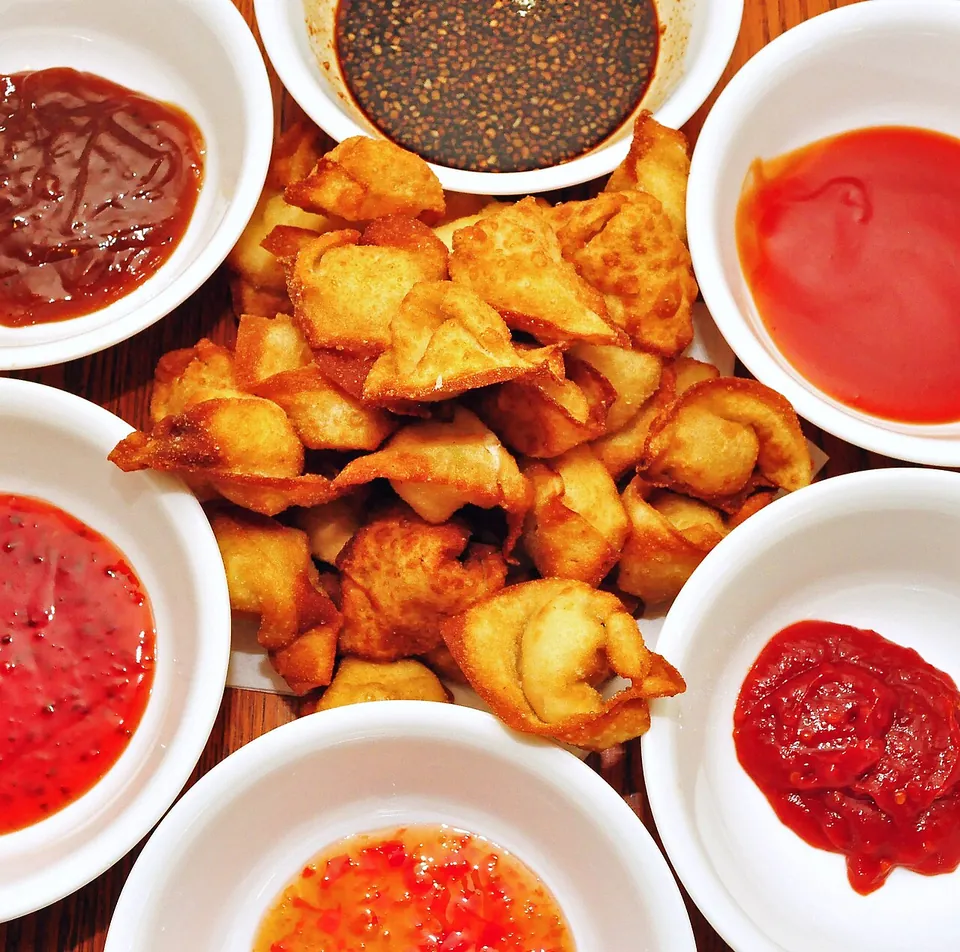
A wonton wrapper stuffed with crab and cream cheese and deep-fried, most likely dreamed up in the 1940s-50s by Victor Bergeron, founder of the tiki restaurant chain Trader Vic's, as a faux-Chinese, faux-Polynesian appetizer. Despite its ubiquity on Chinese-American menus, it has no roots in Chinese or Burmese cooking — cream cheese never appears there.
The three gates
- Ingredient-supply gate
- Cream cheese, a 19th-century American product, is the limiting ingredient; crab was already available.
- Cooking-technique gate
- A borrowed Chinese-American technique: wrapping the filling in wonton wrappers and deep-frying.
- Venue gate
- Tiki bars and American Chinese restaurants, in the Trader Vic's lineage.
Overview
Crab Rangoon is an appetizer of wonton wrappers filled with cream cheese and crab, then deep-fried. It was born in mid-20th-century California, in the 1950s. The setting was the tiki bar, where diners were entertained amid décor evoking the South Pacific islands. The strand credited with fathering the dish is Trader Vic's, the restaurant empire run by Victor Bergeron. By 1955 the name Crab Rangoon appears on the menu of the Beverly Hills location, so it was being served by then at the latest.
Cream cheese is what holds the dish together. That rich, molten filling is what makes it what it is. Cream cheese was a comparatively new ingredient, mass-produced in the United States over the 19th century. The wrapper is borrowed from the wonton, and the technique of folding and frying from Chinese cooking. Crab had long been caught along the coast. For all its exotic name and Chinese wrapper, the ingredient at the heart of its flavor came out of America's own dairy culture.
How we know
Crab Rangoon is dogged by the notion that it is a traditional Chinese dish. Because it turns up as a matter of course in Chinese restaurants across the United States, people have taken it for something eaten in China since long ago. Both the record and the contents of the dish undo that idea.
Start with the contents. Chinese cooking made little use of dairy to begin with, in a region where many people digest lactose poorly. The idea of building a filling around cream cheese exists as a tradition in neither China nor Burma. The name Rangoon points to the former capital of Burma, now Myanmar, yet nothing links this dish to Burmese cooking. It is a signboard name, borrowed only for its whiff of the exotic.
The oldest trail one can actually follow leads to the 1955 menu of the Trader Vic's location in Beverly Hills. The invention is credited to Victor Bergeron, or to Joe Young, a Chinese-American cook who worked at the restaurant. Either way, food history agrees that this is an appetizer devised by Americans within a tiki culture staged to conjure the South Seas and the Far East. Its Chinese pedigree was a story draped over the dish after the fact.
The full set of origin theories and the detailed verification log — traceable all the way to their sources — are available on the Japanese edition.
See the full origin theories and verification log (Japanese) →