All dishes / 東南アジア
Lok lak Period BOrigin theory CVerified
Some fields (dish name, region and gates) are shown from the Japanese-edition data.
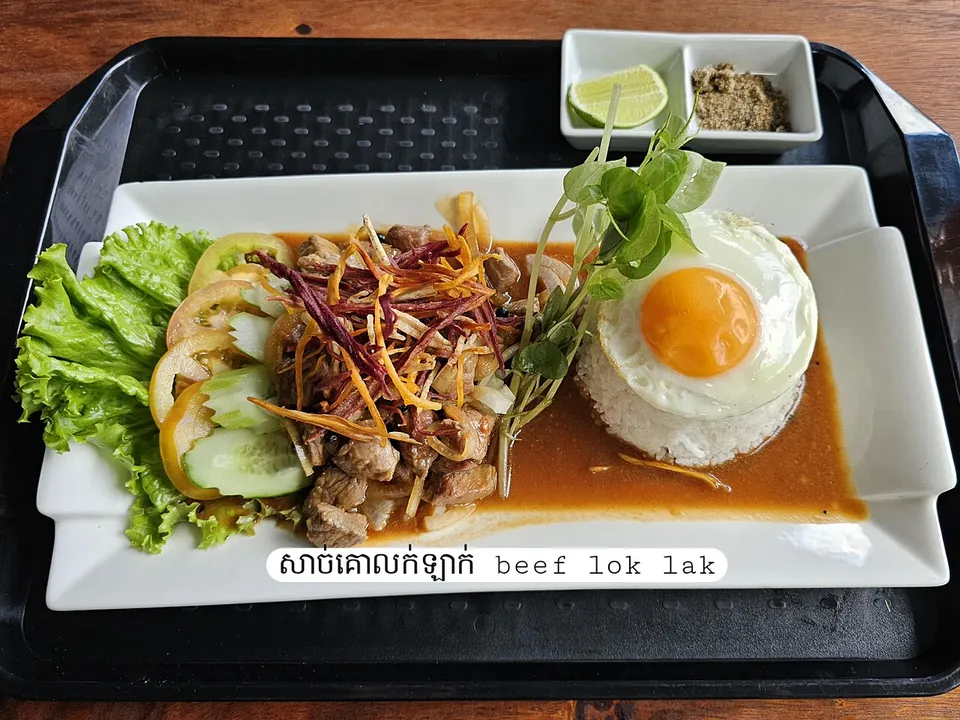
Cubes of beef seared hard and fast in a screaming-hot pan, then dressed with lime and pepper: lok lak is one of Cambodia's signature meat dishes. Cattle had long lived on this land, but their meat reaching the everyday table was a surprisingly recent turn.
Verification highlight popular claim → verdict → evidence
Native humped cattle had long existed in Cambodia but mainly as draft animals; beef only became an everyday food once the French colonial period (1863-1953) built the supply and distribution to sell it as meat. The dish's name is thought to borrow from Vietnamese luc lac ('to shake'), tracing to Saigon's bo luc lac. Main source: the 1931 French colonial livestock report La protection et l'amelioration du betail en Indochine.
The three gates
- Ingredient-supply gate
- Native humped cattle existed long before, but as draft animals rarely eaten as meat. The limiting factor was the French colonial period (1863-1953), when cattle began to be raised and distributed at scale as meat and entered everyday consumption. Kampot pepper and lime were both native.
- Cooking-technique gate
- Beef cut into cubes, stir-fried quickly over high heat, and served with a lime-and-pepper sauce.
- Venue gate
- From urban eateries of the French colonial period to Cambodia's signature meat dish.
Overview
Lok lak is made by tossing diced beef in a hot pan, shaking it as it sears over a fierce flame, and serving it with a dipping sauce of lime and pepper. The Kampot pepper in that sauce and the lime that sharpens it are both long-standing local ingredients, at hand on this land from early on.
Cambodia had kept zebu cattle for a very long time. They were working animals, though, bent to the plough, and their meat rarely made it onto the daily table. Beef became something raised at scale, sold in markets, and eaten regularly only under French Indochina (1863-1953). The colonial cities wanted beef, and husbandry and trade were organized to meet that demand. Sold in the city eateries, the stir-fried beef gradually settled into place as a dish that came to stand for Phnom Penh.
The name lok lak points to the act of 'shaking', mirroring the very motion of tossing the pan as the beef sears.
How we know
Two threads run together through how lok lak came to be.
One begins with beef becoming something people ate. For the International Colonial Exposition held in Paris in 1931, the economic section of French Indochina, with its inspectorate of agriculture, livestock and forestry, drew up a report: La protection et l'amélioration du bétail en Indochine (Hanoi: Imprimerie d'Extrême-Orient, 1931). Its chapter on Cambodia sets the ox down first of all as a partner in the fields. "Le cultivateur cambodgien élève lui-même le bétail nécessaire à son travail" — the Cambodian farmer raises for himself the animals his work requires. And, elsewhere in the same chapter: "Il reste, malgré cela, pour le cultivateur cambodgien l'auxiliaire par excellence" — even so, the ox remains for the Cambodian farmer the helper above all others. The same chapter records something else too. Cochinchina, short of livestock of its own, had always leaned on supply from Cambodia. The ox pulled a plough and, under the colonial administration, was also stock bought and driven across provincial lines. The historian Liam Kelley, reading the same report, argues that beef-eating in Indochina was organized under the pressure of French demand.
The zebu had been on this land all along. Once its meat ran into the markets and reached ordinary tables, a plate of diced beef seared fast and dressed with lime and Kampot pepper found its place on the menus of the colonial city. On this much the accounts do not disagree: French rule and the beef trade built under it are where the dish begins. Who first cooked it, in which kitchen, and in what year is another matter. No record of that has surfaced, and no single founding story stands up.
The other thread ties the dish to Vietnam's bò lúc lắc, or shaking beef. The name lok lak is borrowed from the Vietnamese lúc lắc, 'to shake'. It is generally held that a seared beef dish which arose in Saigon under French rule came first, and that it passed to neighboring Cambodia, where it took the name lok lak. On the Cambodian side, the early version was squares of steak pan-seared in French butter; later, under the influence of Chinese-style stir-frying, it shifted toward thinner, cheaper cuts. Other accounts trace the name to the French escalope or to a Chinese word lu, but these are folk etymologies circulating on recipe sites, without independent documentary support. The earliest printed use of the name has yet to surface: the colonial-era French dictionaries and cookbooks searched so far do not carry it, so the year the dish took shape cannot be narrowed down from the name.
The full set of origin theories and the detailed verification log — traceable all the way to their sources — are available on the Japanese edition.
See the full origin theories and verification log (Japanese) →
Related dishes
Cross-links Sister dishes & same-name dishes (separate lineage)
Shares the key ingredient
- PhoVietnamC
- Beef StroganoffRussiaC
- Chicago Italian beefChicago (USA)C
- Salt beef (the layer before canning)Ireland (Cork / Dublin)C
- AsadoRío de la Plata (Argentina / Uruguay)C
- Lomo saltadoLima (Peru)C
- BulgogiKorean Peninsula (South Korea)B
- ĆevapčićiBalkans (Serbia, etc.)C
- Proto-bulgogi (native grilled-meat proto-layer)Korean PeninsulaC
- Proto-goulash (pre-paprika herdsmen's meat stew proto-layer)HungaryC
- KharchoGeorgia (Caucasus)B
- Proto-rendang (pre-chili merendang proto-layer)West Sumatra (Minangkabau), IndonesiaC
- Nyama chomaEast Africa (Kenya, Tanzania)C
- Philly cheesesteakPhiladelphia (USA)B
- Pastel de chocloChileC
- NihariNorth India (Delhi / Awadh)C
- NikujagaJapanC
- Australian meat pieAustraliaC
- FajitasRio Grande Valley, Texas (USA)B
- Loco mocoHilo, Hawaii (USA)B
- KitfoGurage (Ethiopia)C
- Ropa viejaCubaC
- MachacaNorthern Mexico (Sonora / Sinaloa)C
- Ropa vieja (Iberian prototype)Canary Islands, SpainB
- TibsEthiopian HighlandsB
- BiltongSouth AfricaC
- Carne asadaNorthern Mexico (Sonora)C
- Hamburg steakHamburg (Germany)B
- Montreal-style smoked meatQuebec (Canada)D
- Kare-karePhilippinesC
- PastramiNew York (USA)D
- BraaiSouth AfricaC
- French dip sandwichLos Angeles, California (USA)C