All dishes / 北米
Fajitas Period BOrigin theory BVerified
Some fields (dish name, region and gates) are shown from the Japanese-edition data.
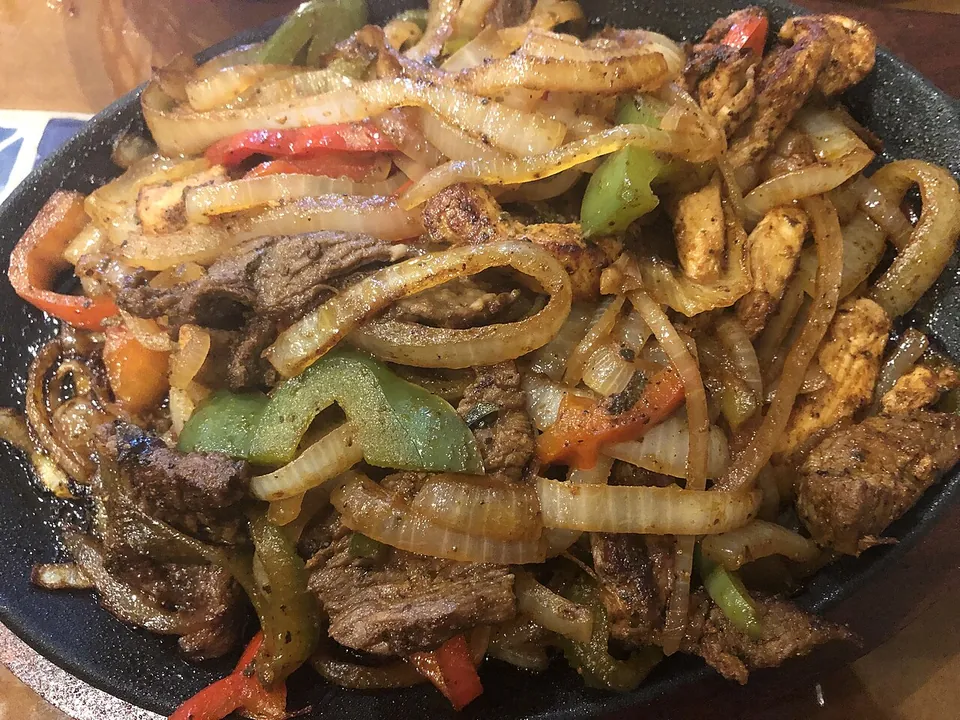
Beef skirt steak grilled over an open flame and wrapped in a tortilla, a dish of Texas. It looks like a sizzling restaurant showpiece, yet it began as the scrap meat handed to cowhands as part of their pay on Texas ranches.
Verification highlight popular claim → verdict → evidence
Fajitas trace to 1930s South and West Texas ranches, where vaqueros (cowhands) received cheaper cuts of beef, including skirt steak, as part of their pay and grilled it quickly over an open flame. This origin was first documented by researcher Homero Recio in a 1984 Texas A&M study built on oral history. The name comes from the Spanish "faja" (strip/sash), already used for the cut before the dish was sold commercially by several vendors between 1969 and 1973 and popularized nationally in the 1980s.
The three gates
- Ingredient-supply gate
- Beef became available through cattle ranching after European livestock arrived; skirt steak was one of the cheaper cuts given to ranch hands as part of their pay.
- Cooking-technique gate
- Grilling directly over an open flame or griddle.
- Venue gate
- Originated as a cowhand's meal on Texas ranches, later served in restaurants that popularized it from the 1970s on.
Overview
A fajita is beef skirt steak — the thin cut from near the diaphragm — grilled quickly over an open flame and wrapped in a tortilla. It is usually served with chili peppers and onions.
The dish is bound up with the cattle-raising of Texas. Cattle became widely available through the ranching that followed their introduction to the New World, and among the cuts, skirt steak was the portion passed to the cowhands when an animal was butchered. The tortilla and the chili pepper were long-established local foods, on everyday tables from early on. What remained was the plain, fast method of grilling the meat over direct heat on a griddle or grate. That the star of the dish is not a prime cut but the meat handed to the men on the ground says much about where it comes from.
The name itself tells that origin. Fajita comes from the Spanish faja, 'strip' or 'band' (from Latin fascia), with a diminutive ending — 'little strip of meat.' From before the 1940s the word already denoted the diaphragm muscle of the steer. It appears in English writing only from the late 1960s into the early 1970s — between 1968 and 1971 — so the dish is not, as a dish, an old one.
How we know
Carried to the table sizzling on a hot plate, the fajita looks every bit a restaurant invention. But trace its beginning and you arrive somewhere plainer and more specific: the butchering yard of a Texas ranch.
In the 1930s, on ranches in south and west Texas, some of the scrap cuts left from butchering were given to the cowhands (vaqueros) as part of their wages. One of these was skirt steak, the thin cut from near the diaphragm. They grilled it quickly over an open flame and wrapped it in a tortilla to fill their stomachs — a meal made from the day's leftovers. That the name means 'little strip of meat' fits that origin without strain.
The first to study this ranch origin academically was Homero Recio, who took a graduate degree in animal science at Texas A&M in 1984. Prompted by the rising retail price of skirt steak, he gathered interviews reaching back to the scrap-meat meals of the 1930s, the way they were grilled, and the Spanish nickname for the cut. His account of the etymology and the dates of the earliest English attestations do not conflict with the dictionary record; language, scholarship, and local testimony draw a single picture.
Coming out as a commercial product happened much later. In September 1969 Sonny Falcón, a meat-market manager, ran the first fajita-taco stand at a festival in Kyle. That same year, at the Round-Up Restaurant in Pharr, Otilia Garza began serving the meat still steaming on a sizzling plate. In 1973 the dish spread to a wider public through Ninfa Laurenzo's restaurant in Houston, and in 1982 George Weidmann at the Hyatt in Austin put 'sizzling fajitas' on the menu, from where it fanned out to national chains. The showy fajita everyone now pictures, in other words, is the dressing that restaurants later put on a ranch-hand's meal.
From a cowhand's share to a restaurant's signature — beneath the flashy presentation lies, unmistakably, the plain food of the Texas vaqueros.
The full set of origin theories and the detailed verification log — traceable all the way to their sources — are available on the Japanese edition.
See the full origin theories and verification log (Japanese) →
Related dishes
Shares the key ingredient
- PhoVietnamC
- Beef StroganoffRussiaC
- Chicago Italian beefChicago (USA)C
- Salt beef (the layer before canning)Ireland (Cork / Dublin)C
- AsadoRío de la Plata (Argentina / Uruguay)C
- Lomo saltadoLima (Peru)C
- BulgogiKorean Peninsula (South Korea)B
- ĆevapčićiBalkans (Serbia, etc.)C
- Proto-bulgogi (native grilled-meat proto-layer)Korean PeninsulaC
- Proto-goulash (pre-paprika herdsmen's meat stew proto-layer)HungaryC
- KharchoGeorgia (Caucasus)B
- Proto-rendang (pre-chili merendang proto-layer)West Sumatra (Minangkabau), IndonesiaC
- Nyama chomaEast Africa (Kenya, Tanzania)C
- Philly cheesesteakPhiladelphia (USA)B
- Pastel de chocloChileC
- NihariNorth India (Delhi / Awadh)C
- NikujagaJapanC
- Australian meat pieAustraliaC
- Loco mocoHilo, Hawaii (USA)B
- KitfoGurage (Ethiopia)C
- Ropa viejaCubaC
- MachacaNorthern Mexico (Sonora / Sinaloa)C
- Ropa vieja (Iberian prototype)Canary Islands, SpainB
- TibsEthiopian HighlandsB
- BiltongSouth AfricaC
- Lok lakPhnom Penh (Cambodia)C
- Carne asadaNorthern Mexico (Sonora)C
- Hamburg steakHamburg (Germany)B
- Bò lúc lắc (Vietnamese shaking beef)Southern VietnamC
- Montreal-style smoked meatQuebec (Canada)D
- Kare-karePhilippinesC
- PastramiNew York (USA)D
- BraaiSouth AfricaC
- French dip sandwichLos Angeles, California (USA)C