All dishes / オセアニア
Pavlova Period BOrigin theory CVerified
Some fields (dish name, region and gates) are shown from the Japanese-edition data.
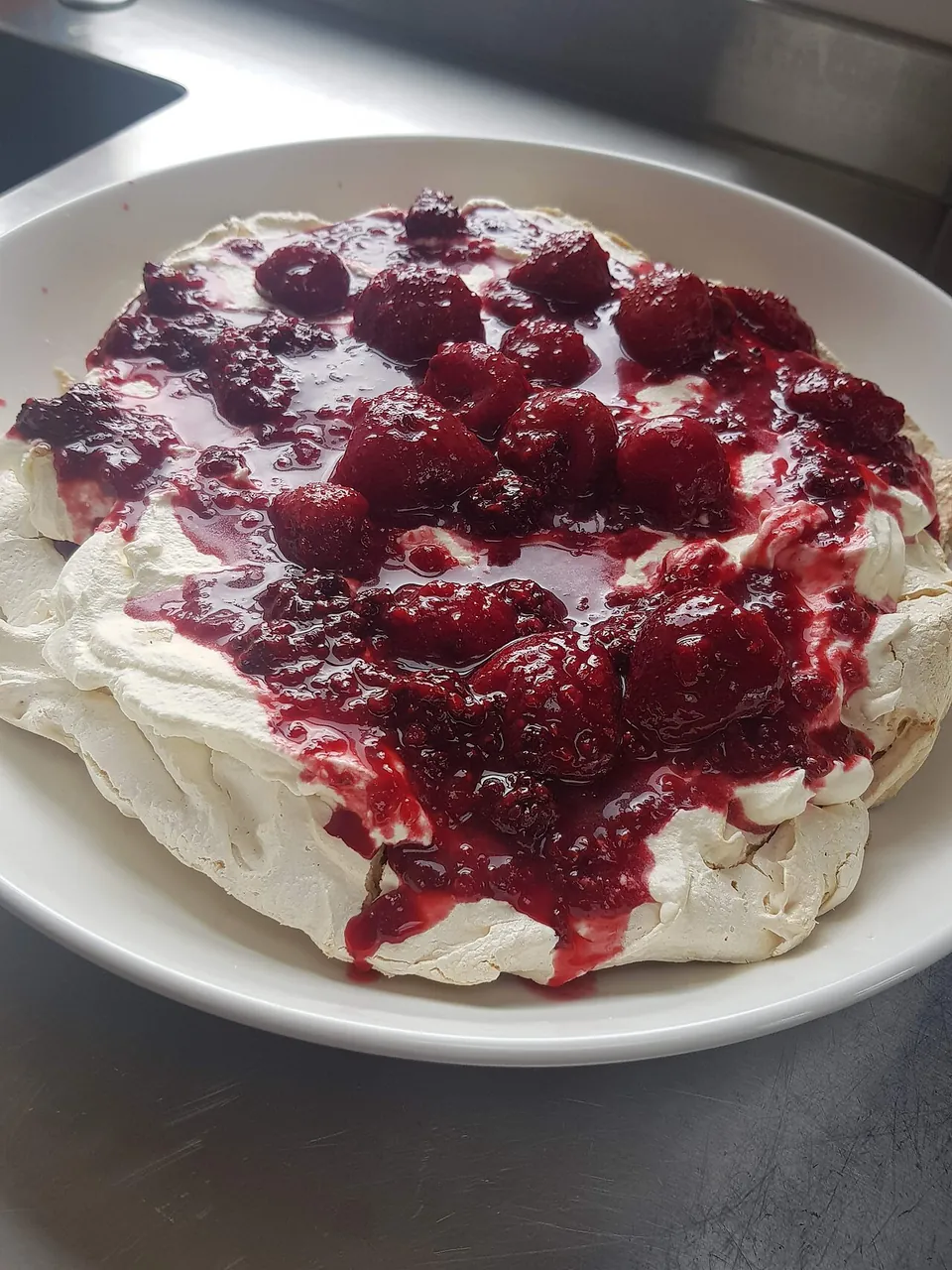
A large baked meringue, crisp on the outside and marshmallow-soft within, crowned with cream and fruit. Australia and New Zealand have quarreled for decades over who invented it, but the famous story of a 1935 creation in Perth has already fallen apart.
Verification highlight popular claim → verdict → evidence
Myth: pavlova was invented in 1935 by chef Herbert Sachse at Perth's Esplanade Hotel, making it an Australian creation. Verdict: undermined by Sachse himself, who said in a 1973 interview that he had based his version on a New Zealand reader's recipe published in an Australian women's magazine. Meringue recipes matching the modern form appear in New Zealand sources from 1929-1933, earlier than the oldest Australian attestations (around 1940), though a broader study traces the underlying meringue-cake technique back to 18th-century Austrian Spanische Windtorte.
The three gates
- Ingredient-supply gate
- Both egg whites and sugar were readily available locally; the limiting factor lay on the technique side.
- Cooking-technique gate
- The technique of baking meringue at low temperature so the outside turns crisp and the inside stays marshmallow-soft.
- Venue gate
- Cafes and home desserts.
Overview
Pavlova is a meringue made by whipping egg whites with sugar and baking them slowly at a low temperature, so the surface dries to a thin, crackable shell while the inside stays soft and marshmallow-like. Whipped cream and fruit go on top. The name honours the Russian ballerina Anna Pavlova, who toured the southern hemisphere in the 1920s.
Egg whites, sugar and cream were all long-established staples in Australian and New Zealander kitchens, always at hand. What gave the dish its present form was the knack of the bake: a low, slow heat. Baked hot and fast, a meringue dries hard all the way through. To dry only the outer shell while leaving the centre half-raw takes a lower temperature, a longer time in the oven, and a slow cooling inside it. Once home and cafe ovens could hold this bake reliably, the pavlova as we know it settled into place.
It came together in the Australia and New Zealand of the 1920s and 30s, which is when recipes of this type start appearing in cookbooks. Not the court, not the grand restaurant, but the home and the cafe: that pedigree captures the character of the dish.
How we know
Two patriotic stories have long clung to the pavlova. The most famous is the Australian one, that Herbert Sachse, a chef at the Esplanade Hotel in Perth, created it in 1935. As an indispensable dish on the Christmas table, it kept the argument alive for decades.
Yet this Perth story is undone by both the man and the record. Sachse himself, in a 1973 interview, admitted his version was based on a recipe submitted to an Australian women's magazine by a New Zealand resident. Far from an invention, it was an adaptation of someone else's earlier recipe. Sachse's descendants further told the food anthropologist Helen Leach that since Anna Pavlova died in 1931, dating the creation to 1935 was likely a mix-up of the year. The very year of creation wavers.
It was Leach, of the University of Otago, who dug out that record. In her book The Pavlova Story (2008) she showed that by 1940 New Zealand cookbooks carried at least 21 pavlova recipes. The earliest that clearly leads to the modern meringue form is the 'pavlova cake' in the 1929 Dairy Exporter Annual, and the 1933 Mothers' Union cookery book from Rangiora preserves, in Laurina Stevens's entry, the recipe as we know it, with egg whites, sugar, cornflour and vinegar. Australia's first documented recipe, by contrast, comes only around 1940. The Oxford English Dictionary (2010) recorded its earliest citation as the 1927 New Zealand Davis Dainty Dishes, but that was a multicoloured jelly, not the modern meringue, so the dictionary hedges its origin as 'Australian and New Zealand', declining to assign it to one country. On the page, New Zealand runs ahead, though that hardly settles the matter.
The joint research of Andrew Paul Wood (New Zealand) and Annabelle Utrecht (Australia) then reframes the question itself. Scanning some 20,000 newspapers and 10,000 cookbooks, they found more than 150 recipes for similar meringue cakes predating the name. The line runs from the Spanische Windtorte, a large meringue confection of seventeenth- and eighteenth-century Austria, carried by German-speaking migrants to the United States as the Schaumtorte, until by the 1890s American cornstarch box recipes were being exported to New Zealand. On this view the question of 'who invented it, Australia or New Zealand' is wrongly framed: the technique of the large meringue cake has a long prehistory in Europe, and Australia and New Zealand were the places that, in the 1920s and 30s, named it after the ballerina and made it their own.
The most famous story, the 1935 Perth invention, has retreated. Even so, which of Australia and New Zealand came first has no decisive proof, and pushed back to its European prehistory the question of 'who invented it' hangs unanswered. The charm of this dessert lies precisely in that: no single birthplace can be fixed, yet it put down roots on the tables of two countries.
The full set of origin theories and the detailed verification log — traceable all the way to their sources — are available on the Japanese edition.
See the full origin theories and verification log (Japanese) →