All dishes / オセアニア
Lamington Period BOrigin theory CVerified
Some fields (dish name, region and gates) are shown from the Japanese-edition data.
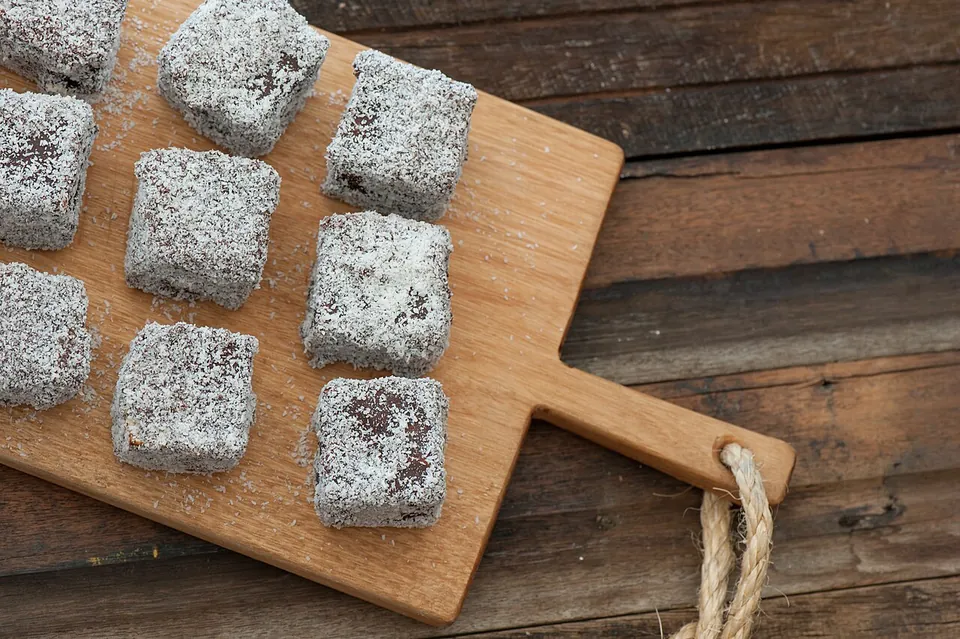
A square of sponge cake dipped in chocolate icing and rolled in shredded coconut, the lamington is an Australian teatime staple. Who first made it has been argued over for decades—one tale even claimed it began as a New Zealand cake called the "Wellington"—but that story was invented by an April Fools' newspaper piece.
Verification highlight popular claim → verdict → evidence
No inventor is confirmed. Two candidates are named: Armand Galland, Lord Lamington's cook, and Amy Schauer, head cookery teacher at Brisbane Technical College; historians treat them as two leading but unproven candidates rather than a settled attribution. The name honors Lord Lamington (or, by another account, his wife). The earliest known printed recipe appeared on 17 December 1900 in Queensland Country Life.
The three gates
- Ingredient-supply gate
- Wheat for the sponge was locally available; chocolate and coconut arrived through colonial trade.
- Cooking-technique gate
- Cutting sponge cake and coating it in chocolate icing and desiccated coconut.
- Venue gate
- A household staple and a fixture of charity bake sales.
Overview
The lamington is a cube of sponge cake dipped in a thin chocolate-flavoured icing and coated all over in desiccated coconut. It is a fixture of Australian home baking and of the trestle tables at charity fetes.
Everything the cake needed was in place by the turn of the twentieth century. Wheat for the sponge was by then grown locally, while the chocolate for the icing and the coconut for the coating both arrived through trade between the colonies. What remained was simply the method: cut a baked sponge into squares, coat each one in chocolate icing, and roll it in coconut. Where those ingredients met that technique, the lamington took shape as a household cake.
The firmest thing on record is the earliest printed recipe, which appeared in the Queensland newspaper Queensland Country Life on 17 December 1900. From there the name and the method spread—to Sydney the following year, in 1901, and to a New Zealand newspaper in 1902.
How we know
The lamington's origins hold two very different kinds of story: one still unsettled, and one shown to be a plain fabrication.
The tale told longest concerns Lord Lamington. As Governor of Queensland (1896–1901) he kept a French-born chef, Armand Galland. One day, so the story goes, an unexpected guest arrived with nothing suitable to serve; Galland cut up some leftover sponge, coated it in chocolate and coconut, and improvised his way out of the moment. That, supposedly, was the beginning, and the cake took its name from the Governor—or, by another account, from his wife. That Galland's wife was Tahitian and at home with coconut is offered as circumstantial support, as are Lady Lamington's own recollections.
In recent years the anecdote has come loose. The historian Maurice French of the University of Southern Queensland, in a two-year, 70,000-word study titled The Lamington Enigma (2013), declined to treat Galland as the sole inventor. A strong rival candidate emerges: Amy Schauer, who led the cookery school at the Brisbane Technical College. A lamington recipe first appeared in print under her name in the Queenslander of 26 November 1904, and French went so far as to say that "even if Schauer did not invent it, she most likely named it." There is also a record of Lady Lamington studying under Schauer at that school. The food historian Alison Vincent likewise stops short of naming any single inventor. What can be said, then, is that two candidates—Galland and Schauer—stand side by side, with no way to decide between them. The State Library of Queensland comes to the same cautious conclusion: the only certainty is the earliest recipe of 1900, and the inventor cannot be identified.
Some origin claims, by contrast, have been ruled out. One is a local tradition that the cake was created at the Ipswich Technical College. That college opened in 1901, but the earliest lamington recipe dates from December 1900, a year earlier. A school cannot have invented a cake that already existed before the school stood. The chronology dismisses the claim outright.
Another is the New Zealand story. For a time it circulated plausibly that the lamington had begun as a New Zealand cake, the "Wellington," which crossed the Tasman and changed its name. But this traces back to an April Fools' piece run by Guardian Australia on 1 April 2014; other outlets took it at face value and cited it, and so it spread. No history supports it. The real direction of travel was in fact the reverse: the lamington, born in Queensland in 1900, reached New Zealand by 1902.
The two unresolved candidates, Galland and Schauer, and the fabrications undone by chronology or by a joke, are different in kind. The first stays open as something not yet settled; the second is set aside—and it is that sorting that makes the question of the lamington's origins worth reading.
The full set of origin theories and the detailed verification log — traceable all the way to their sources — are available on the Japanese edition.
See the full origin theories and verification log (Japanese) →
Related dishes
Shares the key ingredient
- PierogiPolandC
- EmpanadaRío de la Plata (Argentina)C
- BliniRussiaB
- PirozhkiRussiaB
- CheburekiCrimea (Crimean Tatar)C
- BelyashiVolga-Ural (Tatar / Bashkir)C
- JalebiNorthern IndiaB
- Fortune cookieCalifornia (USA)C
- StroopwafelGouda (Netherlands)C
- ChimichangaTucson, Arizona (USA)C
- BuuzMongoliaB
- YantıkCrimea (Crimean Tatar)C
- VarenykyUkraineC
- MandaziEast Africa (Swahili Coast)C
- LángosHungaryC
- Daoxiaomian (knife-cut noodles)Shanxi (China)C
- KhuushuurMongoliaB
- Dobos torteHungaryB
- SambusaEast Africa (Swahili Coast)B
- SarburmaCrimea (Crimean Tatars)B
- ThenthukTibet / NepalB
- ShumaiGuangzhou (China)B
- Jiaozi (gyoza)ChinaC
- Hohhot shaomaiHohhot (China)B
- OliebollenNetherlandsC
- MarquesitaYucatán (Mexico)D
- Halwa puriLahore (Pakistan)D
- Roti prataSingaporeB
- SopaipillaNew Mexico (USA)C
- CoyotaSonora (Northern Mexico)C
- RunzaMidwestern United StatesB
- BanshMongoliaC
- Kashyk-ash (къашыкъ-аш, Crimean Tatar spoon-dumpling soup)Crimea (Crimean Tatar)C
- KulebyakaRussiaB
- Spring roll (Chinese)ChinaC
- ChuchvaraUzbekistan (Samarkand / Fergana)C
- DamperAustraliaC
- SamsaCentral AsiaC
- HalushkyUkraineC
- BanitsaBalkans (Bulgaria)C
- Har gowGuangzhou (China)C