All dishes / ラテンアメリカ
Marquesita Period COrigin theory DVerified
Some fields (dish name, region and gates) are shown from the Japanese-edition data.
A Yucatecan street sweet known for a tender origin tale: an ice-cream maker who supposedly invented it and named it after a marquis's daughter, a favorite regular. But that founding story has no early record for either its inventor or its name, and the region's own leading newspaper admits there is no official version, only a local legend.
Verification highlight popular claim → verdict → evidence
Local legend credits a specific family (the Menas) with inventing this dish in 1930s Mérida and naming it after a marquess's daughter. The claim does not hold up: its only support is a 2020 oral interview with no contemporary advertisements or press records, and a full-text search of Yucatán newspapers from the 1930s-40s (44,855 pages) turns up zero uses of the word 'marquesita,' even though a comparison term from the same period appears over a thousand times. Main sources: Diario de Yucatán investigative report (2025) and the National Digital Newspaper Library of Mexico.
The three gates
- Ingredient-supply gate
- Wheat came from the Old World; Edam cheese reached the Yucatán through Dutch trade
- Cooking-technique gate
- Thin crepe-like batter rolled and grilled until crisp
- Venue gate
- Street-stall sweet of Mérida's plazas
Overview
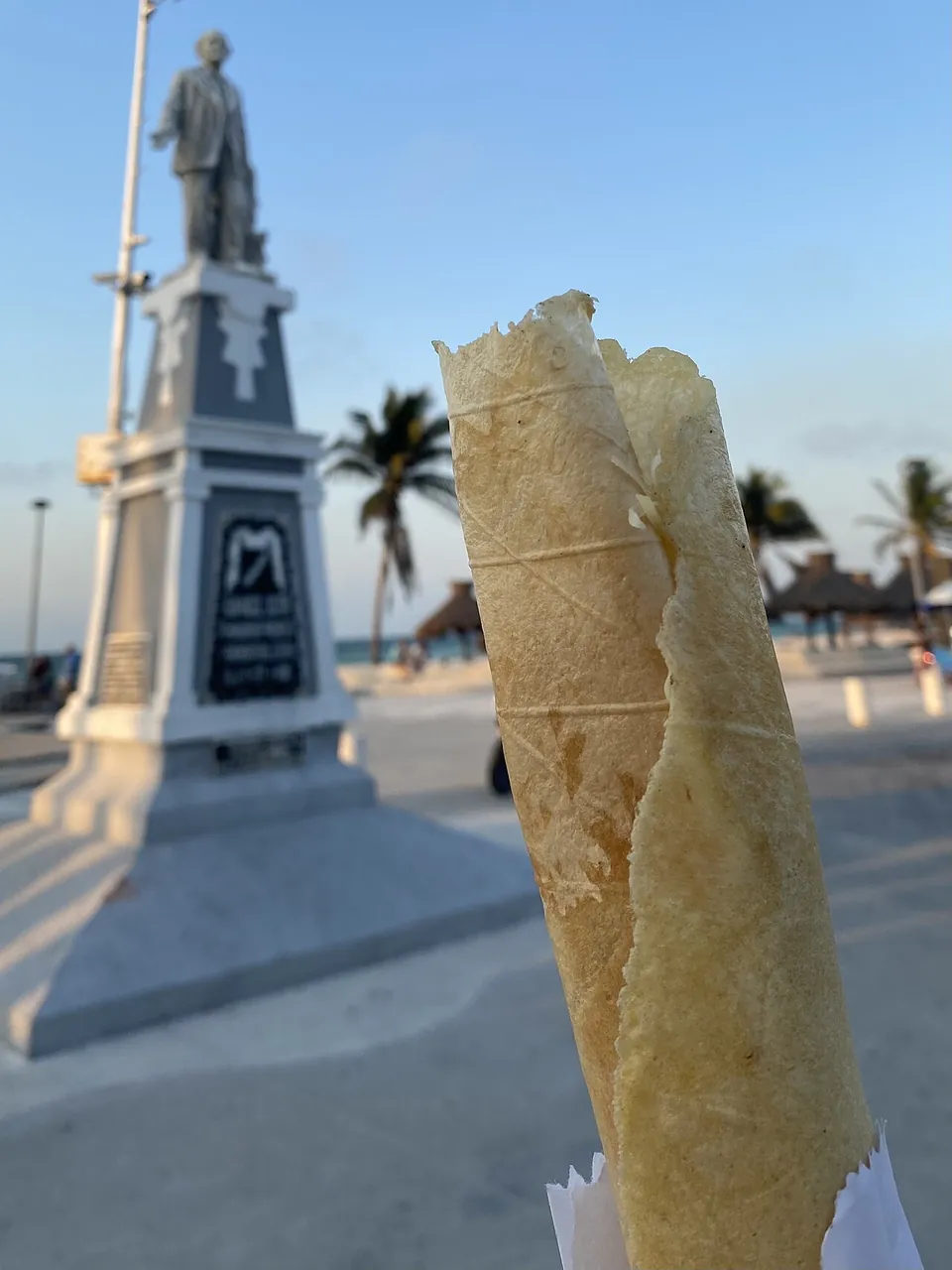
The marquesita is a street sweet of the Yucatan Peninsula in Mexico, made by rolling a thin, cone-shaped waffle batter. The crisp waffle is filled with Nutella, honey, or the region's beloved Edam cheese (locally queso de bola, the round Dutch cheese), and it has long been sold from stalls in the squares and on the street corners of Merida.
The sweet is generally traced to the first half of the twentieth century, to 1930s Merida. The city then had a well-rooted stall culture of ice cream and waffles. Irons for cooking cone-shaped waffles stood on the corners, and vendors selling them lined the squares. Out of that stall culture, the marquesita appeared as a new sweet: a thin batter rolled up.
Its Edam filling had been in the land long before. In the nineteenth century, trade routed through the port of Sisal and through Belize brought round Dutch cheese to Yucatan, where it took deep root in the regional diet. By the time the sweet appeared in the 1930s, that cheese was already an everyday Merida flavor.
How we know
The marquesita comes with a story that has been handed down. In 1930s Merida, an ice-cream maker rolled a cone-shaped waffle into a new sweet and named it 'marquesita' (little marchioness) after the daughter of a marquis, a regular at his shop. The name itself seems to explain the origin, and it makes for a neatly told tale.
Yet no contemporary record supports the story as fact. First, the attribution of an inventor will not settle. One family's name is raised, but whether it was the father or the son, and whether the year was 1930 or 1945, differs from source to source, and none of it rests on independent early records such as period advertisements or business registers. As for the 'marquis's daughter' naming, the region's main newspaper, the Diario de Yucatan, itself acknowledged in a 2025 article that 'no official origin exists; it is only a local legend.' Told as one person's heroic invention, its core lives only in oral tradition.
So what is certain? The individual attribution and the naming anecdote fall away, but the picture that this sweet emerged in 1930s Merida, out of the stall culture of ice cream and waffles, is one on which the sources agree. Who the true inventor was cannot be settled, for want of early sources. The marquesita was not one artisan's bright idea but a sweet born of a certain moment on the street corners of Merida, and that is as far as a firm picture can now reach.
The full set of origin theories and the detailed verification log — traceable all the way to their sources — are available on the Japanese edition.
See the full origin theories and verification log (Japanese) →
Related dishes
Shares the key ingredient
- PierogiPolandC
- EmpanadaRío de la Plata (Argentina)C
- BliniRussiaB
- PirozhkiRussiaB
- CheburekiCrimea (Crimean Tatar)C
- BelyashiVolga-Ural (Tatar / Bashkir)C
- JalebiNorthern IndiaB
- Fortune cookieCalifornia (USA)C
- StroopwafelGouda (Netherlands)C
- LamingtonQueensland (Australia)C
- ChimichangaTucson, Arizona (USA)C
- BuuzMongoliaB
- YantıkCrimea (Crimean Tatar)C
- VarenykyUkraineC
- MandaziEast Africa (Swahili Coast)C
- LángosHungaryC
- Daoxiaomian (knife-cut noodles)Shanxi (China)C
- KhuushuurMongoliaB
- Dobos torteHungaryB
- SambusaEast Africa (Swahili Coast)B
- SarburmaCrimea (Crimean Tatars)B
- ThenthukTibet / NepalB
- ShumaiGuangzhou (China)B
- Jiaozi (gyoza)ChinaC
- Hohhot shaomaiHohhot (China)B
- OliebollenNetherlandsC
- Halwa puriLahore (Pakistan)D
- Roti prataSingaporeB
- SopaipillaNew Mexico (USA)C
- CoyotaSonora (Northern Mexico)C
- RunzaMidwestern United StatesB
- BanshMongoliaC
- Kashyk-ash (къашыкъ-аш, Crimean Tatar spoon-dumpling soup)Crimea (Crimean Tatar)C
- KulebyakaRussiaB
- Spring roll (Chinese)ChinaC
- ChuchvaraUzbekistan (Samarkand / Fergana)C
- DamperAustraliaC
- SamsaCentral AsiaC
- HalushkyUkraineC
- BanitsaBalkans (Bulgaria)C
- Har gowGuangzhou (China)C