All dishes / 北米
Chimichanga Period BOrigin theory CVerified
Some fields (dish name, region and gates) are shown from the Japanese-edition data.
Chimichanga looks like Mexican food, yet it is not from Mexico. Its name is usually explained by a beloved story—a cook who swallowed a curse and blurted out a nonsense word instead—but that word was already sitting in a dictionary before the story is supposed to have happened.
Verification highlight popular claim → verdict → evidence
Competing legends credit either Tucson's El Charro Café (Monica Flin, early 1950s) or Phoenix's Macayo's (Woody Johnson, 1946) with inventing the dish, each with a colorful founding story. Neither holds up well: a Mexican-Spanish dictionary from 1959 already lists a similar word as regional slang for something trivial, predating both invention stories, and newspaper research found the dish advertised at a third, unrelated restaurant as early as 1960. Folklorists studying the US-Mexico border region conclude the deep-fried burrito was a folk food that developed gradually along the Sonora-Arizona borderland, with no single inventor.
The three gates
- Ingredient-supply gate
- Wheat-flour tortillas and meat were both already established staples in the region.
- Cooking-technique gate
- Deep-frying a burrito.
- Venue gate
- Said to have originated by accident at a Mexican restaurant in Arizona.
Overview
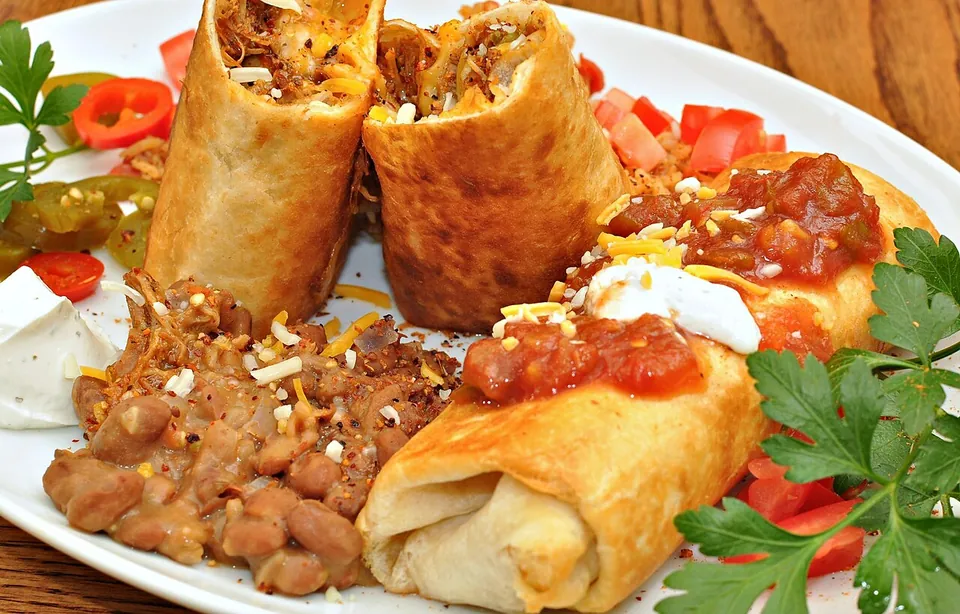
A chimichanga is a burrito, filled with meat and other ingredients wrapped in a wheat tortilla, deep-fried whole. The shell turns crisp and golden while the filling stays hot and moist inside. It reads as a Mexican classic, but its shape was worked out not in Mexico proper but in the American Southwest, above all on the tables of Arizona.
Both of its main ingredients were ordinary in early-twentieth-century Arizona. Wheat tortillas and meat fillings were already a fixture in the kitchens of Mexican-American families along the border country reaching up from Sonora. What set the dish apart was a simple gesture: lowering the wrapped burrito straight into hot oil. Once frying took hold in the diner kitchen, the chimichanga stood up as a dish of its own.
The setting was the border country from northern Sonora into southern Arizona, where wheat and beef were both at hand, and the time was roughly the middle of the twentieth century. Unlike the many regional dishes that carry a long prehistory as preserved food or festival fare, the chimichanga is a comparatively young dish. And because it is young, the question of whose hands first made it stays unusually raw.
How we know
The chimichanga carries a famous origin story. Monica Flin, who founded El Charro Café in Tucson, is said to have accidentally dropped a burrito into the frying pan in the early 1950s; as the oil spat, she started to swear in Spanish, but—with her nieces and nephews present—caught herself and said 'chimichanga' (roughly, 'thingamajig') instead. This, the tale goes, was both the naming and the invention. The Smithsonian's food map carries the story, and the local press has told it again and again.
But the word existed before Flin is supposed to have cried it out. The dialect dictionary of the linguist Francisco Santamaría, 'Diccionario de Mejicanismos' (1959), records 'chivichanga' as a regional term from Tabasco—an old word for a trinket, a trifle, some worthless little thing. The premise that the word was coined on the spot as a swapped-out curse falls apart here. Barry Popik, known for his newspaper-based etymology work, dismisses the naming story on the same grounds.
The invention story is not single, either. Woody Johnson, who founded Macayo's Mexican Kitchen in Phoenix, claimed he devised the dish by frying a burrito at his original restaurant in 1946—placing the birthplace in Phoenix and the date earlier than the El Charro anecdote. And the oldest print reference Popik traced through newspapers is a May 1960 advertisement for Casa Molina, a third Tucson restaurant, offering it filled with chicken, beef, and beans; another shop was already selling it.
Jim Griffith, a folklorist at the University of Arizona, reads these conflicts from a different angle. The chimichanga, in his view, was no one person's invention but a folk food that grew up in the border country where wheat and beef live side by side. Griffith himself came upon it in a Yaqui village outside Tucson in the mid-1950s and reckoned it had been around long before that. Looking for a single inventor sits worse with the surviving print and the dictionary than seeing a dish that spread across several shops and a whole region at once.
The full set of origin theories and the detailed verification log — traceable all the way to their sources — are available on the Japanese edition.
See the full origin theories and verification log (Japanese) →
Related dishes
Shares the key ingredient
- PierogiPolandC
- EmpanadaRío de la Plata (Argentina)C
- BliniRussiaB
- PirozhkiRussiaB
- CheburekiCrimea (Crimean Tatar)C
- BelyashiVolga-Ural (Tatar / Bashkir)C
- JalebiNorthern IndiaB
- Fortune cookieCalifornia (USA)C
- StroopwafelGouda (Netherlands)C
- LamingtonQueensland (Australia)C
- BuuzMongoliaB
- YantıkCrimea (Crimean Tatar)C
- VarenykyUkraineC
- MandaziEast Africa (Swahili Coast)C
- LángosHungaryC
- Daoxiaomian (knife-cut noodles)Shanxi (China)C
- KhuushuurMongoliaB
- Dobos torteHungaryB
- SambusaEast Africa (Swahili Coast)B
- SarburmaCrimea (Crimean Tatars)B
- ThenthukTibet / NepalB
- ShumaiGuangzhou (China)B
- Jiaozi (gyoza)ChinaC
- Hohhot shaomaiHohhot (China)B
- OliebollenNetherlandsC
- MarquesitaYucatán (Mexico)D
- Halwa puriLahore (Pakistan)D
- Roti prataSingaporeB
- SopaipillaNew Mexico (USA)C
- CoyotaSonora (Northern Mexico)C
- RunzaMidwestern United StatesB
- BanshMongoliaC
- Kashyk-ash (къашыкъ-аш, Crimean Tatar spoon-dumpling soup)Crimea (Crimean Tatar)C
- KulebyakaRussiaB
- Spring roll (Chinese)ChinaC
- ChuchvaraUzbekistan (Samarkand / Fergana)C
- DamperAustraliaC
- SamsaCentral AsiaC
- HalushkyUkraineC
- BanitsaBalkans (Bulgaria)C
- Har gowGuangzhou (China)C