All dishes / 東アジア
Xiaolongbao Period BOrigin theory CVerified
Some fields (dish name, region and gates) are shown from the Japanese-edition data.
The story that the Qianlong Emperor praised soup dumplings at Wuxi and had the character for "basket" echo the one for "dragon" is a later legend with no support in the historical record. This thin-skinned steamed bun with soup sealed inside took its present shape in the late nineteenth century, at a dim sum house called Rihua Xuan in Nanxiang, a town on the western outskirts of Shanghai.
Verification highlight popular claim → verdict → evidence
Popular claim: invented by Emperor Qianlong at Wuxi. Verdict: rejected as an unsupported later legend; the modern form is most reliably credited to Huang Mingxian at the Rihuaxuan teahouse in Nanxiang, c.1871, who thinned the dough and added meat aspic. The dish's broader genre (soup-filled buns) traces to Northern Song Kaifeng, but that does not push back the modern form's founding date. Key sources: Dongjing Meng Hua Lu (Song-era record); Shenbao newspaper advertisement, 1889.
The three gates
- Ingredient-supply gate
- Wheat, pork, and ginger are all native to China; the dish does not depend on New World ingredients, so the food-availability gate is loose (native throughout).
- Cooking-technique gate
- Thin hand-rolled dough wrapping a pork-and-aspic (gelatin) filling, steamed in a bamboo basket — the dim sum steaming tradition is the precondition.
- Venue gate
- Teahouse/dim sum restaurant venue; common-people to urban-middle stratum; eaten out; Jiangnan Han community.
Overview
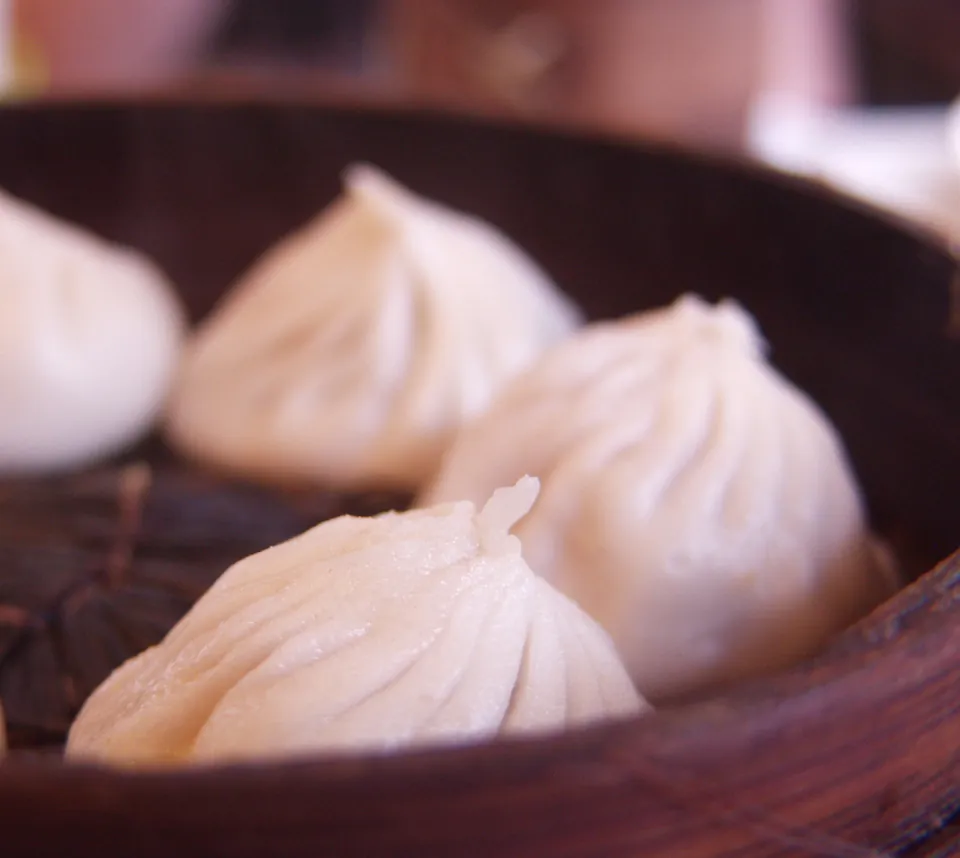
Xiao Long Bao, or xiaolongbao, is a dim sum from Nanxiang, in the western suburbs of Shanghai. Inside a thin, bite-sized skin sits a filling of pork together with a mouthful of hot soup. Lift one from the steaming basket and pinch it with chopsticks, and the skin turns translucent as the broth trembles inside. That one detail is what sets xiaolongbao apart from the many other baozi, the steamed buns of China.
The trick behind it is not simple. The soup is really pork-skin gelatin, an aspic set firm beforehand. Chopped in while still cold and solid, it is folded into the meat filling, wrapped, and set in the basket to steam. As the heat penetrates, the set aspic melts back into a clear broth. To seal that broth in without tearing the skin takes the practised hand that rolls the dough thin and even, and a sure feel for steaming the dumplings through. The dish could only exist on the foundation of a steaming culture built up in the teahouses and dim sum shops of Jiangnan.
The main ingredients were all long rooted in the soil of Jiangnan. Wheat, pork, ginger: these were familiar things, taken for granted in any shop's kitchen. So the novelty of xiaolongbao lies not in any rare ingredient but in the idea of turning set aspic into soup, and in the skill that makes it possible. Born in a shop in Nanxiang, the dish was soon carried into Shanghai proper, where it took root from teahouses to street stalls, eaten out by everyone from ordinary people to the city's office workers.
How we know
Several accounts, differing in date and in character, overlap at the beginning of xiaolongbao. Untangle them and you find a single invention story, its spread, the memory of a far older genre, and a legend that is hard to call history.
The account that best answers the question of who shaped the xiaolongbao we know today is that of Huang Mingxian, who took over the Rihua Xuan dim sum house in the town of Nanxiang. Around 1871, Huang remade the large meat buns of the day into something with more filling and a thinner skin, shrinking the large into the small, and switched the skin from a leavened dough to an unleavened one. Into it he mixed pork-skin aspic, so that steaming turned it to soup, and made the thin-skinned "Nanxiang xiaolong." The often-cited name Guyi Garden, it should be noted, refers to a selling spot and landmark where men of letters gathered, not to the shop where the dish began. As far as local records and reporting can be traced, this Rihua Xuan account holds up, and it is close to the accepted view today.
The earliest trace in writing, however, is not the year of origin itself. As far as it can be followed, an 1889 teahouse advertisement in the newspaper Shen Bao carries the name "Xiang-style bun" (a bun in the Nanxiang manner), and the Jiading County Supplementary Gazetteer, completed early in the twentieth century, records that "the Nanxiang makers are the most renowned." By 1889 at the latest, Nanxiang xiaolong was known in Shanghai as a product for sale. The year that survives in writing and the year of origin are best kept apart.
Those who spread the dish are spoken of separately again. Wu Xiangsheng, a disciple of Huang Mingxian, opened a shop in 1900, and around 1920 made Nanxiang xiaolong popular at Shanghai's Yu Garden, establishing it as an urban dim sum. Its method was later recognized as national intangible cultural heritage. Who made a dish and who spread it are better seen apart, not run together.
Go further back and the soup-filled baozi itself is older. Kaifeng, the capital of the Northern Song, had soup-filled buns known as guantangbao, and Dongjing Meng Hua Lu, which describes life in that capital, names "the plum-blossom buns of Wanglou Shandong" among the celebrated dishes of a famous shop south of Zhou Bridge. After the fall of the Northern Song, this food culture moved south to Lin'an of the Southern Song. But this is the age of the soup-filled bun as a genre, not the age of the xiaolongbao that took shape in Jiangnan at the end of the Qing. An old ancestor and a new dish should not be made into one continuous line.
Set beside all this, the legend of the Qianlong Emperor is plainly of a different stripe. As the emperor toured Wuxi, it goes, he praised the soup buns, and from their nickname "roaming dragon" the character for "basket" was made to echo the one for "dragon." The wordplay is elegant. But no contemporary record supports it. The menu ledger of the 1751 southern tour does not survive at all; the earliest that remains dates to 1765, so there is no way to confirm the emperor's tasting in an original document. A story that ties an origin to an imperial anecdote is undeniably attractive, but it does not connect to how the dish born in Nanxiang actually came to be.
The full set of origin theories and the detailed verification log — traceable all the way to their sources — are available on the Japanese edition.
See the full origin theories and verification log (Japanese) →