All dishes / 東アジア
Yuxiang shredded pork Period BOrigin theory BVerified
Some fields (dish name, region and gates) are shown from the Japanese-edition data.
A stir-fry that carries the name 'fish-fragrant' (yu-xiang) yet contains not a scrap of fish. The often-told family tale—that a Chengdu household turned leftover seasoning from a fish dish onto pork and coined the name—has no support in the cookbooks of its day. The name's real source was a Sichuanese river-fish flavour, sweet and sour and hot, that grew straight out of the province's freshwater-fish cookery.
Verification highlight popular claim → verdict → evidence
The folk tale that a Chengdu family invented the dish by reusing leftover fish seasoning on pork lacks independent documentation -- no source names the family, year, or inventor, and the dish is absent from an 1899-era survey of Chengdu cuisine. The better-supported account holds that 'fish-fragrant' names a flavor profile drawn from Sichuan's freshwater-fish seasoning tradition (sometimes made with pickled chili fermented alongside live carp), later applied to pork; the dish first appears in print around 1911-12 (Lan Yong, History of Sichuan Cuisine; Fuchsia Dunlop, Land of Plenty).
The three gates
- Ingredient-supply gate
- Pork was a native ingredient; the key seasoning, brine-fermented pickled chili, only became possible after chili was adopted in Sichuan.
- Cooking-technique gate
- Stir-frying with a 'fish-fragrant' sauce (pickled chili, sugar, vinegar, scallion, ginger, garlic).
- Venue gate
- Sichuan homes and eateries.
Overview
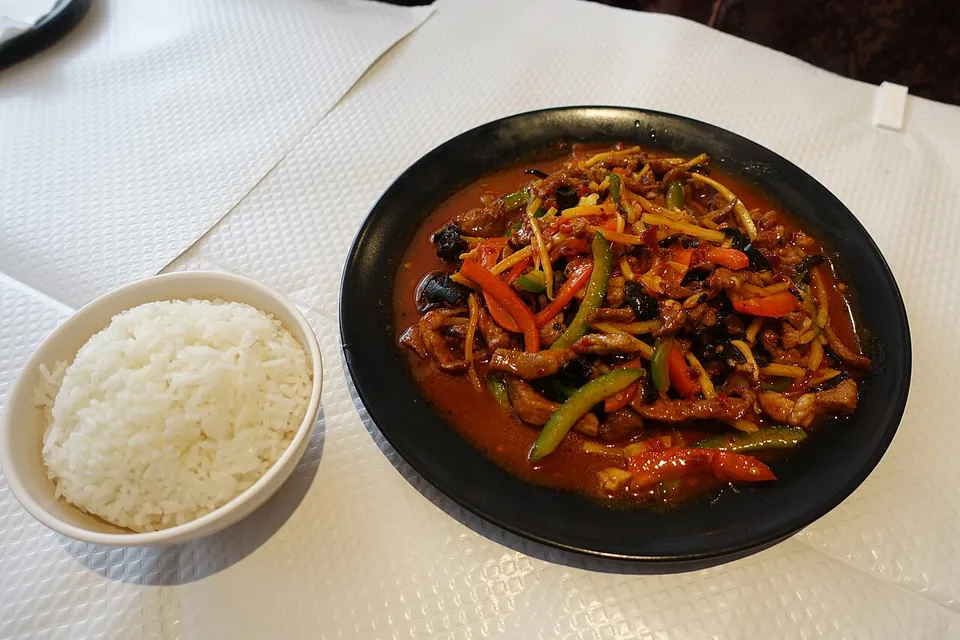
Yu-xiang rousi (fish-fragrant pork slivers) is a Sichuan dish of slivered pork stir-fried with vinegar, sugar, fermented pickled red chilli, and ginger, scallion, and garlic. The first taste layers sweetness, sourness, and heat into a rounded savour that genuinely calls a fish dish to mind—yet there is no fish anywhere on the plate. That gap is the puzzle the dish has carried for a century.
At the heart of the flavour is pao lajiao: red chillies brine-fermented in the Sichuanese way. Country cooks in Sichuan had a method for dressing freshwater fish, such as crucian carp, with these pickled chillies alongside ginger, scallion, and garlic, sweet and sour and hot. In some schools of the craft, live crucian carp were added to the chillies as they fermented in brine, drawing out a deep, fish-suggesting savour. The seasoning built for that fish dish was carried over, more or less whole, onto slivered pork—and because the taste still summoned a fish dish, the name 'fish-fragrant' stayed.
For this flavour to take shape, the chilli itself first had to settle into Sichuan. Only after the New World chilli was taken up in the province and the practice of brining it into pao lajiao had become established could the sweet-sour-hot yu-xiang profile be assembled. Pork had long been on hand, but the fermented chilli that anchors the taste had to arrive and take root before this dish could come into being. Its first appearance in a cookbook falls in the early Republican years, just after the Qing dynasty fell.
How we know
The gap in the name—'fish-fragrant' with no fish—drew a story to fill it. The most-repeated version tells of a Chengdu household, often named as the Liu family, who cooked a freshwater fish and, rather than throw out the leftover seasoning of pickled chilli, ginger, scallion, and garlic, used it on slivered pork. The result was a hit, the story goes, and the name 'fish-fragrant' was born. It names an inventor, a year, a family—everything an origin tale should have.
But no contemporary record supports the anecdote. Chengdu Tonglan, a 1909 survey of everything Chengdu that lists some 1,328 dishes, contains not a single fish-fragrant dish. At the moment the tale claims for the invention, the flavour had not yet been written down. In the cookbook record, yu-xiang rousi first appears later, in 1911–1912, in the Yushi Kongzhong Pengren, as confirmed by the Shanghai Library's annotation. The named-family invention has no independent documentation; it reads as a tale built after the fact to explain the gap in the name.
Only the named-family part gives way, though. The core claim—that the seasoning of a fish dish was carried onto another ingredient—sits well with the record. Lan Yong's History of Sichuan Cuisine ties yu-xiang to the province's freshwater-fish seasoning system, the yu-lazi of brine-fermented pickled chilli with crucian carp added, and Fuchsia Dunlop's writing on Sichuan cooking points to the same lineage. Yu-xiang was not one household's bright idea but the name of a flavour grown out of Sichuan's own fish cookery. This is not a guess weighed among several; it is the settled scholarly view, several studies converging on the same river-fish seasoning line.
The full set of origin theories and the detailed verification log — traceable all the way to their sources — are available on the Japanese edition.
See the full origin theories and verification log (Japanese) →